Data-center storage is evolving rapidly, and Toshiba’s latest M12 Series nearline hard disk drives (HDDs) represent a significant step forward in capacity and efficiency. These 3.5-inch SMR drives, now available in samples, offer capacities ranging from 30 TB to 34 TB—a notable increase that addresses the growing needs of hyperscale environments.
The M12 Series stands out with its host-managed SMR architecture, which optimizes performance for high-workload scenarios while reducing power consumption per terabyte by approximately 18% compared to previous models. This efficiency is crucial as data centers scale up to handle increasing demands, particularly from AI-driven workloads.
Under the hood, the M12 Series incorporates an additional magnetic disk (bringing the total to 11) and transitions from aluminum to glass substrates. This change not only enhances durability but also allows for a thinner form factor, making the drives more compact without sacrificing performance. The drives are helium-filled and combine Toshiba’s proprietary Flux Control Microwave-Assisted Magnetic Recording (FC-MAMR) with SMR technology.
While SMR offers significant capacity benefits, it introduces trade-offs. Data tracks overlap in a manner similar to roof shingles, which can impact random write operations over time. Toshiba mitigates this through its host-managed architecture, where the system controls data placement and rewriting, ensuring minimal slowdowns in server environments.
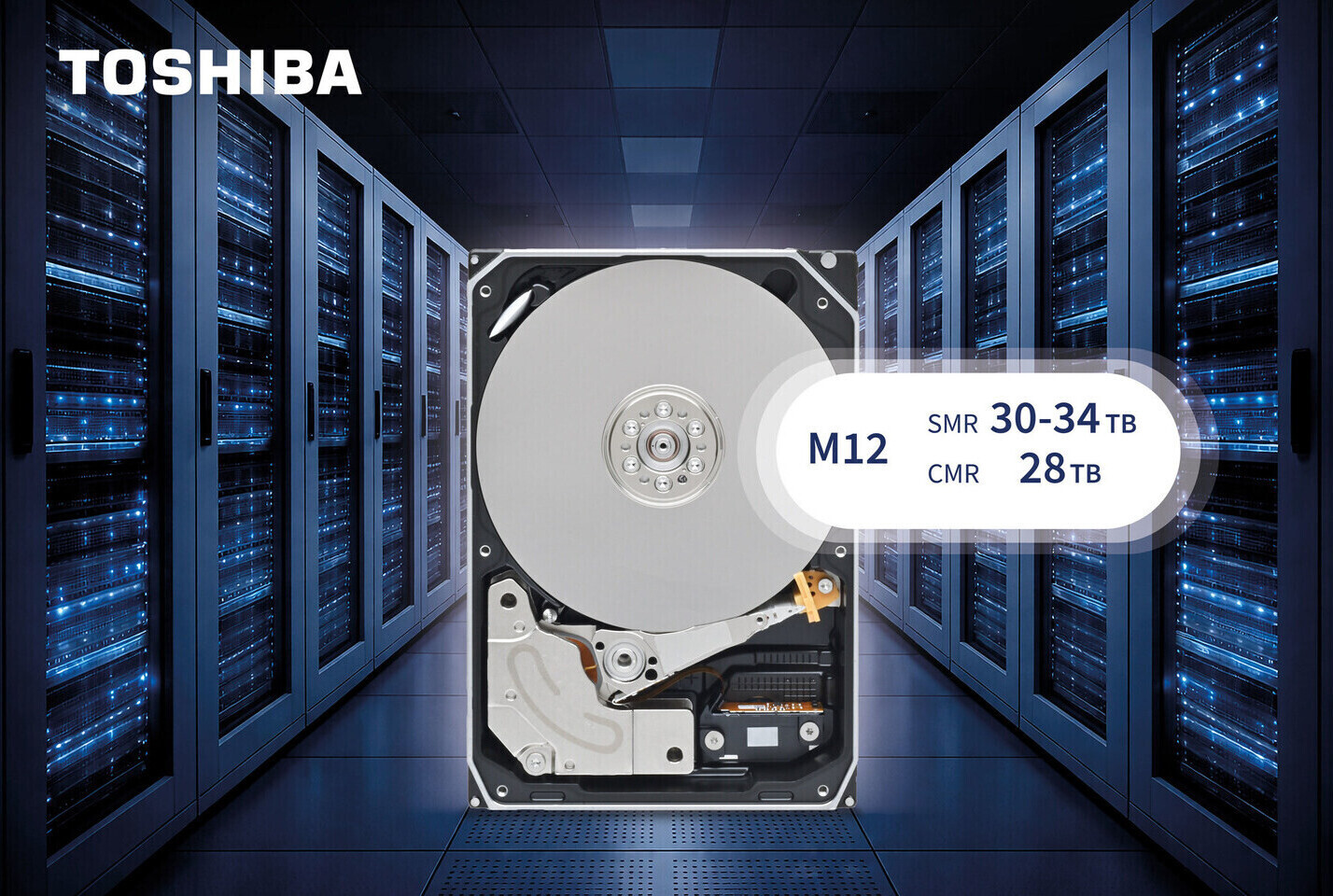
- Capacity: 30–34 TB (SMR), up to 28 TB (CMR, expected Q3 2026)
- Form factor: 3.5-inch nearline
- Max transfer rate: 282 MiB/s (8% faster than previous generation)
- Power efficiency: ~18% lower W/TB vs. prior models
- Workload rating: 550 TB/year, MTTF/MTBF: 2.5M hours
- Annual failure rate (AFR): 0.35%
The M12 Series is engineered for continuous operation in data centers, where reliability and capacity are paramount. Toshiba’s roadmap suggests further advancements, including Heat-Assisted Magnetic Recording (HAMR) and potential 12-disk configurations, which could push storage density even further.
For everyday consumers, these drives are not a direct concern, as they are tailored for enterprise storage needs. However, the technology behind them will shape how data centers manage growing workloads, particularly as AI-driven storage demands surge globally.
The next significant milestone is the expected Q3 2026 release of CMR-based M12 drives, which could provide a performance alternative for applications where SMR’s limitations are more pronounced. Pricing and mass availability remain to be confirmed, but the focus here is on capacity and efficiency—two critical factors as data volumes continue to grow exponentially.