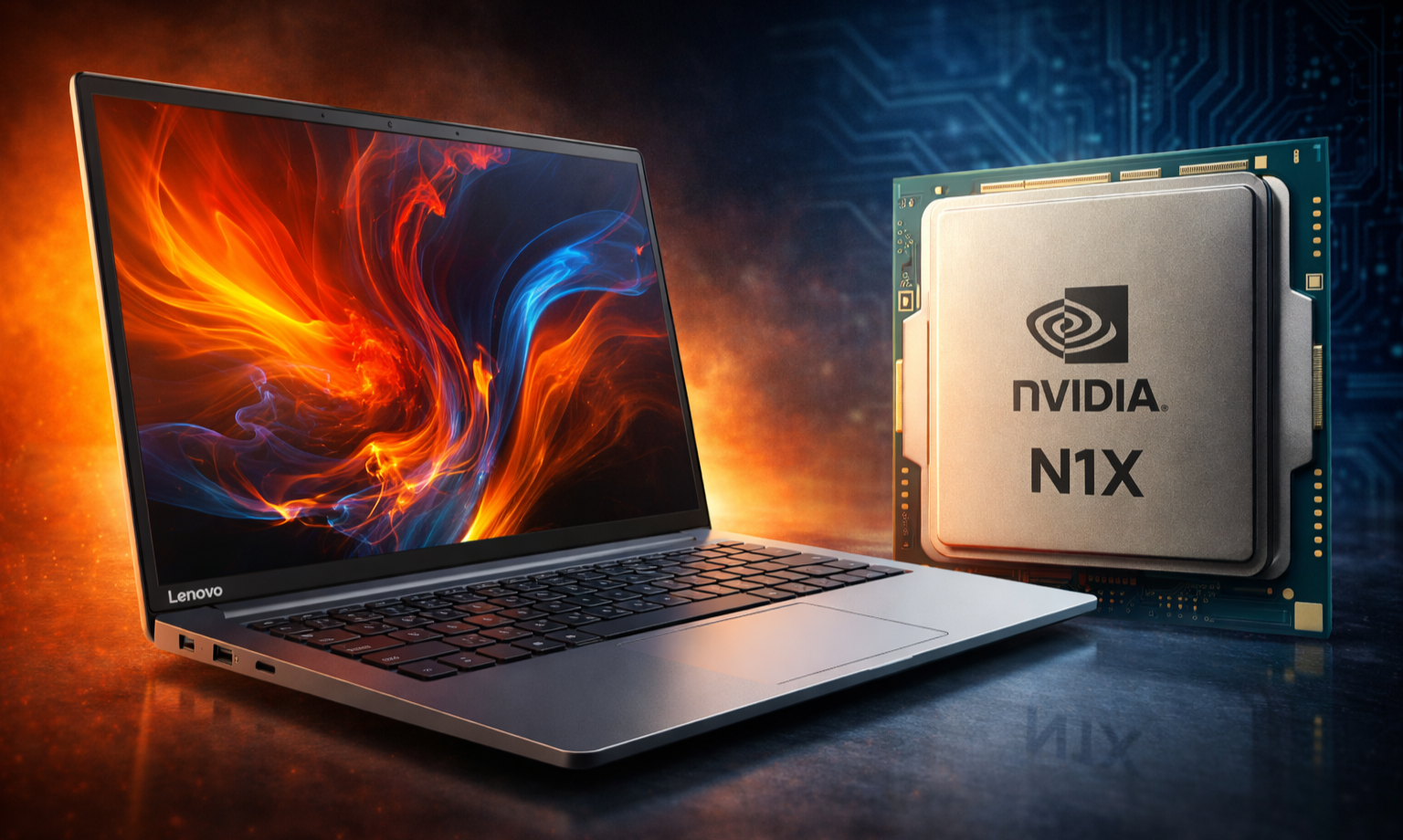
Lenovo is gearing up to introduce its first true Windows on Arm gaming laptops, leveraging NVIDIA’s upcoming N1 and N1X SoCs. Unlike traditional Arm chips, these combine an Arm-based processor with a Blackwell-derived GPU, eliminating the need for discrete graphics and enabling modern game performance on a single chip.
The lineup includes six models across Lenovo’s Ideapad, Yoga, and Legion series, each distinguishable by a new naming convention—an ‘N’ prefix after the screen size, signaling NVIDIA’s Arm chips. The Ideapad Slim 5 and Yoga Pro 7 models will feature the N1 chip, prioritizing efficiency and battery life, while the Yoga 9 2-in-1, Legion 7, and two Yoga Pro 7 variants will adopt the more powerful N1X.
The N1X SoC is particularly notable, integrating a 10-core Cortex-X925 CPU paired with a 10-core Cortex-A725 configuration and a 6,144-CUDA-core Blackwell-based iGPU. While performance may be slightly constrained by power limits, it rivals a desktop GeForce RTX 5070 in integrated graphics, making it the most capable Arm-based GPU to date.
Key Specs and What They Mean
- N1 Chip Models: Ideapad Slim 5 14N1V11, Ideapad Slim 5 16N1V11, Yoga Pro 7 15N1V11
- N1X Chip Models: Yoga Pro 7 15N1X11, Yoga 9 2-in-1 16N1X11, Legion 7 15N1X11
- N1X GPU: 6,144 CUDA cores (Blackwell-based iGPU, comparable to RTX 5070)
- N1X CPU: 10 Cortex-X925 (performance cores) + 10 Cortex-A725 (efficiency cores)
This marks a departure from traditional Arm laptops, which often rely on external GPUs or weaker integrated graphics. The N1X’s integrated solution could redefine portable gaming, though power constraints may limit performance compared to discrete GPUs like the RTX 5070 or RTX 5060 in current gaming laptops.
Lenovo’s move aligns with broader industry trends, as Arm-based chips gain traction for their efficiency and NVIDIA’s Blackwell architecture pushes integrated graphics closer to desktop-level performance. However, pricing and release dates remain unconfirmed—potential buyers should expect further updates as the launch nears.
For now, the focus is on Lenovo’s ability to deliver a seamless Windows on Arm experience. If successful, these laptops could set a new standard for portable gaming, blending Arm efficiency with NVIDIA’s GPU prowess.