The era of power-hungry 4K gaming displays may be drawing to a close. While high refresh rates and ultra-high resolution have long demanded substantial wattage, the latest wave of QD-OLED monitors is proving that stunning visuals can now come with a much lighter environmental footprint. MSI’s two new models—one optimized for high-end setups, the other tailored for mainstream gamers—are at the forefront of this shift, demonstrating how display efficiency can keep pace with even the most demanding gaming workloads.
Central to these monitors is a 30% improvement in light efficiency, achieved through Penta Tandem technology. This advancement allows for brighter HDR performance without proportionally increasing power consumption, a balance that could prompt manufacturers to rethink cooling designs and cable management solutions. The MPG 322UR QD-OLED X24, designed for high-refresh gaming, goes further with a 98 W USB-C port capable of charging laptops while the display operates, while the MAG 321UP QD-OLED X24 offers a more streamlined 15 W option. Both models support DisplayPort 2.1a (UHBR20), ensuring compatibility with next-generation GPUs.
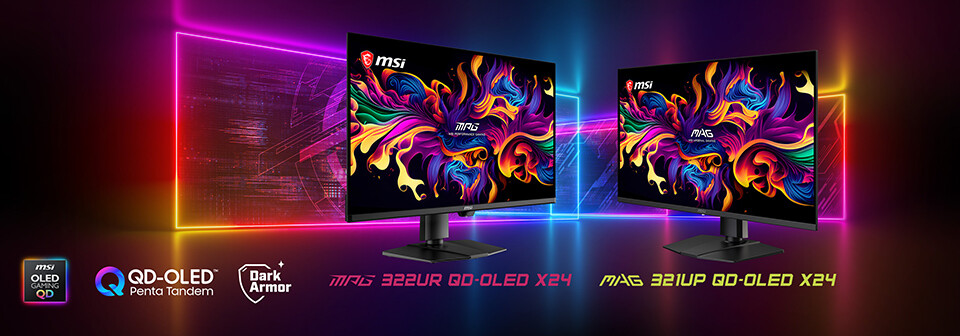
- 31.5-inch 4K QD-OLED panels with Penta Tandem efficiency
- 98 W Power Delivery via USB-C on the MPG 322UR, 15 W on the MAG 321UP
- DisplayPort 2.1a (UHBR20) support for full-bandwidth connectivity
- AI Care Sensor and OLED Care 2.0 for panel longevity
- Uniform Luminance and DarkArmor Film for visual consistency and durability
The impact of these advancements extends beyond the screen itself. Gamers who have long struggled with heat management, cable clutter, and power supply constraints may soon see those challenges ease. The MPG 322UR’s AI Care Sensor, which detects human presence without compromising privacy, offers a preview of how smart features can now integrate seamlessly with high-performance gaming setups. Meanwhile, the MAG 321UP’s OLED Care 2.0 system mitigates burn-in risks, making 4K QD-OLED more accessible to those who previously avoided it due to longevity concerns.
This shift is not just about reducing power consumption—it’s about redefining what gamers expect from premium displays. The combination of deeper blacks (40% darker with DarkArmor Film), enhanced scratch resistance, and customizable HDR settings suggests that efficiency and durability are now as critical as resolution. Whether this trend will trickle down to mid-range models or remain a premium-tier feature is still an open question, but one thing is certain: the industry has reached a point where performance no longer needs to come at the cost of power or heat.
For now, these monitors serve as a benchmark for what’s possible in gaming display technology. Brighter images with lower power draw, smarter cooling integration, and features that protect both the panel and the user experience—it’s a combination that could fundamentally reshape how gamers approach their setups in the years to come.