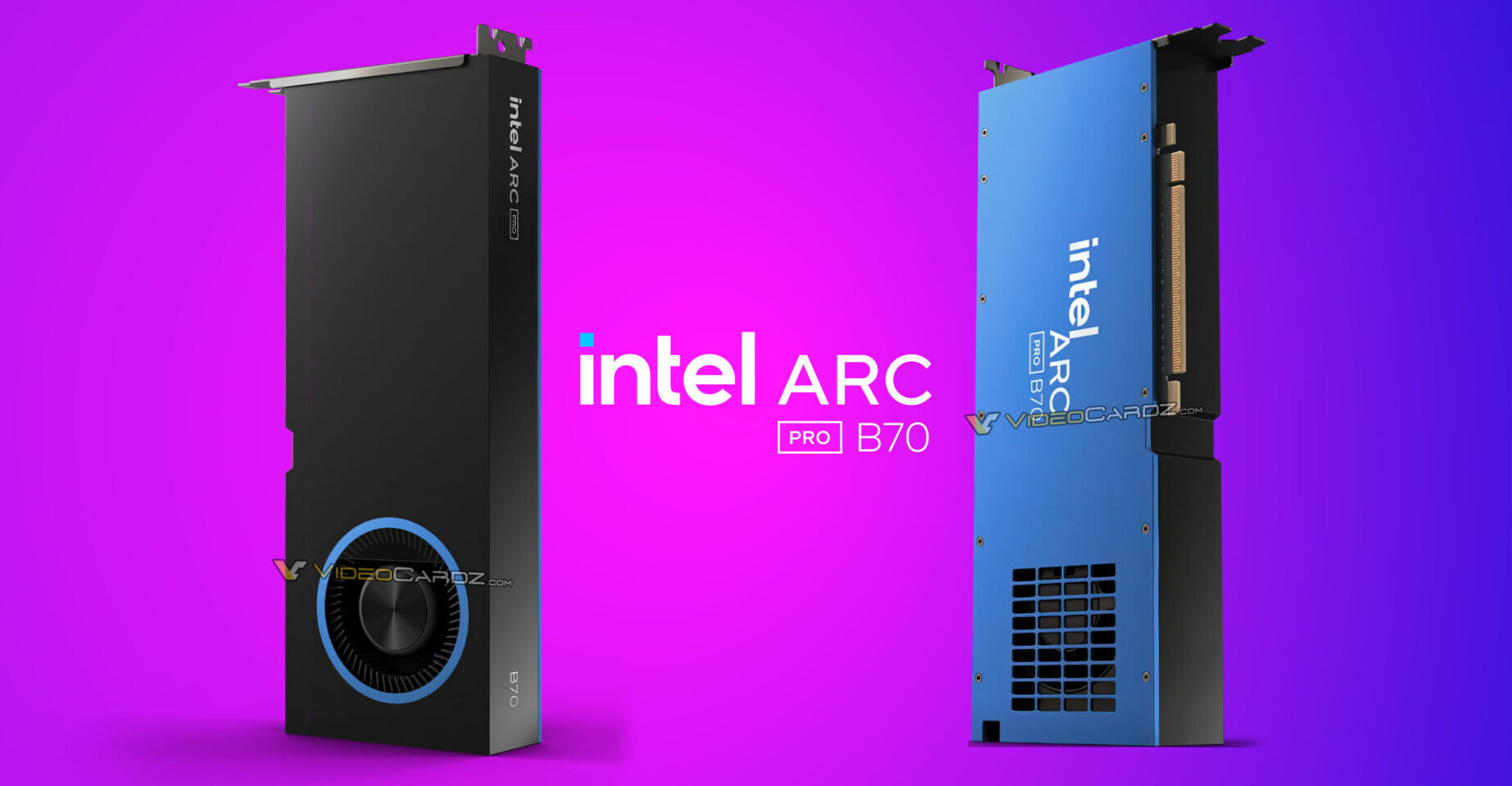
The Intel Arc Pro B70 GPU, part of the 'Battlemage' series, is poised to make a significant entrance into the professional graphics card market. With a focus on high-performance computing tasks, this GPU promises to offer substantial improvements over its predecessor, the Arc Pro B60.
Key specs for the Arc Pro B70 include 32 Xe2 cores, 32 GB of ECC GDDR6 memory, and a 256-bit memory bus. The total graphics power (TGP) is expected to range from 160 W to 290 W, with a reference design thermal design power (TDP) of 230 W. This configuration suggests a card designed for demanding workloads, likely targeting professional users in fields such as AI, rendering, and scientific computing.
- Display: 32 Xe2 cores
- Memory: 32 GB ECC GDDR6
- Memory Bus: 256-bit
- Total Graphics Power (TGP): 160-290 W
- Thermal Design Power (TDP): 230 W
The Arc Pro B70 is expected to show significant performance improvements over the Arc Pro B60, particularly in AI workloads. Preliminary testing indicates a geometric mean performance increase of about 1.49x under SLA constraints and a 1.13x improvement at a fixed batch size. These gains suggest that the new GPU could be a strong contender in professional markets where performance and efficiency are critical.
In terms of market positioning, the Arc Pro B70 is likely to compete with high-end GPUs from AMD and Nvidia, such as the RX 6800 XT and RTX 3080. Its specifications, including the higher core count and power budget, hint at a card that could challenge these established players in the professional segment.
The Arc Pro B70 is expected to launch on March 25, along with its smaller sibling, the B65 Pro. The B65 Pro will feature the same VRAM configuration but with only 20 Xe2 cores, effectively making it a more budget-friendly option for users with less demanding needs.
For IT teams evaluating GPUs for professional workloads, the Arc Pro B70 presents an interesting proposition. Its combination of high core count, substantial VRAM, and efficient power delivery could make it a compelling choice for data centers and workstations. However, compatibility risks may arise due to its unique architecture, so thorough testing will be essential before widespread adoption.
As the launch date approaches, industry watchers will be keen to see how the Arc Pro B70 performs in real-world scenarios. Its potential to disrupt the professional GPU market could hinge on factors such as driver maturity, software support, and overall system integration. For now, the card remains a promising but untested entity in what is shaping up to be an intriguing quarter for professional graphics solutions.