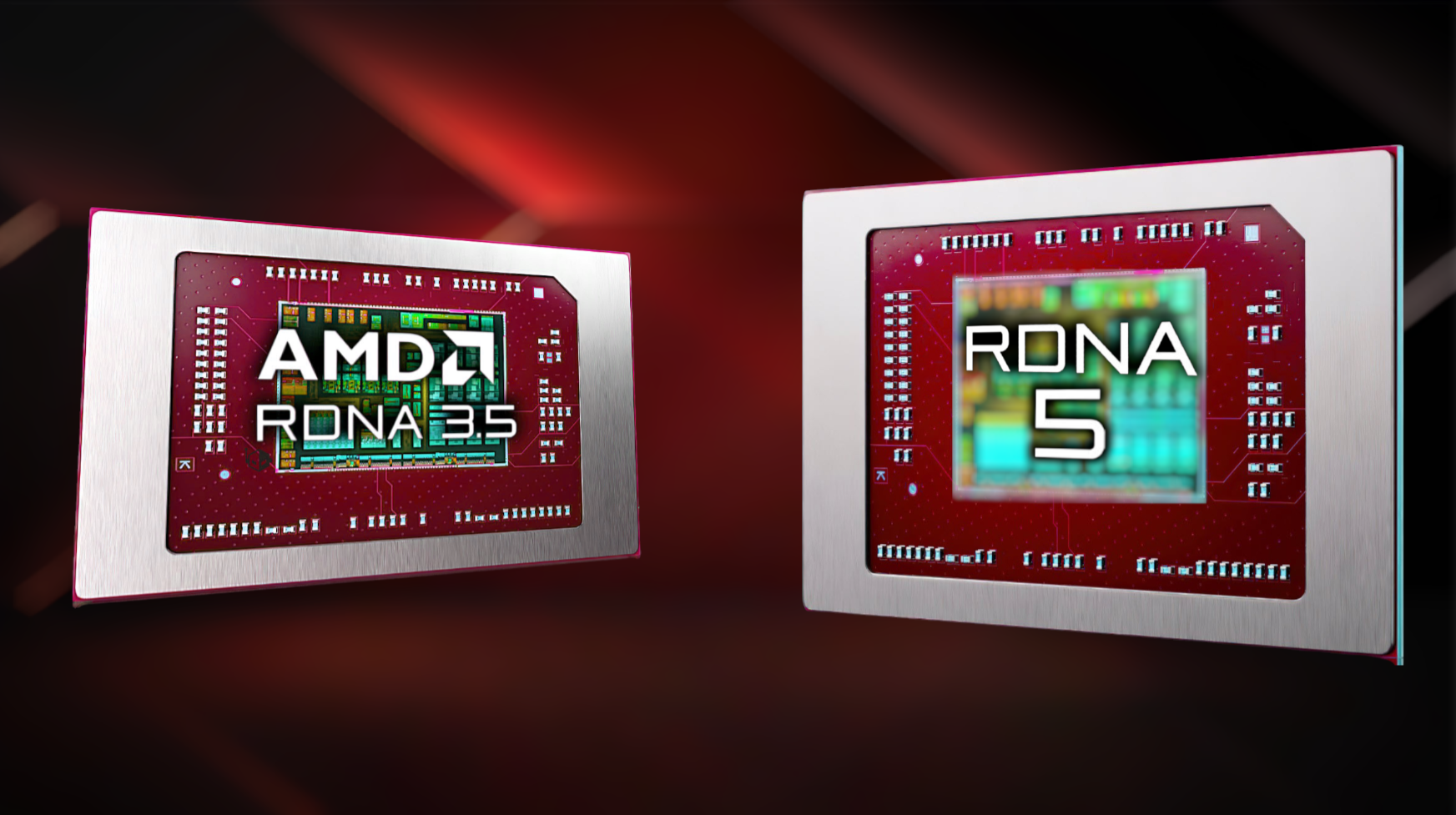
AMD’s integrated graphics strategy is taking a sharp turn, with a two-tiered approach that will keep RDNA 3.5 in mainstream APUs through 2029 while reserving RDNA 5 for premium models. The decision effectively sidesteps RDNA 4—a newer architecture already powering discrete GPUs—marking a deliberate separation between budget and high-end iGPU performance.
Why RDNA 3.5 Isn’t Going Away
Since the launch of RDNA 3 in 2022, AMD’s APUs have seen incremental upgrades rather than a full architectural refresh. RDNA 3.5, introduced with the Ryzen AI 300 and 400 series, brought modest clock speed bumps and efficiency gains but retained the same core design. Now, AMD is doubling down on this approach for mainstream chips—office laptops, budget devices, and systems paired with dedicated GPUs—ensuring stability without major overhauls.
The Ryzen AI 400 Gorgon Point family, for example, still relies on RDNA 3.5, with configurations ranging from 16 compute units (CUs) in standard models to 40 CUs in the high-end Gorgon Halo variant. This segmentation reflects a pragmatic stance: not every user needs cutting-edge iGPU performance, and RDNA 3.5 delivers sufficient capability for entry-level and mid-range needs.
A Leap Over RDNA 4
What’s unusual is AMD’s decision to bypass RDNA 4 entirely for APUs. The architecture, which debuted in discrete GPUs like the Radeon RX 7000 series, introduced AI accelerators, enhanced ray tracing, and support for FSR Redstone. Yet, for integrated graphics, AMD is skipping it—likely because RDNA 4’s gains wouldn’t justify the complexity for low-power, area-constrained dies.
Instead, the next major jump comes with RDNA 5, slated for premium APUs starting with the Medusa Point family. Early indications suggest Medusa Premium and Halo models will feature RDNA 5-based iGPUs, with separate AT4 GMD and AT3 GMD dies optimized for performance. The monolithic Medusa Point variant, however, will continue using RDNA 3.5, maintaining a clear performance tier.
Performance Gaps and Competitive Pressure
The strategy underscores AMD’s response to Intel’s aggressive push in integrated graphics. Intel’s Xe3 architecture, now in its second generation with Xe3P, has closed the gap with AMD’s RDNA 3.5 in raw performance. Meanwhile, Intel’s partnership with NVIDIA hints at future x86 SoCs with RTX-level graphics—though AMD has yet to address how this might influence its roadmap.
For AMD, the Medusa Point family represents a critical inflection point. By increasing core counts and optimizing RDNA 3.5 for mainstream chips, AMD aims to counter Intel’s gains while reserving RDNA 5 for models where it matters most—such as premium laptops and workstations where iGPU performance is a differentiator.
What’s Next for APUs?
Key milestones include
- Ryzen AI 500 (Medusa Point): The last major family to use RDNA 3.5, with optimizations to compete against Intel’s Xe3.
- RDNA 5 Transition: Premium Medusa Premium and Halo models will adopt RDNA 5, with performance targets likely exceeding current iGPU benchmarks.
- Beyond 2029: Future APUs (Ryzen AI 600+) will fully transition to RDNA 5, aligning with AMD’s discrete GPU roadmap.
The division between mainstream and premium APUs reflects a broader industry trend: not all users need the same level of graphics performance. For AMD, the move ensures efficiency in low-end markets while reserving innovation for segments where it drives revenue and differentiation.
With Intel’s Xe4 and NVIDIA’s potential x86 integration on the horizon, AMD’s strategy may force a reckoning in integrated graphics. But for now, the company has charted a clear course: stability for the masses, and breakthroughs for those willing to pay for them.