When a developer unboxes a new ultraportable laptop, the choice of processor can make or break the user experience. For Panther Lake-H, Intel’s latest mobile CPU, that decision is more complicated than it appears.
The chip is built on a three-tile architecture: Compute, Graphics, and I/O, each fabricated on different nodes—Intel 18A for the main compute tile, TSMC N3E for the graphics tile (with up to 12 Xe cores), and TSMC N6 for the I/O tile. The result is a die that looks like a puzzle, held together by structural silicon filler tiles to maintain a rectangular shape for better cooling efficiency.
The Compute tile alone measures 14.32 mm × 8.04 mm (115 mm²) and houses 16 CPU cores—6 performance (P-cores), 8 efficiency (E-cores), and 4 low-power island E-cores. The P-cores boost to 5.10 GHz, while the standard E-cores max out at 3.80 GHz; the low-power island cluster is capped at 3.70 GHz. This segmentation suggests a focus on balancing power draw with sustained performance, but whether that translates into real-world gains remains an open question.
Memory support is another area where Panther Lake-H follows a familiar path: dual-channel DDR5 or LPDDR5X up to 9600 MT/s, with an 8 MB memory-side cache acting as a buffer. The NPU (neural processing unit) is upgraded to the fifth generation, featuring three neural compute engines with 1.5 MB of scratchpad RAM each, totaling 4.5 MB—a modest increase from previous generations but one that could matter in AI workloads.
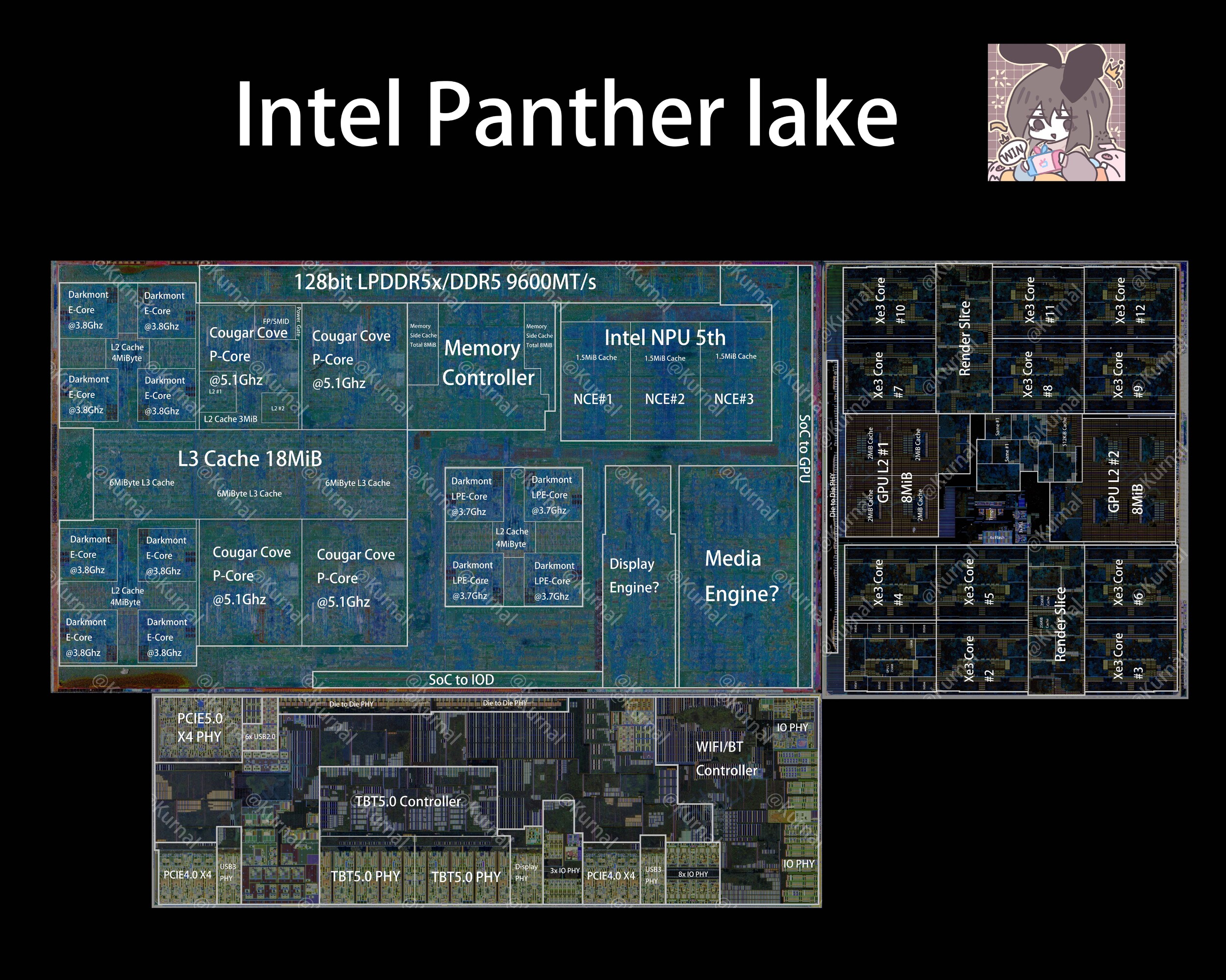
The Graphics tile, built on TSMC’s N3E node, contains up to 12 Xe cores and 16 MB of L2 cache. This is the same architecture used in Meteor Lake but with a higher core count, hinting at better integrated graphics performance for devices without discrete GPUs. However, the trade-off is clear: more cores mean higher power consumption, which could limit battery life in thin-and-light designs.
On paper, Panther Lake-H looks like an evolution of Intel’s disaggregated approach seen in Arrow Lake and Meteor Lake. But the real test will be how it performs against competitors like AMD’s Ryzen 8040 series, which has already shown stronger power efficiency in benchmarks. If Intel cannot close that gap, the chip may struggle to justify its place in next-generation ultraportables.
The I/O tile remains largely unchanged from Arrow Lake, with four PCIe 5.0 lanes, eight PCIe 4.0 lanes, two Thunderbolt 5 ports, and integrated Wi-Fi 7/Bluetooth 5.4 support. This ensures compatibility with high-speed peripherals and next-gen connectivity, but it doesn’t address the core question: Will Panther Lake-H deliver enough performance to compete in a market where power efficiency is non-negotiable?
For developers, the answer may come down to whether Intel can prove that the mixed-node design actually improves efficiency—or if it’s just another step forward without a clear breakthrough. The stakes are high: in an ecosystem where every watt counts, even small gains matter.