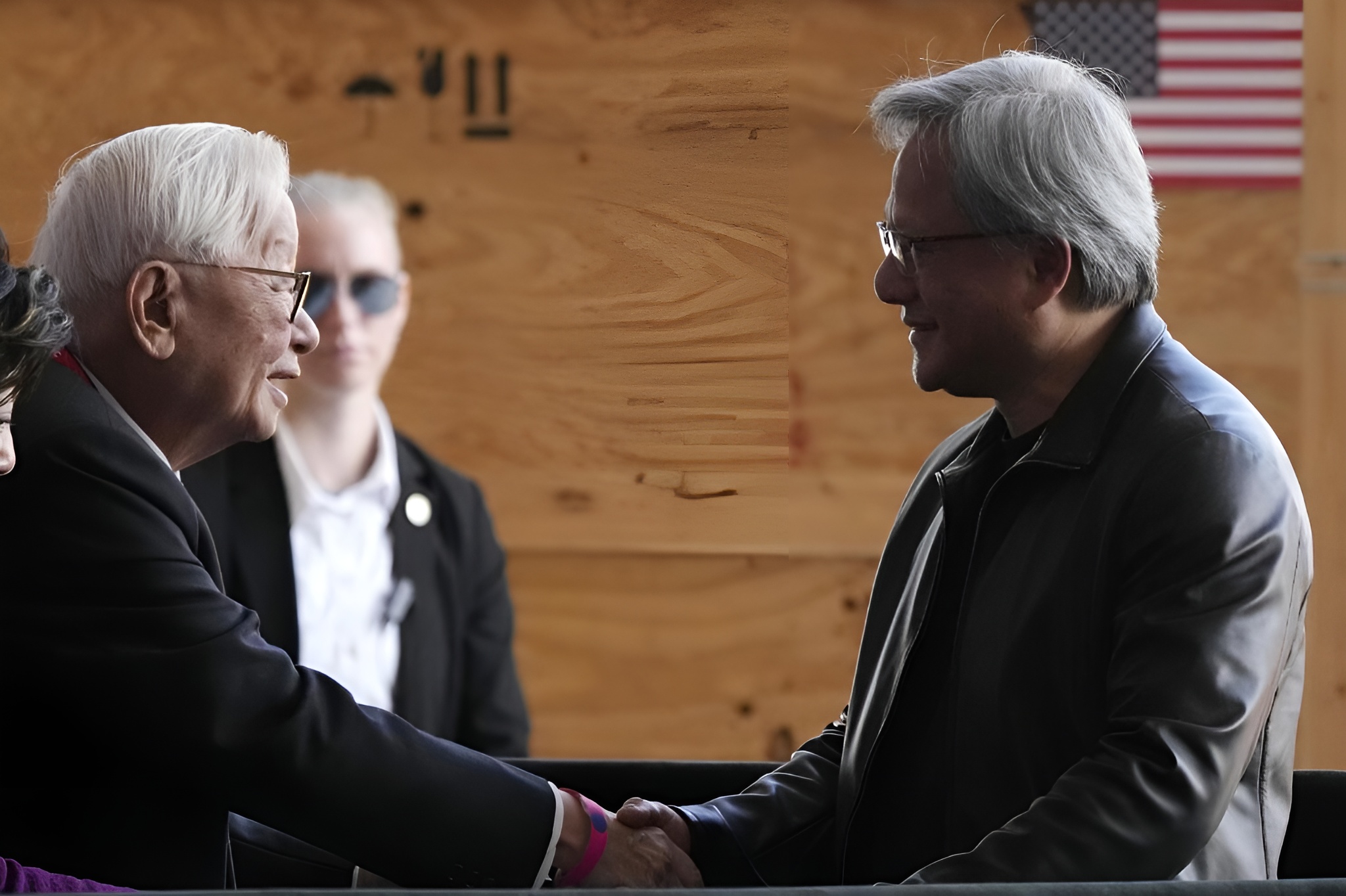
Taipei—In a scene that underscores the unshakable bond between two titans of the semiconductor industry, TSMC founder Morris Chang sat down with NVIDIA CEO Jensen Huang at a local restaurant. The meeting, captured by local media, marked Chang’s first public appearance in more than a year, offering a rare glimpse into the enduring collaboration that has shaped modern computing.
The encounter took place during Huang’s latest visit to Taiwan, a stop that reflects NVIDIA’s deep reliance on TSMC’s advanced manufacturing capabilities. With AI-driven demand surging, the two leaders—whose professional paths intersected decades ago—reaffirmed a partnership that has repeatedly defied industry expectations.
At a glance
- Key figures: Morris Chang (TSMC founder, 94), Jensen Huang (NVIDIA CEO)
- Location: Taipei restaurant
- Context: Chang’s first public appearance in over a year
- Background: Huang previously declined a CEO offer from TSMC in the early 2000s
- Focus: AI chip production, supply chain challenges, and long-term manufacturing commitments
A partnership built on trust
Huang’s decision to prioritize Taiwan for his first major 2026 visit signals the urgency of securing TSMC’s capacity, particularly as NVIDIA’s next-generation AI chips—including the Vera Rubin series—ramp up production. The two executives have a history dating back to NVIDIA’s early days, when Huang chose TSMC over competitors to manufacture its GPUs. That bet, made when TSMC was still a niche player, became a cornerstone of NVIDIA’s dominance in graphics and AI acceleration.
Chang’s presence, despite his age and reported health concerns, highlights the personal stakes in this alliance. While Huang did not disclose specifics of their discussion, industry observers note that TSMC’s advanced packaging lines are fully booked by NVIDIA for years, leaving little room for rivals. The meeting may have touched on strategies to expand capacity, especially as China’s orders for AI chips like the H200 create bottlenecks.
Beyond chips: a shared vision
The relationship between Huang and Chang extends beyond business. In the early 2000s, Huang was offered the role of TSMC CEO but declined, opting instead to focus on NVIDIA. Their mutual respect has since become legendary in tech circles, with Chang often credited for recognizing NVIDIA’s potential when others did not.
Huang’s upcoming ‘trillion-dollar banquet’ in Taiwan—an annual gathering with local partners like Foxconn and Wistron—will likely delve deeper into supply chain logistics. The event, set for this month, aims to align Taiwanese manufacturers with NVIDIA’s next wave of AI infrastructure. Chang’s rare appearance suggests his continued influence, even as TSMC’s day-to-day operations are led by younger executives.
Why it matters now
The semiconductor industry is at a crossroads. With geopolitical tensions and soaring demand, TSMC’s role as the sole provider of cutting-edge chips for NVIDIA and AMD has never been more scrutinized. Chang’s meeting with Huang serves as a reminder that, despite the industry’s rapid evolution, some relationships are built on decades of mutual trust—and that trust remains the foundation of innovation.
For NVIDIA, the stakes are clear: without TSMC’s ability to scale, the company’s AI ambitions could stall. For TSMC, the partnership ensures a steady pipeline of high-margin contracts. As both leaders navigate an era where chips dictate global power dynamics, their meeting was more than a symbolic gesture—it was a quiet affirmation that the future of semiconductor leadership still hinges on the past.