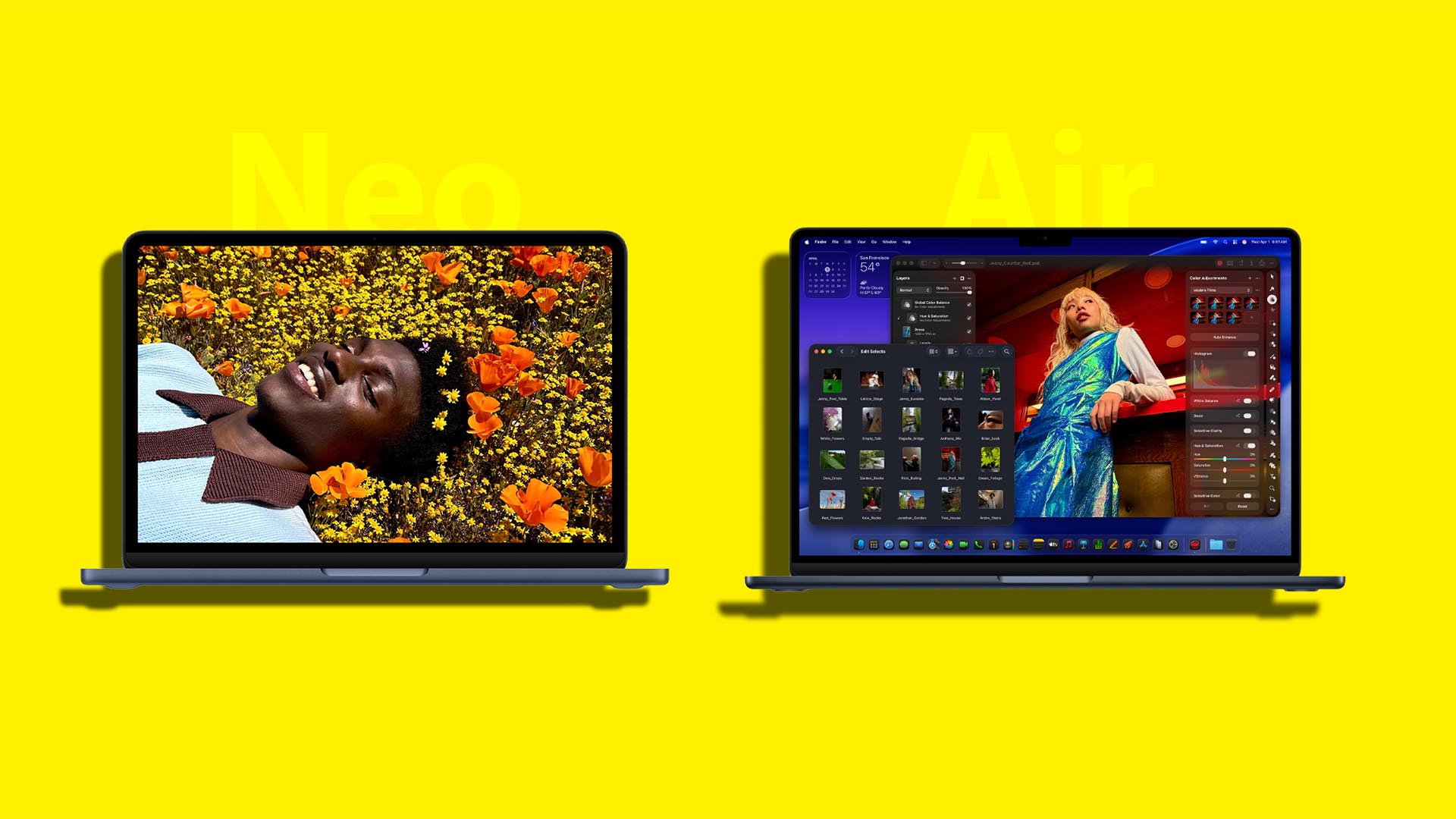
The MacBook Neo and M5 MacBook Air represent two distinct approaches to laptop design, each catering to different user needs. The Neo aims to deliver a more affordable entry point into Apple’s ecosystem, but its compromises in performance, storage, and connectivity may leave many users wanting more.
At first glance, the Neo appears to be a streamlined version of the M5 Air, with a smaller battery and less powerful chip. However, the differences go deeper than just cost savings. The M5 Air retains its position as a versatile workhorse, offering nearly twice the CPU performance, double the memory bandwidth, and support for external displays at much higher resolutions and refresh rates. This makes it a far more capable machine for tasks that demand serious processing power.
- Display:
- MacBook Neo: 13-inch, 2,408 x 1,506 IPS LCD (219 PPI), 500 nits
- M5 MacBook Air: 13.6-inch or 15.3-inch, 2,560 x 1,664 or 2,880 x 1,864 IPS LCD (P3 wide color, True Tone), 500 nits
The M5 Air’s larger screen and enhanced display technology are subtle but meaningful upgrades. While both models cap brightness at 500 nits, the M5 versions add P3 color support and True Tone, making them better suited for creative work—even if you’re not editing video or designing graphics full-time. The Neo, on the other hand, sticks with standard IPS, which is adequate for office tasks but feels dated next to the M5’s panel.
- Performance:
- MacBook Neo: A18 Pro (6-core CPU, 5-core GPU), 3nm N3E, 60GB/s memory bandwidth, 8GB unified RAM (fixed)
- M5 MacBook Air: M4 (10-core CPU, up to 10-core GPU), 3nm N3P, 153GB/s memory bandwidth, 16GB–32GB unified RAM
The performance gap is the most noticeable difference between the two models. Geekbench numbers show the M5 MacBook Air outperforming the Neo by 95% in multi-core tests and 21% in single-core performance. This translates to a significant advantage for tasks like compiling code, rendering 3D models, or handling multiple browser tabs with heavy extensions. The Neo’s A18 Pro chip is efficient enough for everyday work, but it’s not built for pushing limits.
- Storage:
- MacBook Neo: Base 256GB (up to 512GB)
- M5 MacBook Air: Base 512GB (up to 4TB)
Storage is another area where the Neo’s budget nature becomes apparent. The base model starts with just 256GB, and there’s no upgrade path beyond 512GB. In contrast, the M5 Air offers 512GB as standard and scales up to 4TB for an additional $200. For users accustomed to modern laptops with 1TB or more, the Neo’s storage will feel cramped quickly.
- Connectivity:
- MacBook Neo: Wi-Fi 6E (no Thunderbolt), two USB-C ports (one 10Gb/s, one 480Mb/s)
- M5 MacBook Air: Wi-Fi 7 (N1 chip), two Thunderbolt 4 ports (40Gb/s), MagSafe charging
The lack of Thunderbolt on the Neo is a dealbreaker for many power users. While it can drive one 4K display at 60Hz, the M5 Air supports dual 6K displays or a single 8K screen—useful for developers, video editors, or anyone who needs more than one monitor. The M5 also gets Wi-Fi 7 and MagSafe charging, which the Neo skips entirely.
Battery life tells a similar story. The Neo’s 36.5Wh cell lasts around 16 hours on video playback, but the M5 Air’s 55.8Wh or 66.5Wh cells push that to 18 hours—hardly a dramatic difference, but it adds up over a workday.
- Audio & Camera:
- MacBook Neo: 1080p FaceTime camera, dual speakers
- M5 MacBook Air: 12MP Center Stage (Desk View), four speakers with dynamic head tracking
The M5 Air’s audio and camera upgrades are the kind of details that matter in daily use. The Center Stage camera with Desk View support makes video calls feel more professional, while the four-speaker system with spatial audio delivers better sound quality than the Neo’s two-speaker setup.
Pricing reflects these differences sharply: the Neo starts at $599 (8GB/256GB) or $699 (8GB/512GB), while the M5 Air begins at $1,099 (16GB/512GB). The Neo’s $400 savings come with real limitations—smaller storage, weaker performance, and no future-proofing for external displays or advanced wireless standards.
For students or casual users, the Neo is a decent choice. It won’t overheat under light workloads, and its build quality remains top-tier. But if you’re upgrading from an older laptop—or if you’ve used an M1 MacBook Air—you’ll notice the performance drag immediately. The M5 Air isn’t just faster; it’s more capable in every way that matters for serious work.
Availability is expected to be confirmed soon, with both models likely launching in late 2026. Color options will include Silver, Blush, Citrus, and Indigo for the Neo, and Sky Blue, Midnight, Starlight, and Silver for the M5 Air.