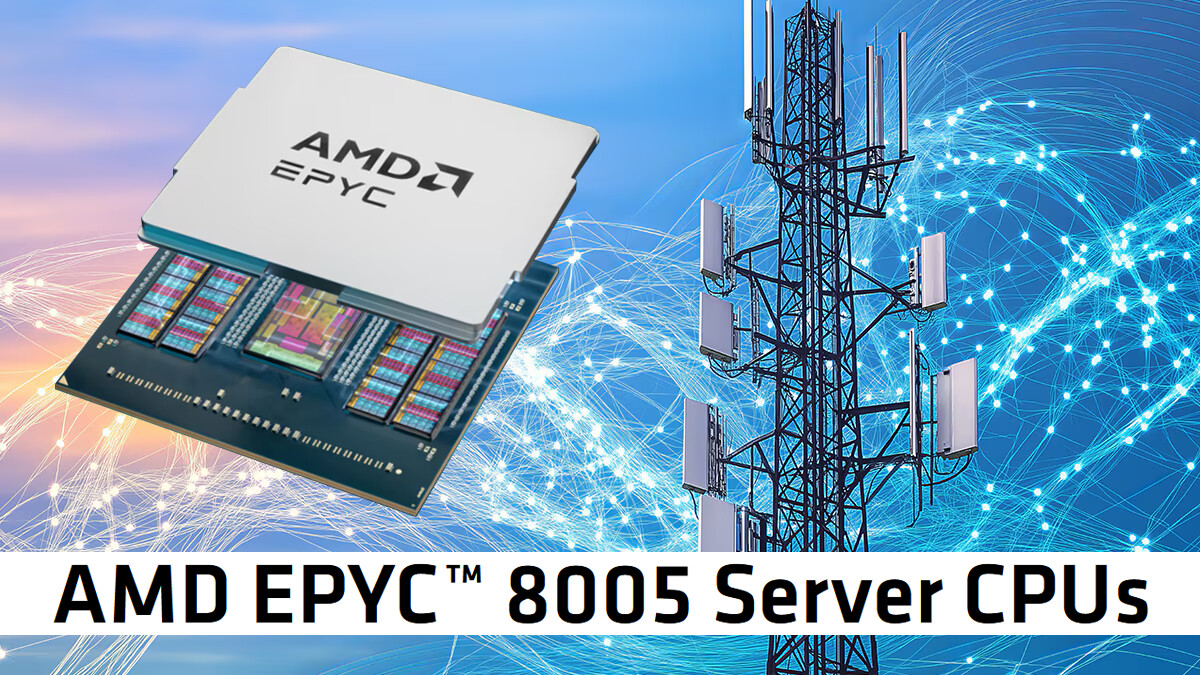
AMD has unveiled its latest server-grade CPU lineup, the EPYC 8005 series codenamed ‘Sorano,’ designed to fill a critical gap in its product stack. Positioned between the flagship EPYC 9005 and the more budget-oriented EPYC 4005, the 8005 series targets single-socket environments where power efficiency and cost-effectiveness are paramount—particularly in telecom, edge computing, and virtualized radio access networks (vRAN).
The new chips are built on AMD’s Zen 5 architecture and emphasize performance-per-watt over raw multi-socket scalability, making them ideal for space-constrained deployments like cell towers and distributed edge servers. Unlike its predecessors, the 8005 series scales up to 84 cores in a single socket and supports power envelopes as high as 225 watts, catering to demanding workloads without requiring complex cooling solutions.
For telecom operators, the EPYC 8005 introduces specialized optimizations for 5G vRAN workloads, including hardware-accelerated LDPC decoding. This enhancement improves uplink throughput and forward-error-correction processing while maintaining the deterministic latency critical for real-time network functions. The updated Zen 5 execution pipeline and vector capabilities further bolster these capabilities, ensuring predictable performance in high-stakes environments.
AMD has also highlighted the series’ compatibility with NEBS-compliant platforms, which are essential for telecommunications infrastructure requiring robust reliability and environmental resilience.
Key Specifications
- Architecture: Zen 5
- Core Count: Up to 84 cores (single-socket)
- Power Envelope: Up to 225 W TDP
- Target Workloads: Telecom, edge computing, vRAN, and NEBS-compliant deployments
- Specialized Features: LDPC decoding acceleration for 5G, deterministic latency for real-time applications
- Thermal Range: Wide operating temperatures for edge and outdoor deployments
The EPYC 8005 series represents a strategic shift for AMD, focusing on efficiency and deterministic performance rather than sheer core count. This approach aligns with the growing demand for high-performance, low-power solutions in edge and telecom sectors, where reliability and energy consumption are as critical as raw processing power.
While AMD has not yet released a full SKU list or detailed benchmarks, the series is expected to launch in the coming months, with more technical details likely to follow closer to availability. The emphasis on performance-per-watt and specialized telecom optimizations positions the EPYC 8005 as a compelling option for operators looking to modernize their infrastructure without compromising on efficiency.