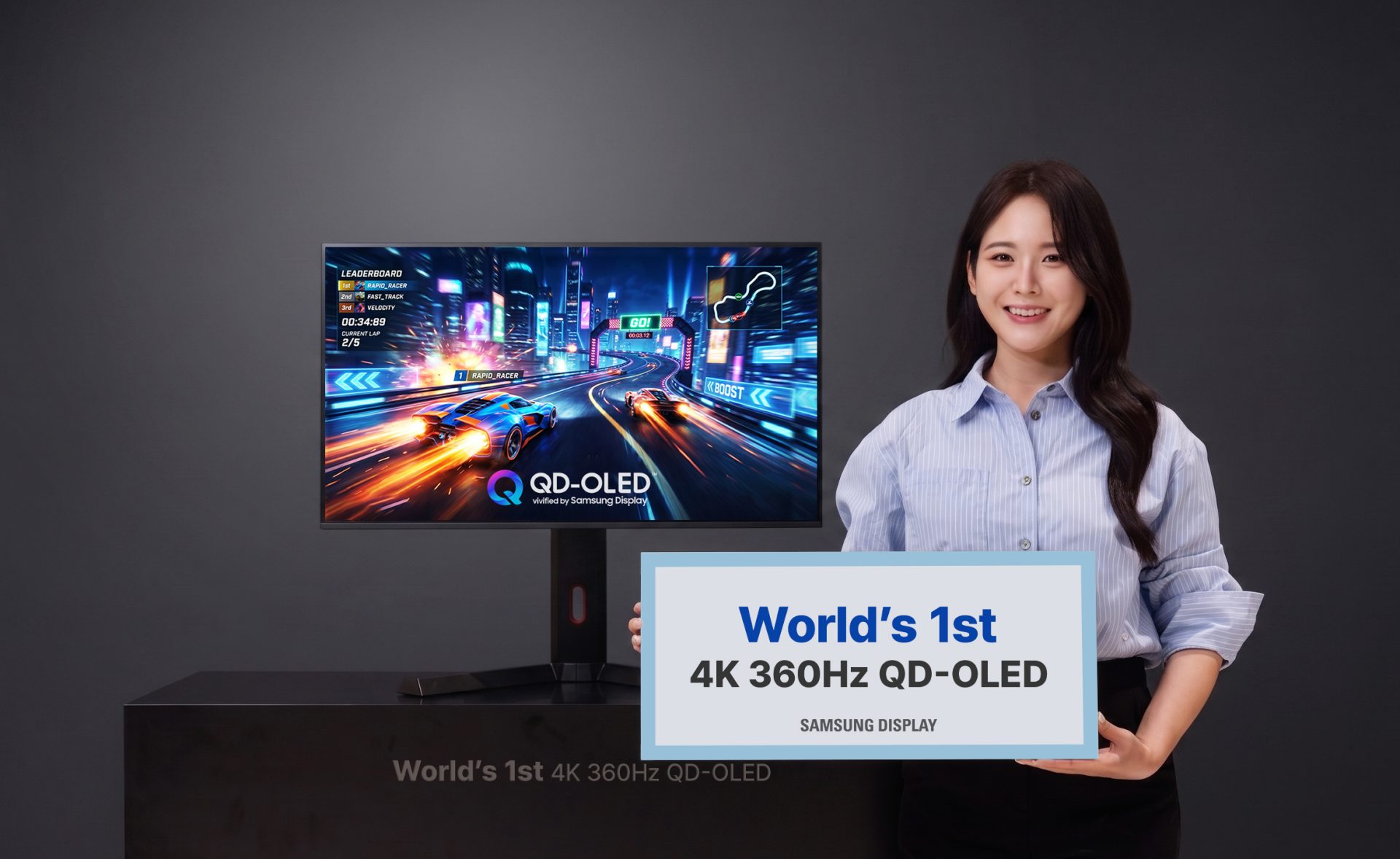
For years, consumers have faced an unyielding choice: 4K resolution or high refresh rates. Now Samsung has introduced a QD-OLED panel that appears to break that barrier, delivering native 360Hz at 4K and a dual-mode leap to 680Hz.
This development could reshape the landscape for gaming monitors and high-end displays, where refresh rate and resolution have historically competed for limited bandwidth. The new panel combines quantum dot technology with OLED’s self-luminous pixels, promising both vibrant color and smooth motion—without sacrificing resolution.
Key specifications
- Resolution: 4K (3840 × 2160)
- Native refresh rate: 360Hz at 4K
- Dual-mode refresh rate: Up to 680Hz when paired with a compatible GPU
- Panel technology: QD-OLED (Quantum Dot OLED)
The dual-mode capability suggests Samsung is targeting scenarios where raw speed matters more than resolution, such as competitive gaming or fast-paced media consumption. However, the long-term practicality of 680Hz in real-world applications remains uncertain, given current GPU and display port limitations.
What it means for users
For power users, this panel could eliminate a key decision point: whether to prioritize resolution or smoothness. The ability to toggle between modes—without sacrificing color accuracy or black levels—could appeal to those who demand both high-end visuals and performance.
Yet, the 680Hz mode is likely tied to specific use cases where such refresh rates are meaningful, rather than a universal upgrade path for all consumers. The real test will be whether software and hardware ecosystems can keep pace with these capabilities over time.
Competitive context
Samsung’s move comes as other manufacturers are also pushing the boundaries of display technology, but few have attempted to merge 4K resolution with such high native refresh rates. The challenge now is whether this panel can deliver on its promise without introducing new tradeoffs—such as increased power consumption or thermal constraints—that might limit its adoption.
For now, buyers should weigh the immediate benefits against long-term uncertainty. If the dual-mode feature proves reliable and widely supported, it could set a new benchmark for high-performance displays. Otherwise, the gap between theory and practical application may remain.