The Ryzen AI 400 series, built on the Gorgon Point silicon and powered by Zen 5 cores, marks AMD’s latest push into AI-accelerated desktop processors. However, this generation introduces a notable tradeoff: while it expands core counts and integrated GPU capabilities, it reduces the number of usable PCIe lanes available to users—particularly for discrete GPUs.
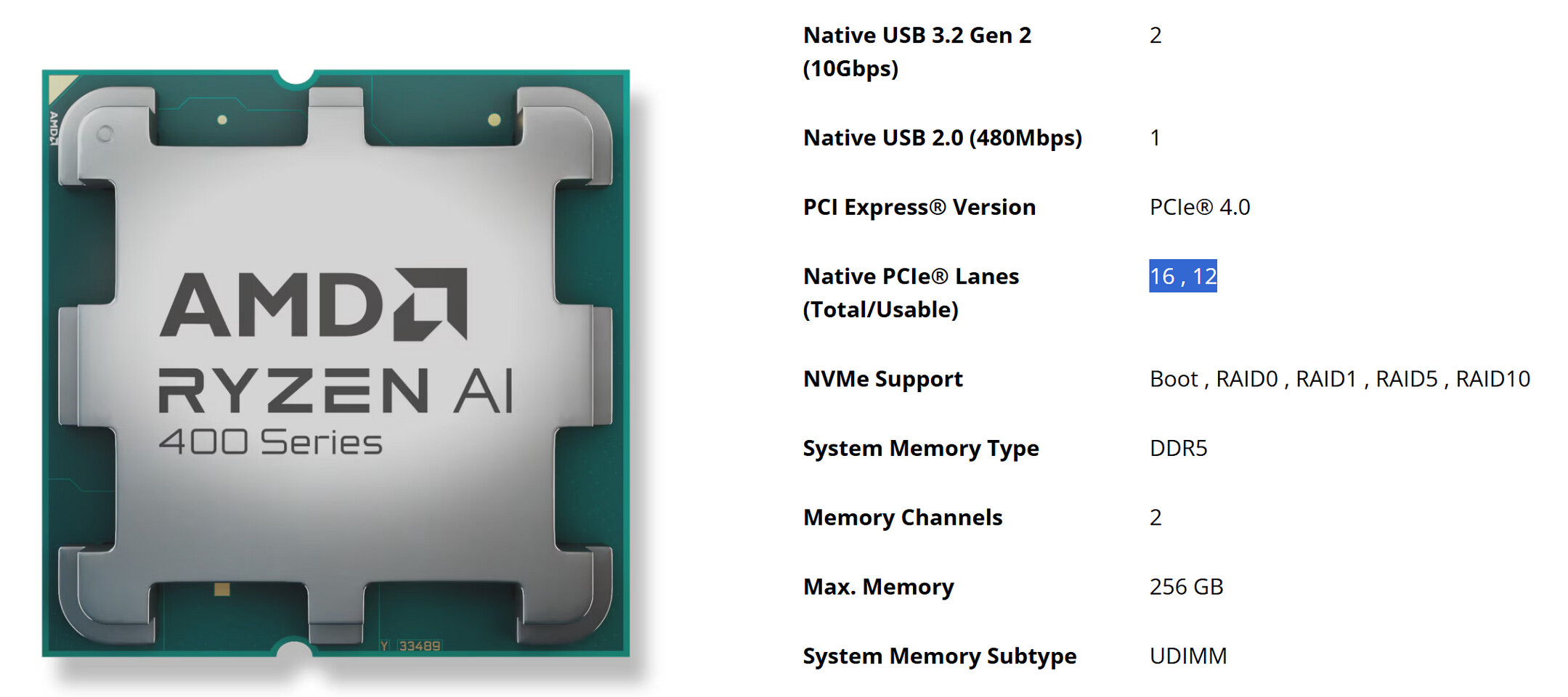
At launch, the top-tier Ryzen AI 7 450G offers 16 native PCIe 4.0 lanes, but four are reserved for the chipset link, leaving just 12 usable lanes for other components. This means that when paired with an M.2 NVMe SSD, only eight lanes remain for a discrete GPU, forcing it to operate in x8 mode rather than the full x16 bandwidth of PCIe 4.0. Lower-tier models may provide as few as 10 usable lanes, further limiting performance for high-end graphics cards.
Why It Matters
For users building systems with multiple high-speed SSDs and a high-end GPU, the Ryzen AI 400 series presents a clear limitation. While AMD’s design prioritizes efficiency—particularly in small form factor builds where space and power consumption are concerns—the reduction in PCIe lanes could leave enthusiasts and professionals seeking maximum bandwidth without a viable path to full x16 performance on AM5 motherboards.
Testing with mid-range GPUs, such as the RTX 5060 Ti, shows that operating in x8 mode results in only a slight performance dip—around 2% at 1080p and 1% at 1440p. However, for high-end GPUs like the upcoming RTX 5090 or RX 9070 XT, even this small drop could translate to noticeable real-world differences in rendering workloads or AI acceleration tasks.
Key Specifications
- Chipset: Ryzen AI 400 / Ryzen AI PRO 400 (Gorgon Point)
- Cores: Up to 8 cores (4 Zen 5 + 4 Zen 5c), with the top model featuring only half the available iGPU compute units
- PCIe: 12 usable PCIe 4.0 lanes (4 reserved for chipset link), down from previous generations’ higher lane counts
- Process Node: 3 nm for CCDs, 2 nm for IOD (as per AMD’s roadmap)
- TDP: Up to 200 W for high-end models
The reduction in PCIe lanes is part of a broader shift toward efficiency, with AMD focusing on integrated graphics performance and smaller motherboard designs. While this approach benefits compact builds and power-conscious users, it leaves those seeking maximum discrete GPU bandwidth with fewer options.
For now, users who prioritize high-bandwidth configurations—such as pairing multiple NVMe SSDs with a high-end GPU—may still look to older desktop platforms or AMD’s server and workstation lines for full x16 PCIe 4.0 support. The Ryzen AI 400 series, meanwhile, remains a strong choice for AI workloads, integrated graphics performance, and systems where bandwidth demands are less critical.
The exact availability and pricing of the Ryzen AI 400 series have not been confirmed, but it is expected to launch in early 2026 alongside AM5 motherboard updates.