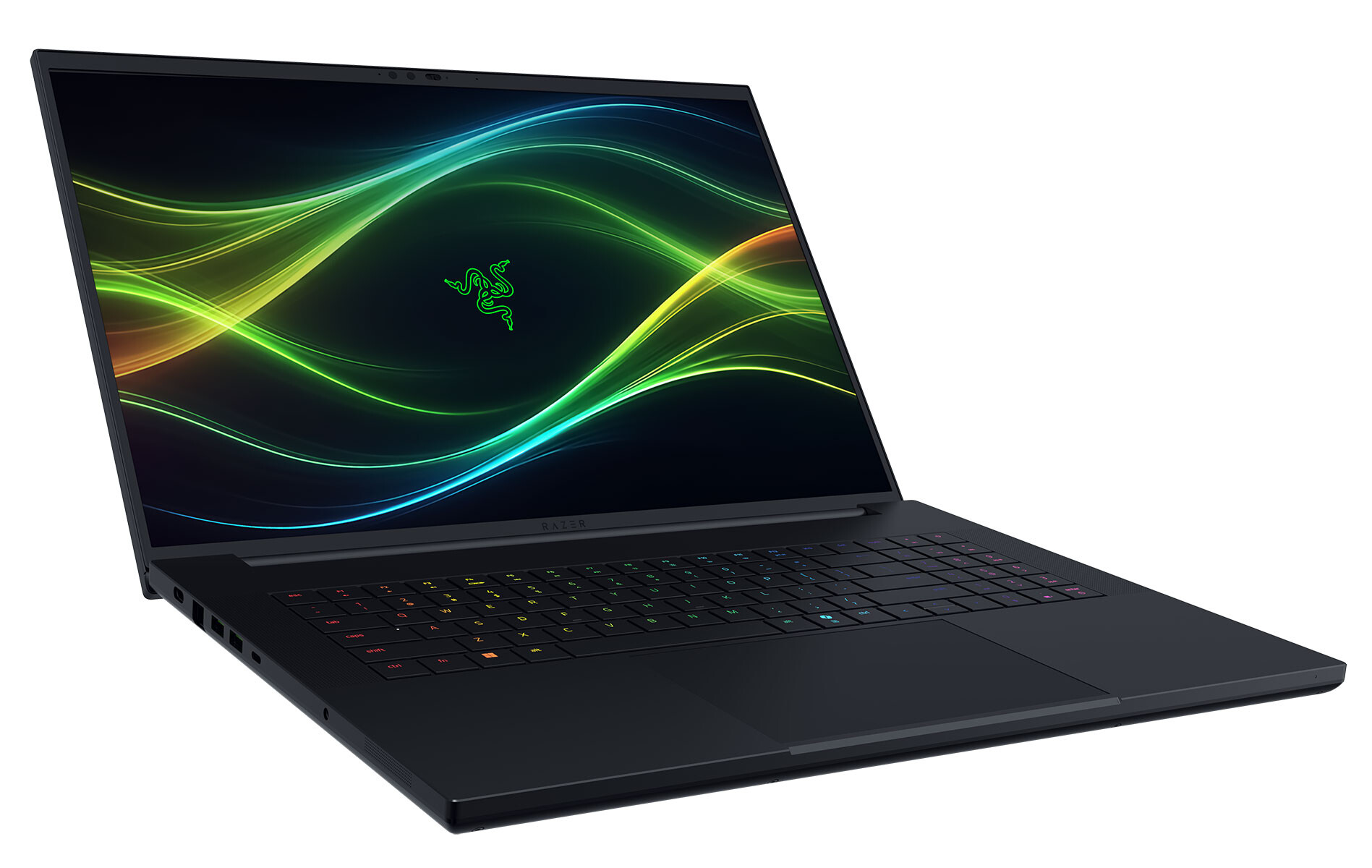
The Razer Blade 18 has arrived, pushing the boundaries of what a gaming laptop can achieve. This latest iteration is not just about raw power—it’s about merging high-performance gaming with sophisticated AI workflows into one seamless platform.
At its core, the Blade 18 is built around the Intel Core Ultra 9 290HX Plus processor, which delivers up to a 5.5 GHz boost clock speed. When paired with an optional NVIDIA GeForce RTX 5090 laptop GPU—featuring 24 GB of VRAM and a 175 W TGP—the system becomes a desktop-class machine capable of handling demanding AI tasks alongside high-framerate gaming.
What sets this iteration apart is its focus on local AI execution. The RTX 5090 configuration supports NVIDIA’s next-gen RTX AI technologies, allowing developers to run large language models (LLMs) and generate images faster without relying solely on cloud infrastructure. Benchmarks show up to 37% faster LLM inference, with token processing reaching 162 tokens per second—a significant leap in responsiveness for AI workflows.
More Than Just Gaming
The Blade 18’s dual-mode 18-inch display is another standout feature. Users can switch between UHD+ at 240 Hz for precision-driven tasks like development and content creation, or FHD+ at 440 Hz for ultra-smooth competitive gaming. This adaptability ensures the laptop remains versatile across different workloads.
Sustained performance is critical for both gamers and AI developers, and Razer has addressed this with an advanced vapor chamber cooling system. Combined with a refined multi-fan design, the Blade 18 maintains peak performance during extended sessions—whether rendering 3D assets, compiling large codebases, or running intensive AI models.
Connectivity and Audio: A Desktop Replacement
- Thunderbolt 5: For ultra-fast data transfer and high-bandwidth peripherals.
- Wi-Fi 7: Ensures low-latency wireless performance for online gaming and cloud tasks.
- HDMI 2.1 and 2.5 Gb Ethernet: Supports seamless connectivity for multi-monitor setups and high-speed networking.
The laptop also includes a six-speaker system powered by THX Spatial Audio+, delivering immersive 7.1.4 virtual surround sound—ideal for gaming, film editing, or music production. A 5 MP IR webcam with Windows Hello support further enhances its professional capabilities.
Razer’s commitment to sustainability is evident in the Blade 18’s construction. The chassis is precision-milled from a single block of aluminum, now incorporating recycled materials. Additionally, the laptop comes with a two-year battery warranty and RazerCare support options for added peace of mind.
Looking Ahead: What This Means for IT Teams
The Blade 18’s arrival signals a shift in how laptops are used—not just as portable gaming rigs, but as full-fledged desktop replacements. For IT teams managing workloads that span AI development and high-end gaming, this means reduced dependency on cloud resources, faster local processing, and greater control over data.
While the RTX 5090 configuration is a significant leap in power, its 175 W TGP may pose thermal challenges for some users. However, Razer’s cooling advancements suggest these concerns are being addressed. The real question now is whether this level of performance will drive broader adoption of desktop-class laptops in enterprise environments.
One thing is clear: the Blade 18 is not just another gaming laptop. It’s a platform that bridges the gap between traditional computing and next-gen AI workloads, setting a new benchmark for what a high-performance laptop can achieve.