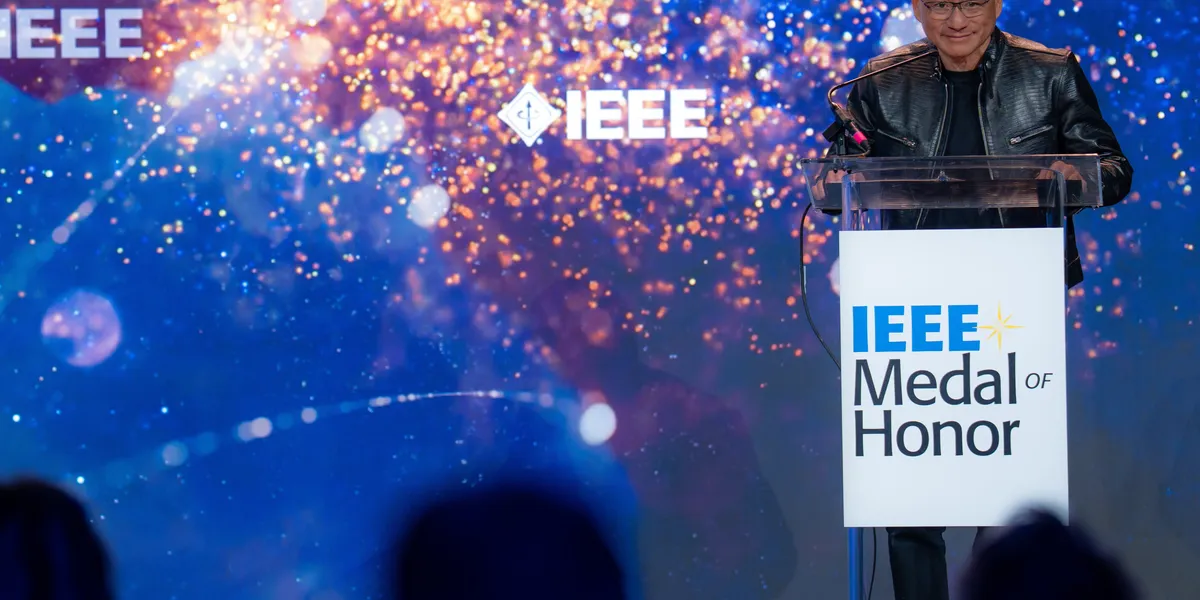
The IEEE Medal of Honor has been awarded to Jensen Huang, recognizing his foundational role in developing graphics processing units (GPUs) and their transformative applications in artificial intelligence and scientific computing. This prestigious award, carrying a $2 million prize, underscores the lasting impact of GPU technology on modern computing.
Huang's leadership at Nvidia since its inception in 1993 has been instrumental in shaping the trajectory of AI and high-performance computing. The introduction of programmable GPUs in 1999 marked a turning point, enabling advancements that now underpin industries from medicine to machine learning.
Technical Legacy
- GPU Foundations: Developed the first programmable GPU architecture, shifting computing paradigms by leveraging parallel processing for graphics and later AI workloads.
- AI Integration: Nvidia's GPUs became essential for training deep neural networks, accelerating research in autonomous systems and medical imaging.
- Industry Influence: The technology's adoption in data centers and supercomputing redefined performance benchmarks across fields.
While the award highlights Huang's vision, the real-world significance lies in how GPUs transitioned from rendering graphics to powering AI models. Users in research labs notice this most acutely: tasks that once took hours now complete in minutes due to GPU-accelerated algorithms. This shift has become a standard, not an exception.
Broader Recognition
Huang's contributions extend beyond engineering. His inclusion among Time magazine's 'Architects of AI' and past accolades—such as Fortune's Businessperson of the Year—reflect his influence on both technology and business strategy. Yet, the IEEE Medal of Honor stands out for its focus on technical innovation that benefits society.
The ceremony in New York this April will celebrate not just Huang but the collaborative efforts that turned GPU architecture into a cornerstone of modern computing. For industries relying on data-driven solutions, this recognition serves as a reminder: the foundation laid decades ago continues to shape the future.