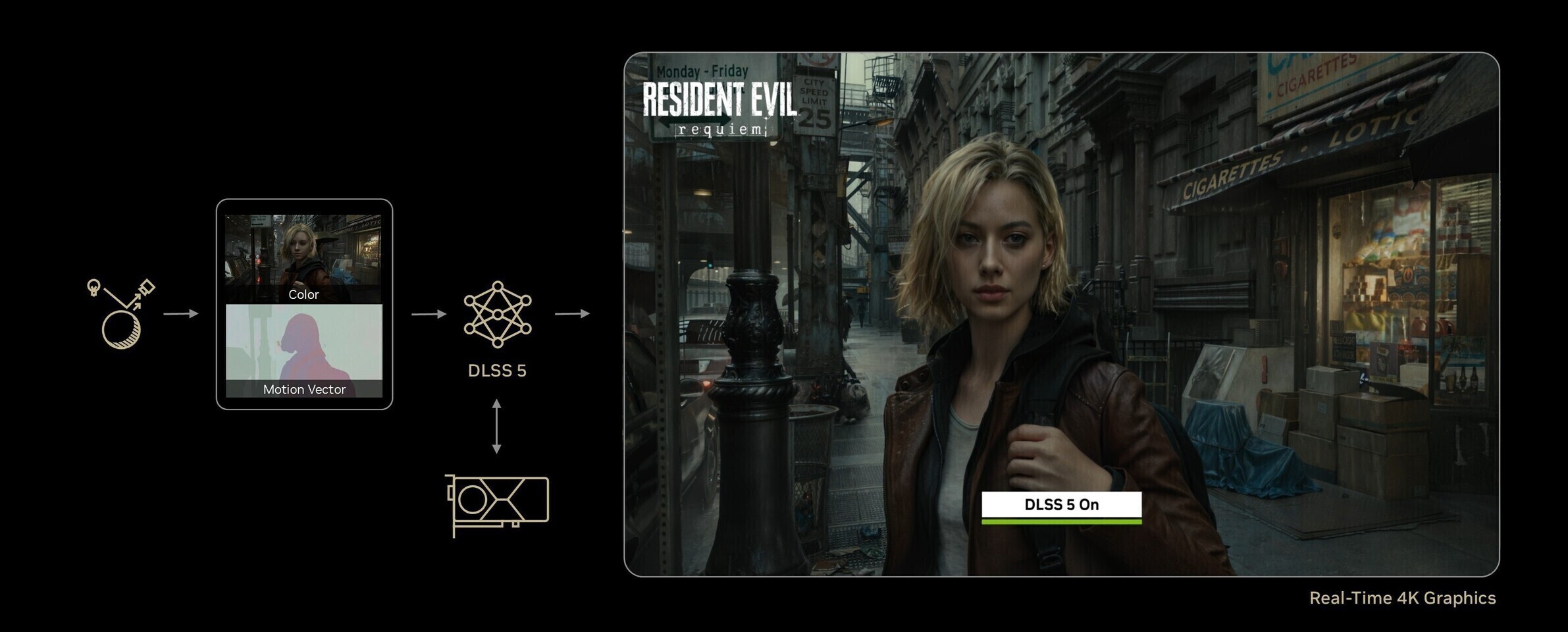
Friday, May 8th 2026 DLSS 5: Gamers Prefer Original Visuals, Many Await Real-World Results Editorial by AleksandarK Today, 08:21 Discuss (1 ) When NVIDIA announced its Deep Learning Super Sampling (DLSS) 5 technology, which the company describes as the first real-time neural rendering technology to bring photorealism to game textures, the response from gamers was not entirely positive. Many were unhappy with the results, and the backlash grew online. That's why we asked the readers in a poll to share their opinions on the technology and found a consistent theme in the results. After collecting nearly 20,000 votes, a majority of 58% of gamers expressed that AI should not alter games at all. They prefer to keep their favorite titles original and intact, as envisioned by the original game studio, without any changes to lighting or photorealism. They want no alterations, meaning AI should not change character faces, apply realistic material rendering, or add any other modifications. Interestingly, the second-largest group is still undecided, waiting to see real-world results in their favorite AAA titles. When DLSS 5 is implemented in major releases, about 28% of gamers who have seen NVIDIA's DLSS 5 demos believe that the final release will shape their opinion, whether positive or negative. This indicates that the technology has not yet fully resonated with the gaming community, who require further convincing. A smaller segment, 8.1% of those polled, believes that DLSS 5-enabled titles actually look better than native rendering, showing some optimism that the technology can improve visuals. Finally, about 6.4% of respondents are willing to accept visual changes if they lead to a significant FPS boost. As with DLSS and other upscaling methods, gamers now expect to see a substantial performance increase from neural rendering, and the situation appears similar with DLSS 5. What is DLSS 5? The primary goal of DLSS 5 is to enhance a game's visual fidelity through techniques that improve scenes by adding photorealistic lighting and materials. Notably, DLSS 5 aims to respect the original artistic intent by using the game's color and motion vectors for each frame, aligning the DLSS 5 model with the specific setting. This technology promises to keep the output consistent with what the game developers originally envisioned, and just gives each original frame a visual overhaul without changing the game's original vision. DLSS 5 processes 2D frames and motion vectors as input, applying its generative AI model to output frames in a 2D context rather than 3D. Although the model is trained on materials that might appear three-dimensional visually, its actual work is based on 2D imagery. It identifies each frame's motion vectors and anchors the model to them, operating in a 2D space instead of a full 3D environment. This approach to handling graphics is much more computationally efficient, as achieving complete photorealism in 3D would require more GPU power than is currently available. No underlying geometry is changed. What about Game Studios? In my opinion, the vast majority of game studios do not want the artistic intent altered by generative AI. There are artists who carefully plan how the game will look and how it will appear at different settings. However, as an increasing number of game studios rely on AI for their artistic work, this approach might actually benefit those who prefer to offload some creative work. Especially those studios that don't have a distinct artistic style are likely to be among the first adopters of any neural rendering technique to help elevate their otherwise boring styles of game design. This is especially true for game studios that rely on Unreal Engine 5, which is starting to make every game appear nearly the same over time, as having a universal way of processing video game elements and art creates similar content, just under a different label. While in-game developments may be different, including the main character and their storylines, I feel a bit like games are starting to take on the same feeling. Basically, if you played a single UE5-based game, you will feel more familiar with many other releases, just in a different environment. Gamers are now afraid that this problem will appear with neural rendering techniques if these are applied to many textures and character faces, which could all end up looking the same and bring a monotonous look to the game industry. Until game developers start enforcing their own artistic style through further customization, technologies like DLSS 5 might become problematic for any studio trying to stand out and be unique. I have no doubt that NVIDIA is taking everyone's feedback into account and incorporating it into their development pipeline. DLSS 5 is expected to launch this fall, giving the company a few months to polish the technology before it goes public. NVIDIA is known for having a very methodical approach to developing the DLSS family of AI models, which includes supercomputers running for years to optimize every part of the technology. In the upcoming release, I hope to see much of the gamers' feedback incorporated and the drawbacks addressed through an improved AI model, which will hopefully fulfill NVIDIA's vision of enhanced, photorealistic textures on every PC. Related Tags: AI Deep Learning DLSS DLSS 5 Games GPU Neural Rendering NVIDIA photorealistic Real realistic Results Jul 23rd 2025 DDR6 Memory Arrives in 2027 with 8,800-17,600 MT/s Speeds (196) Jan 16th 2026 NVIDIA Reportedly Ends GeForce RTX 5070 Ti Production, RTX 5060 Ti 16 GB Next (210) Sep 18th 2025 NVIDIA Buys $5B Worth of Intel, RTX iGPUs Coming to x86, Shares up 25% (256) Sep 10th 2025 NVIDIA GeForce RTX 50-Series SUPER GPUs Could Arrive at CES 2026 (69) Mar 30th 2026 NVIDIA Readies Rubin-based GeForce RTX 60-series with Massive RT Performance Gains (161) Sep 3rd 2025 NVIDIA Discrete GPU Market Share Dominance Expands to 94%, Notes Report (237) Dec 31st 2025 Leaks Predict $5000 RTX 5090 GPUs in 2026 Thanks to AI Industry Demand (124) Mar 16th 2026 NVIDIA Unveils DLSS 5 with Real-Time Neural Rendering (305) Jul 29th 2025 NVIDIA to Debut GeForce RTX 50-series SUPER GPUs by Christmas (112) Sep 29th 2025 March-April Release of NVIDIA GeForce RTX 50-series SUPER Lineup, Possible CES Reveal (73) Add your own 1 on DLSS 5: Gamers Prefer Original Visuals, Many Await Real-World Results #1 TheGeekn°72 Unless the devs themselves told the DLSS5 model what to generate and *somehow* the output is deterministic, AI has no fucking business changing how any given content looks. Glad to see the pushback from nearly everyone involved in the gaming production/consumption chain.