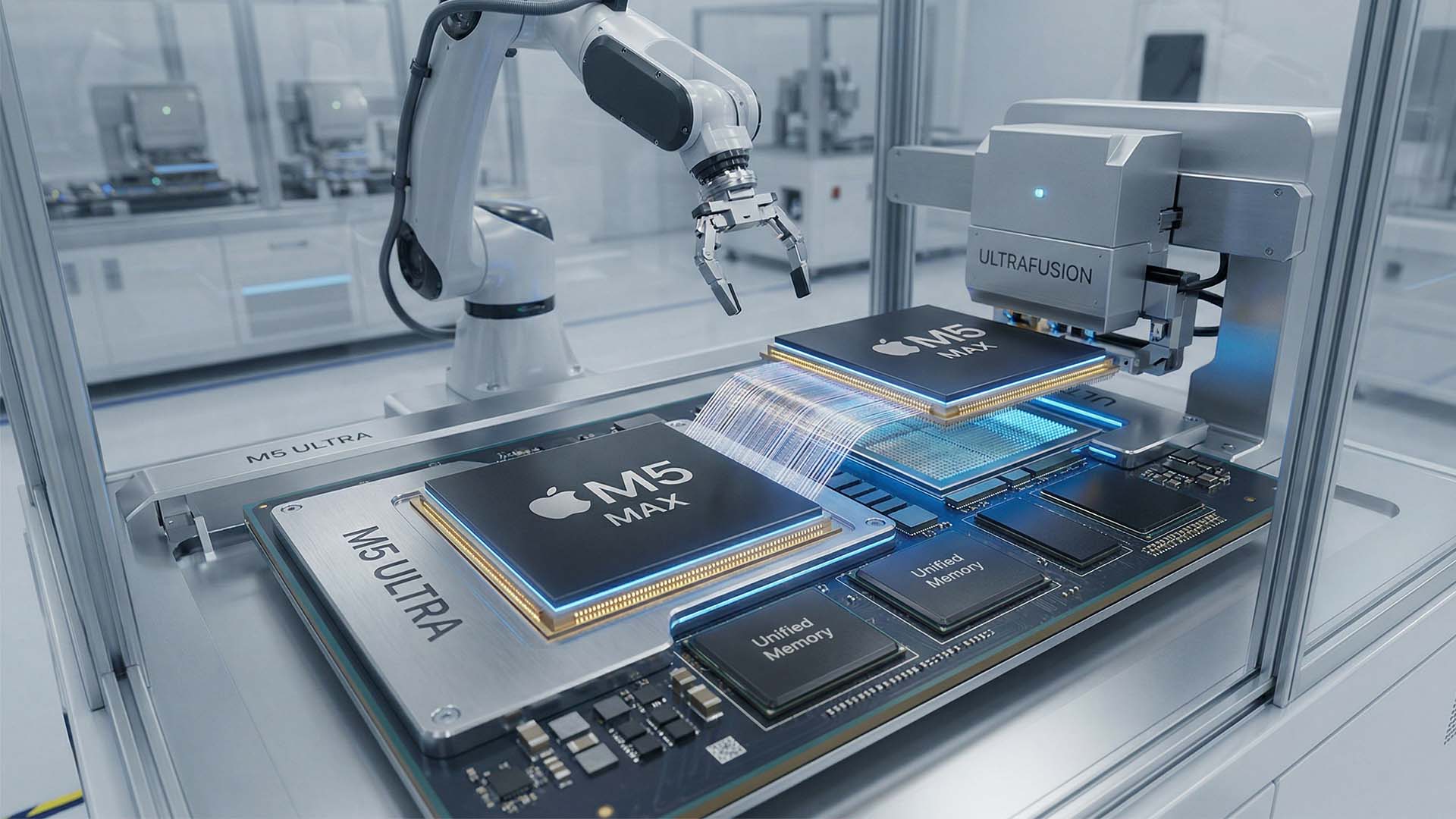
Rumor Semiconductor Apple’s M5 Ultra Architecture Details Are Unknown, But Some Pragmatic Thinking Concludes The UltraFusion Process Will Return Omar Sohail • at EDT Add on Google This time, it will be a combination of UltraFusion and Fusion Architecture to form a single Apple Silicon / Image made using Gemini The Fusion Architecture that Apple introduced with the M5 Pro and M5 Max allowed the company to scale the limitations of chipset development, packing in more CPU cores operating at higher clock speeds while maintaining impressive efficiency. This leaves only the M5 Ultra to be announced, but unlike the other SoCs, there are few details surrounding its architecture. Fortunately, a series of logical explanations indicate why Apple will bring its UltraFusion process to this silicon, just like it has with the M3 Ultra. However, this approach also means that we’ll witness the pairing of both Fusion Architecture and UltraFusion to form a single chipset, making it a first in Apple Silicon history. As for why Apple could choose this approach for the M5 Ultra, we’ve discussed it at length below. Related Story Samsung Will Soon Become More Profitable Than NVIDIA, And It Just Clinched An Exclusive 3-Year Display Contract From AppleThe UltraFusion architecture has been ‘battle tested’ in real-world scenarios, and reusing an older design helps increase M5 Ultra yields and lower costs Despite a previous report stating that the M5 Ultra will feature a monolithic die, Fred the Frenchy on X believes that Apple will retain the use of UltraFusion by combining two M5 Max units to form a single unit. The reason for this is simple; Apple has leveraged UltraFusion technology for three workstation-class chipsets now, with every release offering notable gains in compute and GPU performance. Looking at how consistently an older method of combining two SoCs has been used, it has obviously been proven to be less expensive while also offering more yields, meaning that the M5 Ultra can be mass produced in a higher number while costing less. The UltraFusion Interposer will sit between the two M5 Max dies, with each CPU and GPU block joined by Cu-Cu (copper-to-copper) direct bonding, for a total of two units. Fred the Frenchy predicts the M5 Ultra chipset design Keep in mind that Cu-Cu direct bonding is also expensive, which is why Apple would not prefer to uso it to join the two M5 Max dies and instead, rely on the ‘tried and tested’ UltraFusion process. Our guess is that the top-end version of the M5 Ultra will ship with a 36-core CPU and an 80-core GPU to deliver the best possible compute and GPU performance. Apple will also have to worry less about using the M5 Ultra across two products because it has thrown in the towel on the Mac Pro, meaning that no more models will be updated, leaving just the Mac Studio waiting to be refreshed. About the : Omar Sohail is a and analyst for 's mobile section, specializing in the technology and business of the mobile industry. His expertise lies in the intricate hardware supply chain, covering developments in semiconductor manufacturing, chip lithography, and camera sensor technology. Follow on Google to get more of our news coverage in your feeds. Further Reading Apple Shows Its Cards, Plans To Move The Production Of Its Upcoming Baltra ASIC In-House A18 Pro Supply For The MacBook Neo Has Run Dry, Leaving Apple With A Dilemma That May Compromise The Affordable Mac’s Low Price Apple’s And Its Suppliers Can’t Seem To Agree On The iPhone Fold’s Material Choices And Prices, Putting Its 2026 Launch In Jeopardy Apple Is Trying To Phase Out M4 Chip-Based Products, Which Is Why You Can’t Get Your Hands On Mac Mini And Mac Studio Devices Right Now Read all on Apple’s M5 Ultra Architecture Details Are Unknown, But Some Pragmatic Thinking Concludes The UltraFusion Process Will Return