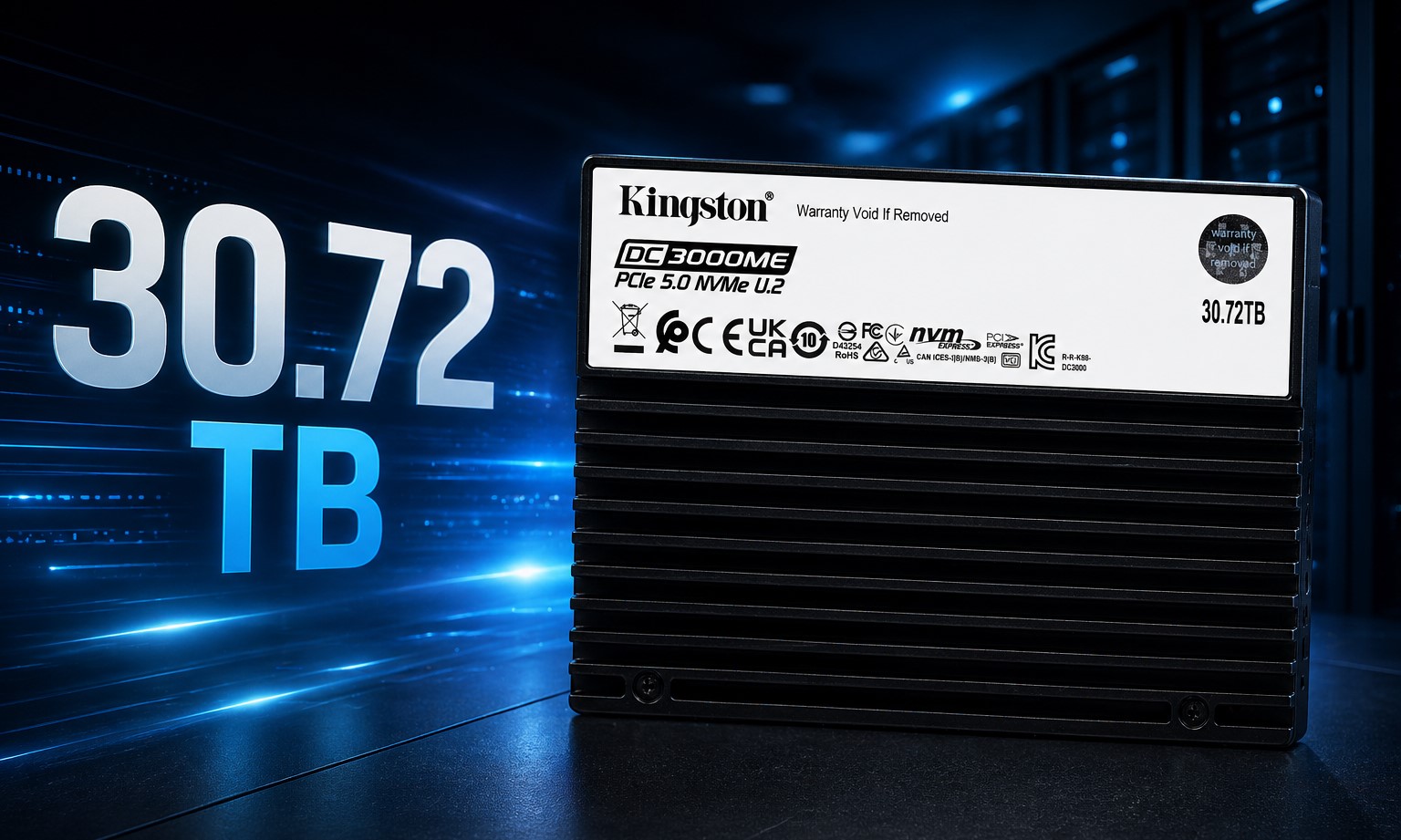
In the cramped server bays of a growing AI data center, a single drive now holds more than triple the data once crammed into racks—30.72 TB, to be exact—but whether that capacity translates to smoother workloads depends on how quickly the rest of the ecosystem catches up.
Kingston’s new DC3000ME Gen 5.0 SSD pushes the boundaries of what a single drive can store and stream, with sequential read speeds hitting 14 GB/s and write speeds at 12 GB/s. The jump from previous generations is stark: double the capacity of its immediate predecessor while nearly doubling bandwidth. This isn’t just about raw numbers, though; it’s about whether those numbers land in real-world performance gains or get stuck waiting for software and infrastructure to evolve.
The drive targets enterprise environments where data growth has outpaced traditional storage architectures. AI training sets, for example, can balloon from terabytes to petabytes overnight, demanding drives that keep pace without choking the pipeline. Kingston’s solution here is a blend of higher density NAND and a revised protocol stack optimized for Gen 5.0 speeds. The result on paper is impressive: sustained throughput that could shave hours off large dataset transfers or model training cycles.
Yet, the practical impact remains uncertain. Most data centers still run on Gen 4.0 infrastructure, which may not fully leverage the new drive’s capabilities without firmware updates or hardware upgrades. Compatibility isn’t just a technical hurdle—it’s an economic one. Deploying these drives en masse means balancing immediate performance gains against the cost of retrofitting older systems. For now, the DC3000ME remains a high-end niche product until the broader industry follows suit.
What’s confirmed: the drive delivers on its advertised specs, with endurance rated for 1.2 million hours of operation in enterprise workloads and error correction that matches the reliability demands of data centers. What’s still unconfirmed: how quickly software stacks—from database engines to AI frameworks—will tap into Gen 5.0 speeds without creating bottlenecks elsewhere.