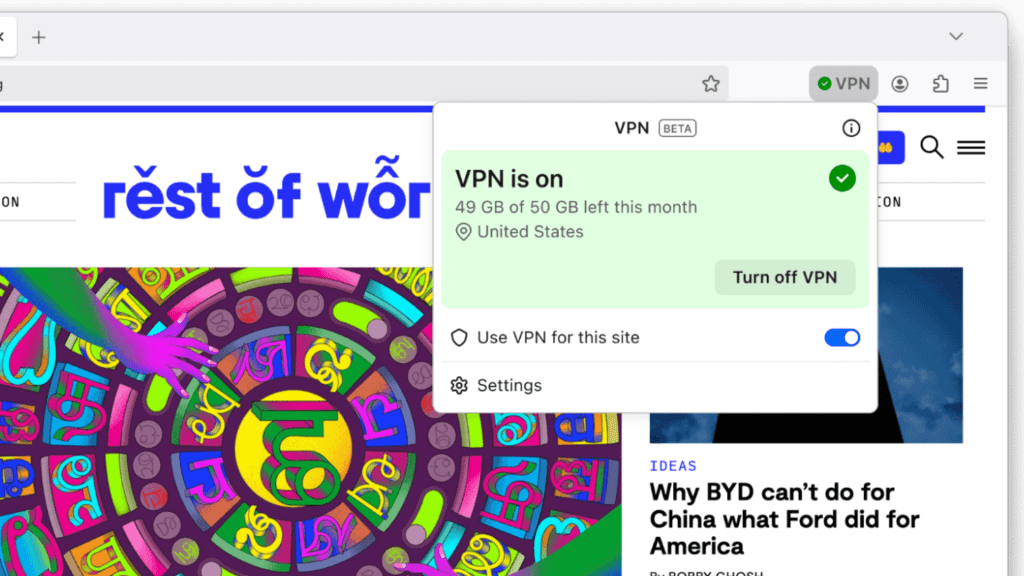
For those who prioritize convenience over robust privacy, Mozilla’s Firefox VPN presents itself as an effortless addition to the browser. However, beneath its surface lies a service that, while functional, is severely constrained in both capacity and capability.
The built-in VPN, now integrated into Firefox for all users across desktop and mobile platforms, routes traffic through Mozilla’s network of servers spread across up to 10 locations—including major hubs like New York, London, and Tokyo. Yet, it imposes a rigid data cap of just 3 GB per month, a figure that pales in comparison to even the most basic free-tier alternatives. This limit resets only after 90 days of inactivity, meaning long-term users are perpetually on the brink of hitting their allowance, regardless of whether they’re casual browsers or power users with higher data needs.
Advanced Users Face Hard Limits
- Data cap of 3 GB/month—reset only after 90 days of inactivity
- No granular server selection beyond a default pool, limiting location control
- Speed throttling on congested servers, though Mozilla claims performance is optimized for general use
The VPN’s simplicity is both its strength and weakness. For casual users, the lack of additional configuration or account requirements means privacy protections are always active without friction. However, this same simplicity excludes advanced features that power users and enthusiasts rely on, such as protocol selection or kill-switch options. The service lacks the depth expected from a tool designed for those who treat VPNs as part of a layered security strategy.
For gamers, the limitations extend beyond data capacity to performance. While Mozilla’s servers are designed to minimize latency, they are not optimized for low-ping scenarios that gaming demands. The 3 GB cap further complicates this, leading to frequent disconnections during extended sessions—a critical flaw for users who need uninterrupted connectivity.
Casual Users Benefit from Basic Protections
Despite its shortcomings, the Firefox VPN does serve a purpose for casual users. It acts as a free-tier alternative to paid services, providing basic encryption that can shield browsing activity on public Wi-Fi networks. However, its usefulness is confined to those with minimal privacy needs.
The 3 GB limit is the most noticeable constraint, but it’s not the only one. The lack of transparency around server jurisdictions and logging policies leaves power users with unanswered questions. Even when compared to other free VPNs, such as ProtonVPN, which offers 10 GB/month without restrictions, Mozilla’s offering feels restrictive and underwhelming.
It’s important to note that the Firefox VPN is not malicious in its design. It simply doesn’t meet the expectations of users who demand more than the bare minimum. For those already leveraging Firefox for its default privacy protections, the built-in VPN might add a thin layer of extra security without impacting their budget. But for anyone requiring reliability, speed, or actual data capacity, this service falls short.
In conclusion, the Firefox VPN is a stopgap measure rather than a comprehensive solution. It may suffice for casual users seeking a free safety net, but power users and enthusiasts will find its constraints too restrictive to justify its use as anything more than an occasional convenience.