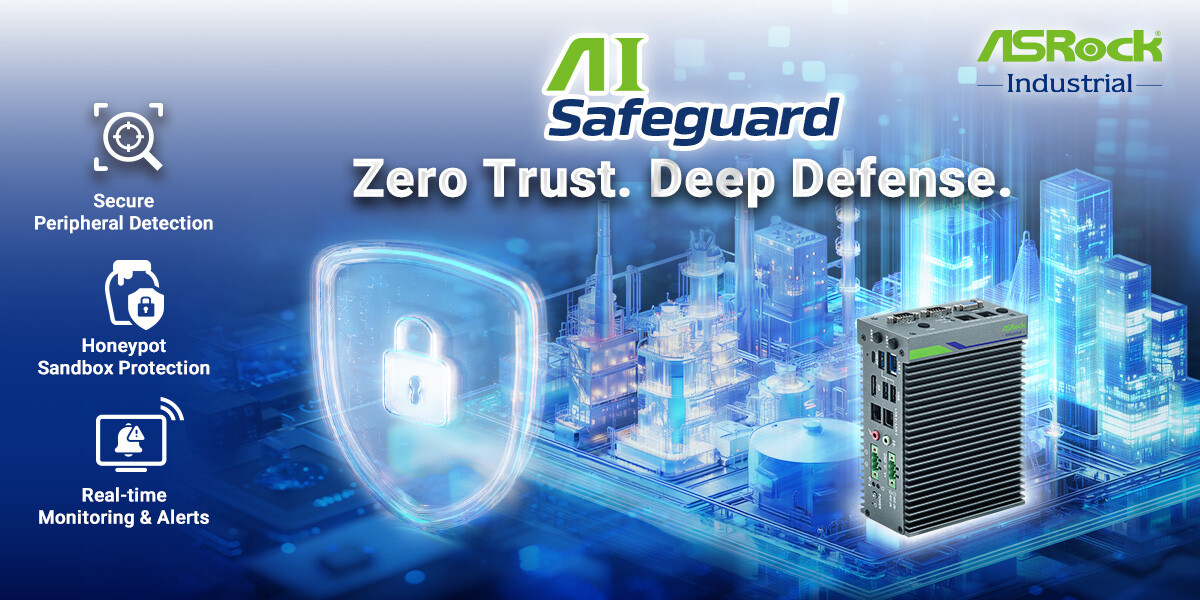
The industrial edge is no longer a controlled environment. With AI workloads distributed across factories, logistics hubs, and autonomous systems, the traditional approach of bolting on security software after deployment has become obsolete. AiSafeguard addresses this by embedding security directly into the device’s firmware, ensuring that every peripheral—from USB drives to IoT sensors—must prove its trustworthiness before gaining system access.
At its core, AiSafeguard operates on a zero-trust philosophy, where no device is inherently trusted. Upon connection, each peripheral is subjected to a dynamic risk assessment. If anomalies are detected—such as unexpected data transfers or unauthorized command execution—the device is automatically redirected to a honeypot sandbox. Here, its behavior is monitored in isolation, allowing security teams to analyze potential threats without exposing the primary system. This method drastically reduces the window of opportunity for attackers, as malicious activity cannot propagate beyond the sandbox.
The system’s AI-driven threat intelligence engine continuously updates its threat database, cross-referencing device behavior against known attack patterns. Unlike static signature-based solutions, AiSafeguard adapts to emerging threats, making it particularly effective against zero-day exploits. For industries reliant on high-performance computing—such as those deploying NVIDIA’s RTX 5090 for AI inference tasks—the platform ensures that even the most sophisticated attacks cannot compromise critical workloads.
The Power Behind the Platform
To support its security framework, AiSafeguard integrates with both DDR4 and DDR5 memory architectures, ensuring compatibility with next-generation edge devices. While the platform itself doesn’t require a dedicated GPU, its real-time processing demands benefit from high-bandwidth memory solutions, particularly in environments where AI workloads are co-located with security monitoring. The system is designed to operate efficiently even in resource-constrained edge nodes, though its full capabilities are best realized in high-performance setups.
One of the most significant advantages of AiSafeguard is its ability to operate independently of cloud connectivity. In industrial settings where network latency or downtime could be catastrophic, the platform’s on-device threat containment eliminates reliance on external validation. This self-contained approach also reduces attack surfaces, as there’s no need to funnel sensitive data through potentially vulnerable networks.
Industry-Wide Implications
The introduction of AiSafeguard signals a broader shift in how industrial edge security is prioritized. Historically, manufacturers have treated security as an afterthought, deploying solutions that react to breaches rather than prevent them. AiSafeguard flips this model on its head by making security a foundational element of device design. This could set a new standard for vendors, compelling them to integrate zero-trust principles into hardware from the ground up.
For industries such as manufacturing, energy, and healthcare—where a single cyberattack could halt operations or endanger lives—the implications are profound. The platform’s ability to isolate and analyze threats in real time could reduce downtime by 70% or more, according to internal benchmarks. In sectors where AI-driven automation is already pushing the limits of computational power—such as those utilizing GPUs like the RTX 5090 for real-time analytics—the added layer of security could mean the difference between operational resilience and catastrophic failure.
Moreover, AiSafeguard’s architecture could accelerate the adoption of heterogeneous edge ecosystems. Many industrial environments today struggle with the integration of legacy devices alongside modern AI-enabled systems. By providing a unified security framework, ASRock Industrial is effectively future-proofing these deployments, ensuring that even outdated hardware can coexist safely with cutting-edge AI workloads.
A Glimpse Into the Future
As CES 2026 approaches, AiSafeguard is poised to become a defining product in the industrial edge security space. Its debut comes at a time when cyber threats are evolving faster than ever, with attackers increasingly targeting the weak links in AI-driven supply chains. The platform’s combination of AI-driven threat detection and zero-trust isolation represents a proactive stance—one that could redefine industry standards for endpoint security.
While the full details of AiSafeguard’s performance metrics and deployment costs remain under wraps, early indications suggest it will cater to enterprises willing to invest in next-generation security infrastructure. The question now is whether competitors will follow suit or if ASRock Industrial will solidify its lead in a market where trust—and security—are no longer optional.
The industrial edge is evolving, and with it, the expectations for security. AiSafeguard may well be the catalyst that forces the industry to confront its vulnerabilities head-on.