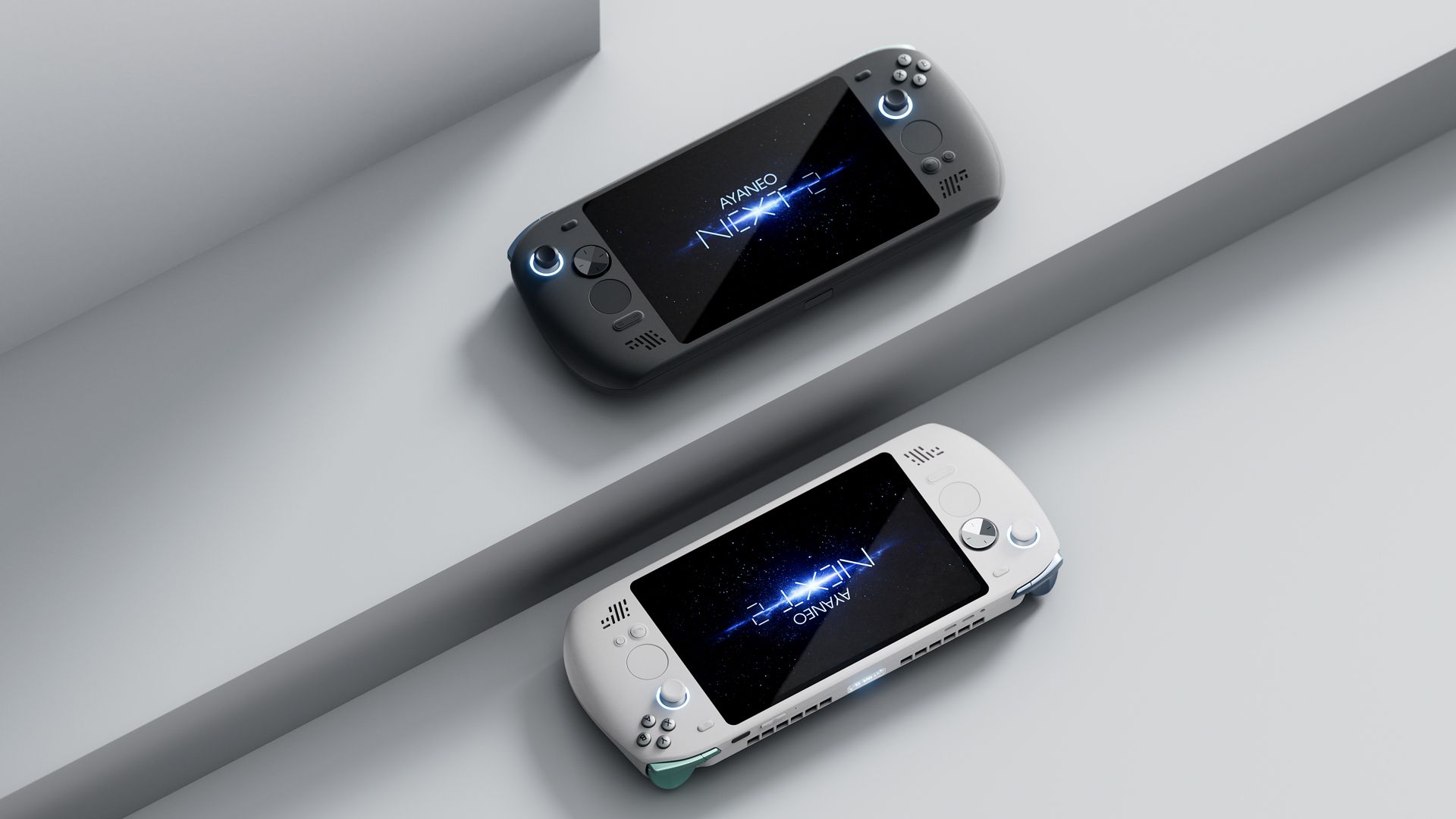
The handheld gaming PC market just got its most powerful battery-included option, but at a cost that rivals high-end desktops. Ayaneo’s Next II, a successor to its well-received Kun model, arrives with a 116 Wh internal battery—a feature no other Ryzen AI Max+ handheld currently offers—and a 9.06-inch 2400×1504 OLED display capable of 60 Hz to 165 Hz refresh rates. Yet its pricing, especially for the lower-tier AI Max 385 model, may leave buyers weighing whether the convenience justifies the expense.
At launch, the Next II isn’t just a gaming device; it’s a statement of engineering ambition. The AI Max+ 395 configuration, paired with 128 GB RAM and 2 TB storage, starts at $3,499 during early access, climbing to $4,299 in standard retail. That’s a premium even high-end desktops rarely demand. But the real talking point is the $1,799 AI Max 385 model—a more accessible entry point that still packs an 8-core, 16-thread CPU with a 5 GHz boost clock and Radeon 8050S graphics, all configurable between 45 W and 120 W TDP. For comparison, the GPD Win 5—the closest competitor—lacks an internal battery and requires an external power pack, while the OneXPlayer OneXFly Apex undercuts Ayaneo’s pricing by $200 but shares the same limitation.
Why the Next II Stands Out
The Next II’s 116 Wh battery is a double-edged sword. On one hand, it eliminates the need for cumbersome external power solutions, making it the only Ryzen AI Max+ handheld truly portable without compromise. On the other, its capacity exceeds TSA limits for carry-on lithium batteries, meaning travelers may need to check it as baggage—a tradeoff few handhelds demand. The dual touchpads, Hall-effect triggers, and TMR joysticks (a nod to its predecessor’s precision controls) further refine its appeal for gamers tired of conventional D-pad limitations.
Specs That Demand Context
- Display: 9.06-inch 2400×1504 OLED, 60–165 Hz, 1155 nits peak brightness
- CPU: Ryzen AI Max 385 (8C/16T, up to 5 GHz), configurable 45–120 W TDP
- GPU: Integrated Radeon 8050S (32 CUs)
- Memory: 32 GB (AI Max 385) / 64 GB (AI Max+ 395) / 128 GB (high-end)
- Storage: 1 TB (base) / 2 TB (high-end) NVMe SSD
- Battery: 116 Wh internal (AI Max+ models)
- Ports: Dual USB-C (Thunderbolt 4), HDMI 2.1, microSD
- Pricing: $1,799 (early) / $1,999 (retail) for AI Max 385; $3,499 (early) / $4,299 (retail) for AI Max+ 395
Those specs translate to raw performance, but not without caveats. The AI Max 385 is a capable chip for handheld gaming—capable of handling Cyberpunk 2077 on Low settings or Elden Ring at Medium—but its integrated graphics mean demanding titles will still require concessions. The 1 TB storage is generous for most users, though upgrading to 2 TB adds nearly $700. Meanwhile, the $300 premium over the OneXFly Apex for the AI Max 385 model hinges on battery convenience, a feature that may not matter to stationary or docked users.
A Market of Tradeoffs
The Next II isn’t just competing with other handhelds; it’s competing with high-end laptops. A $1,999 Ryzen AI Max+ handheld with a 165 Hz OLED and 120 W TDP could theoretically outperform many $2,500 gaming laptops in raw specs, but the lack of a full discrete GPU limits its appeal beyond integrated graphics. For developers or power users, the dual USB-C ports (with Thunderbolt 4 support) offer flexibility, but the absence of an HDMI-out alternative (beyond HDMI 2.1) may frustrate some.
Ayaneo’s design choices reflect a focus on gaming purity—no compromises on controls, display quality, or thermal efficiency. Yet the $1,999 price tag for the base model raises questions: Is the internal battery worth $300 more than the OneXFly Apex? Will the AI Max 385’s integrated GPU hold up in 2025, or will Intel’s upcoming Panther Lake handhelds (rumored to arrive later this year) redefine the category? For now, the Next II carves a niche as the only Ryzen AI Max+ handheld with true portability, but whether that justifies its cost remains a gamble.
Availability begins with early access pricing, with general retail following soon. For those willing to pay the premium, it’s the most powerful handheld on the market—just don’t expect it to come cheap.