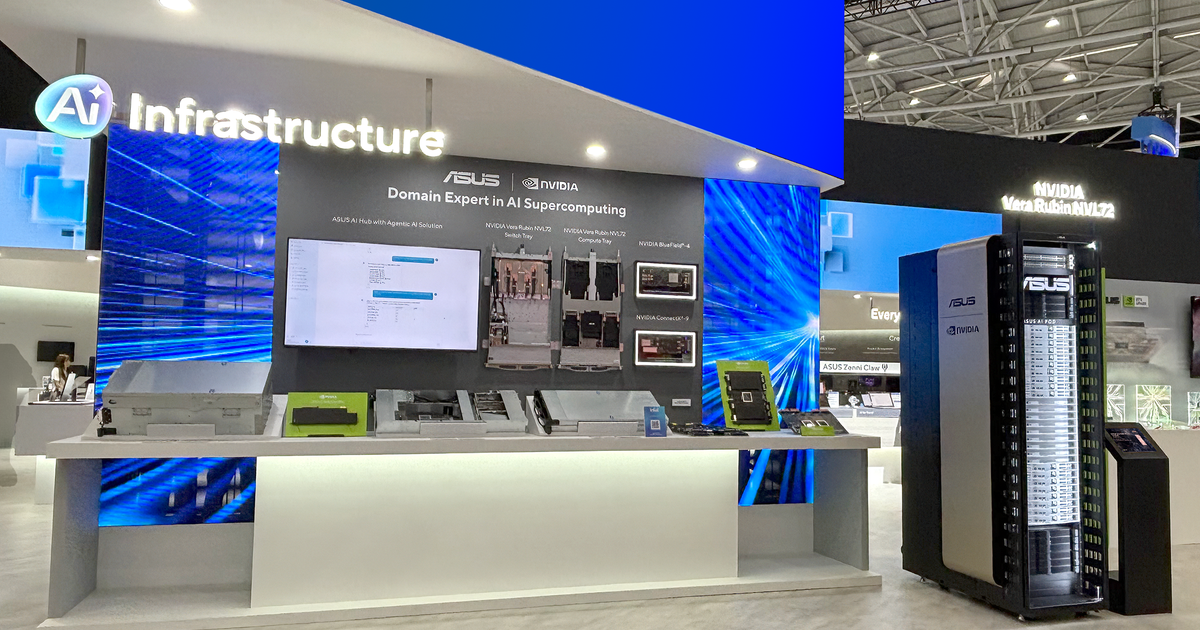
The presentation centered around a system codenamed ‘GB300 NVL72,’ representing a strategic move by ASUS to cater to the escalating demands of organizations requiring substantial computational power for complex AI simulations and data analysis. The core of the demonstration highlighted NVIDIA’s advancements in GPU architecture, promising significant performance improvements for parallel processing tasks – a critical element within modern AI development.
Scalable Supercomputing Solutions
ASUS positioned the GB300 NVL72 as more than just a single server; it presented an end-to-end solution geared toward rack-scale AI deployments. This approach emphasizes modularity and scalability, allowing organizations to incrementally increase compute resources as their needs evolve. The system architecture is designed with future expansion in mind, facilitating seamless integration within larger supercomputing ecosystems.
The demonstration underscored the importance of interconnectivity within these large-scale systems. Efficient data transfer between processing units is paramount for maximizing performance. While specific details regarding the network infrastructure utilized remain undisclosed, ASUS’s focus on holistic system design suggests a carefully considered approach to minimize bottlenecks and optimize workflow.
Performance Targets & NVIDIA's Blackwell Architecture
The showcased platform is engineered to deliver substantial computational throughput. Initial estimates point toward capabilities approaching 10 petaflops, indicating a considerable leap in processing power compared to previous generation systems. This level of performance opens doors for tackling increasingly complex scientific simulations and accelerating AI model training, particularly within areas such as drug discovery, climate modeling, and materials science.
A key element of the demonstration was the integration with NVIDIA’s latest GPU architecture – a move designed to capitalize on ongoing advancements in GPU technology. This partnership leverages NVIDIA’s expertise in high-performance GPUs alongside ASUS’s experience in designing robust and reliable server solutions. The synergy between these two technological leaders aims to provide users with cutting-edge performance and stability.
Liquid Cooling for Enhanced Thermal Management
Recognizing the heat generated by high-performance computing, ASUS incorporated a sophisticated liquid cooling system into the GB300 NVL72. This advanced thermal management solution is crucial for maintaining optimal operating temperatures and preventing performance throttling – a common issue in demanding compute environments. The utilization of liquid cooling demonstrates a commitment to delivering sustained peak performance even under heavy workloads.
The effectiveness of the liquid cooling system contributes directly to the platform's stability and reliability, essential qualities for long-running simulations and continuous AI training tasks. ASUS’s implementation suggests a thorough understanding of thermal engineering principles within the context of high-performance computing.

- Modular Design: Facilitates scalability and adaptability to evolving workloads.
- Advanced Cooling: Ensures sustained peak performance through efficient heat dissipation.
- Rack-Scale Architecture: Enables seamless integration into larger supercomputing environments.
Beyond the Hardware: Software and Ecosystem
ASUS’s presentation wasn't solely focused on the hardware components of the GB300 NVL72. The company emphasized the importance of a comprehensive ecosystem supporting the platform, including optimized software drivers, libraries, and tools. This holistic approach aims to simplify deployment and management for users, reducing operational complexity and accelerating time-to-value.
The system’s architecture is designed to be compatible with popular AI frameworks and development environments, allowing researchers and engineers to leverage their existing expertise without significant retraining. ASUS recognizes that a powerful platform is only as effective as the software ecosystem surrounding it.
Future Implications & Market Positioning
The GB300 NVL72 represents a strategic move by ASUS to establish itself within the rapidly growing market for high-performance computing infrastructure. The platform’s scalability, coupled with NVIDIA's GPU technology, positions it as a viable solution for organizations engaged in demanding AI workloads and scientific research.
The demonstration at SC25 highlights the increasing need for powerful compute solutions to drive advancements in areas such as artificial intelligence, data analytics, and scientific simulation. ASUS’s approach – combining hardware innovation with a focus on ecosystem support – aligns with this trend and demonstrates a commitment to providing cutting-edge technology to meet these evolving demands.
The system's capabilities are expected to appeal to a broad range of users, including research institutions, government agencies, and private sector companies involved in advanced computing applications. Further developments surrounding the GB300 NVL72 will likely involve ongoing optimization and integration with emerging technologies, solidifying ASUS’s position as a key player in the future of high-performance computing.
The unveiling of the GB300 NVL72 at SC25 underscores the ongoing innovation within the high-performance computing landscape. As AI continues to transform industries, the demand for powerful and scalable compute solutions will only intensify. ASUS’s demonstration provides a glimpse into the future of supercomputing – a future characterized by modularity, advanced cooling technologies, and seamless integration with leading GPU architectures.