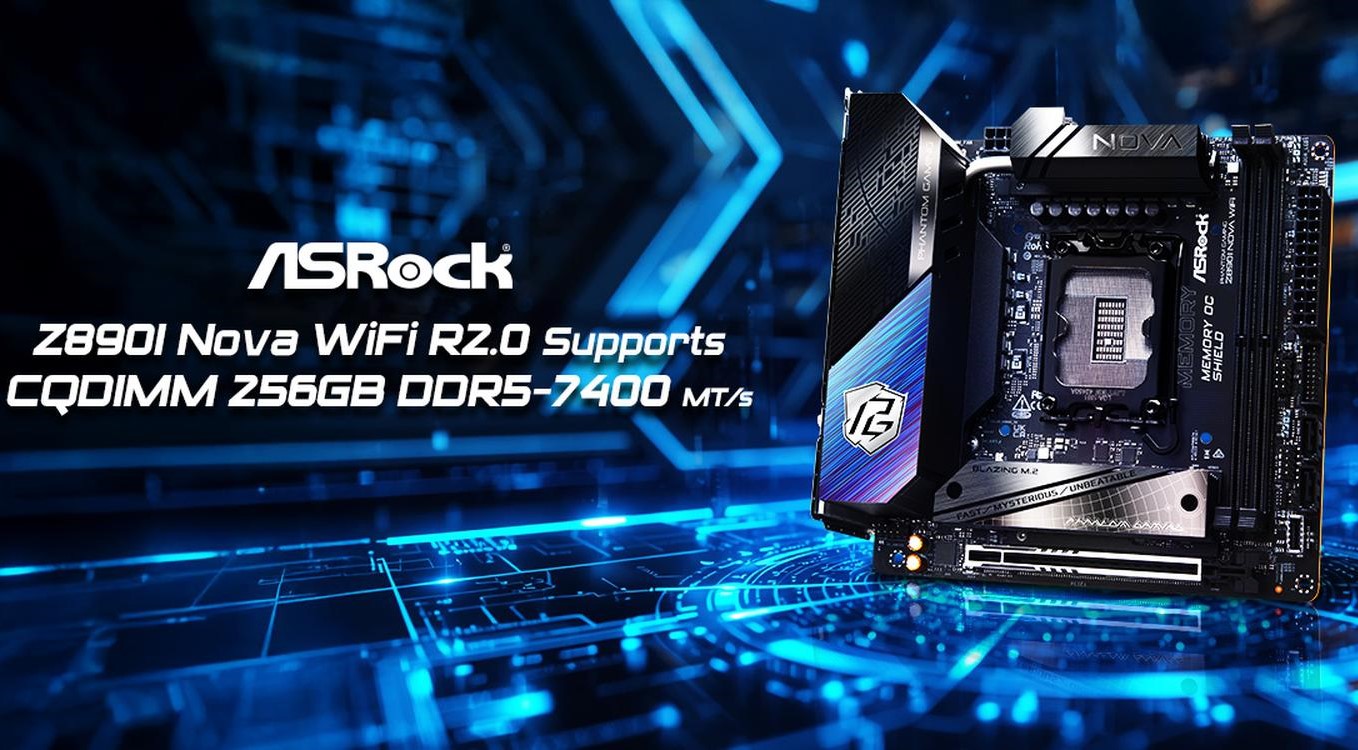
High-performance computing for small businesses has long been constrained by a fundamental trade-off: more RAM capacity often means sacrificing speed. That dynamic shifted dramatically with ASRock's demonstration of a 256 GB DDR5 CQDIMM kit running at 7400 MT/s on its Z890I Nova WiFi R2.0 motherboard, pushing the boundaries of what was considered achievable with high-density memory modules.
Breaking the Speed-Capacity Barrier
The achievement centers on CQDIMM technology, which embeds a clock driver directly into the module itself. This innovation significantly reduces signal interference and jitter that typically plague large-capacity DDR5 kits as they approach higher frequencies. Most users can reliably run 32 GB or 64 GB modules at around 7000 MT/s, but 256 GB configurations have historically maxed out near 6400 MT/s due to thermal and signal integrity challenges.
Technical Breakthroughs
- Memory configuration: 256 GB DDR5-7400 CQDIMM (comprising two Kingston 128 GB 4-rank modules)
- CPU compatibility: AMD Ryzen 5 7500F and higher series processors
- Motherboard platform: Z890I Nova WiFi R2.0 with optimized circuit pathways
The revised Z890I Nova WiFi R2.0 motherboard plays a crucial role in this performance leap. ASRock's engineering team implemented targeted optimizations to the board's power delivery and signal routing, enabling stable operation at 7400 MT/s without requiring overclocking adjustments. This level of optimization is particularly valuable for business workloads that demand both capacity and speed—such as video rendering, virtualization environments, or large-scale data processing.
Practical Considerations
While this demonstration represents a significant advancement, practical adoption remains limited to systems with compatible hardware. The Z890I Nova WiFi R2.0's small form factor and ASRock's firmware tuning were essential components in achieving this result. For businesses operating on tighter budgets or with less demanding workloads, the immediate benefits may be more theoretical than practical.
Looking ahead, this achievement suggests that the performance gap between high-capacity DDR5 modules and their lower-density counterparts is narrowing rapidly. As CQDIMM technology becomes more widespread across motherboard manufacturers, the ability to combine massive RAM capacity with high clock speeds could become standard rather than exceptional. For now, however, those seeking both 256 GB of memory and 7400 MT/s speeds will need to invest in carefully selected hardware configurations that meet these demanding specifications.
The demonstration serves as a clear indicator that the next generation of business-class workstations may no longer have to choose between capacity and speed. When combined with compatible processors like the Ryzen 5 7500F, this level of performance opens new possibilities for workflows that previously required compromises in either department.