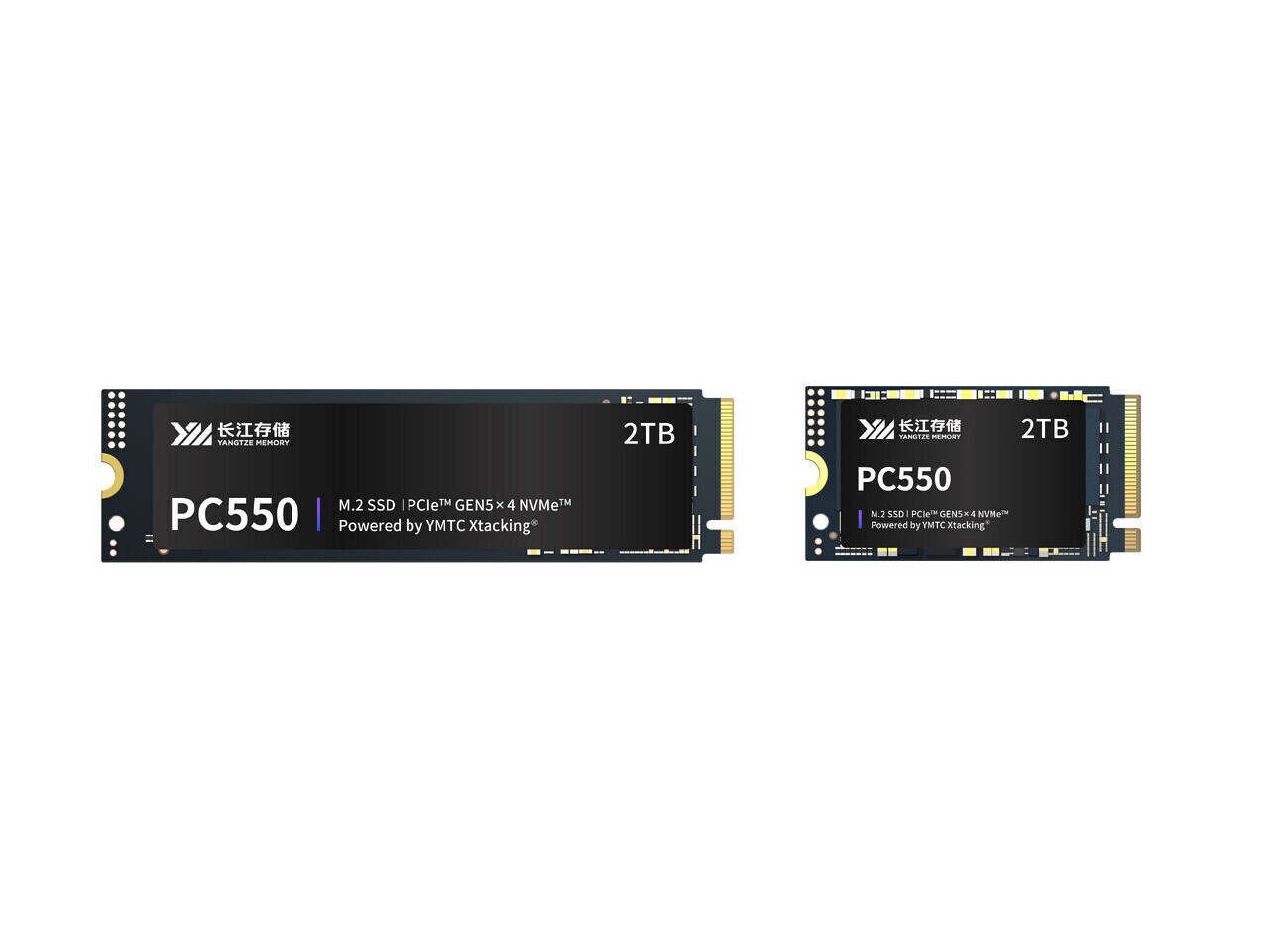
In a market where storage speed often comes at the cost of power consumption and price, Yangtze Memory Technologies Corp (YMTC) has entered the fray with its first PCIe 5.0 M.2 NVMe SSD for client devices: the PC550.
The drive balances performance with efficiency, offering sequential read speeds up to 10,500 MB/s and write speeds of 10,000 MB/s—figures that position it above most PCIe Gen 4 drives but below some PCIe 5.0 competitors. This tradeoff may appeal to OEMs seeking a cost-effective yet capable storage solution for notebooks and desktops.
A four-channel design with a focus on efficiency
YMTC’s PC550 stands out with its four-channel architecture, which the company claims reduces power consumption and thermal output compared to more common eight-channel designs. This could be particularly advantageous for thin-and-light notebooks where heat management is critical.
The drive is built around YMTC’s X4-9070 3D NAND, leveraging its Xtacking 4.0 technology, and comes in three capacity variants: 512 GB, 1 TB, and 2 TB. While pricing details remain undisclosed, the focus appears to be on balancing performance with power efficiency—idle consumption is under 3 milliwatts, and active consumption stays below 6 watts.
Performance that prioritizes real-world usability
Random IOPS scale with capacity, with the 512 GB model delivering up to 880,000 random read IOPS and 1,100,000 random write IOPS. Larger capacities (1 TB and 2 TB) push these figures closer to 1,300,000 IOPS for both operations, though endurance ratings vary: 300 TBW for the 512 GB model, 600 TBW for 1 TB, and 1,200 TBW for 2 TB.
These specs suggest a drive optimized more for sustained workloads than raw speed, making it suitable for enterprise storage needs where longevity and power efficiency matter as much as performance. However, it may not yet compete with the highest-end PCIe 5.0 drives that push beyond 15,000 MB/s in sequential operations.
As OEM demand for affordable, high-performance storage grows—especially amid ongoing supply constraints—the PC550 could carve out a niche for itself, particularly if YMTC can prove its reliability and consistency at scale. For now, it remains to be seen whether this drive will become a staple in next-generation systems or if more aggressive performance will continue to set the benchmark.