For those who equate business laptops with the uninspired, the Acer TravelMate X4 14 AI might seem like another forgettable metal-and-plastic slab. Yet beneath its conservative exterior lies a machine that punches well above its weight—especially when priced right. At a time when premium brands command steep premiums, Acer’s offering emerges as a compelling alternative for professionals who need reliability without the frills.
The TravelMate X4 14 AI isn’t the first laptop to blend modest specs with practicality, but it does so with a few standout trade-offs. Its Intel Core Ultra 5 226V processor—an eight-core chip with a 4.5 GHz turbo boost—pairs with 16GB of LPDDR5x RAM and a 512GB PCIe 4.0 SSD, a configuration that keeps costs down while still handling daily workloads with ease. Where it excels is in connectivity: two Thunderbolt 4/USB-C ports, a Gigabit Ethernet jack (a rarity in this category), and support for Wi-Fi 7 and Bluetooth 5.4 ensure it stays relevant in a world where adaptability matters.
Design, however, remains its Achilles’ heel. The laptop’s 0.64-inch-thick chassis, while sturdy, leans on familiar silver and gunmetal finishes that blend seamlessly into any office. There’s no bold color scheme or premium magnesium alloy here—just a functional, slightly utilitarian aesthetic that feels more like a corporate standard than a statement piece. The 14-inch 120Hz IPS display (1920×1200) is crisp enough for productivity but lacks the brightness or HDR of more premium models, making it less ideal for media consumption. Audio, too, falls short, with downward-firing speakers that struggle to fill a room without distortion.
Yet it’s in performance where the TravelMate X4 14 AI reveals its true value. Benchmarks show it holding its own against competitors with more expensive chips. In PCMark 10, it scores 6,962, a result that places it ahead of many Core Ultra 7-powered laptops in real-world productivity tasks. Even in Cinebench 2024, a test where multi-threaded performance typically exposes weaknesses, it delivers competitive numbers—thanks in part to Intel’s AI Boost (40 TOPS NPU) and efficient power management. The 100W TDP processor avoids the throttling common in thinner, lighter designs, ensuring sustained performance during demanding workloads.
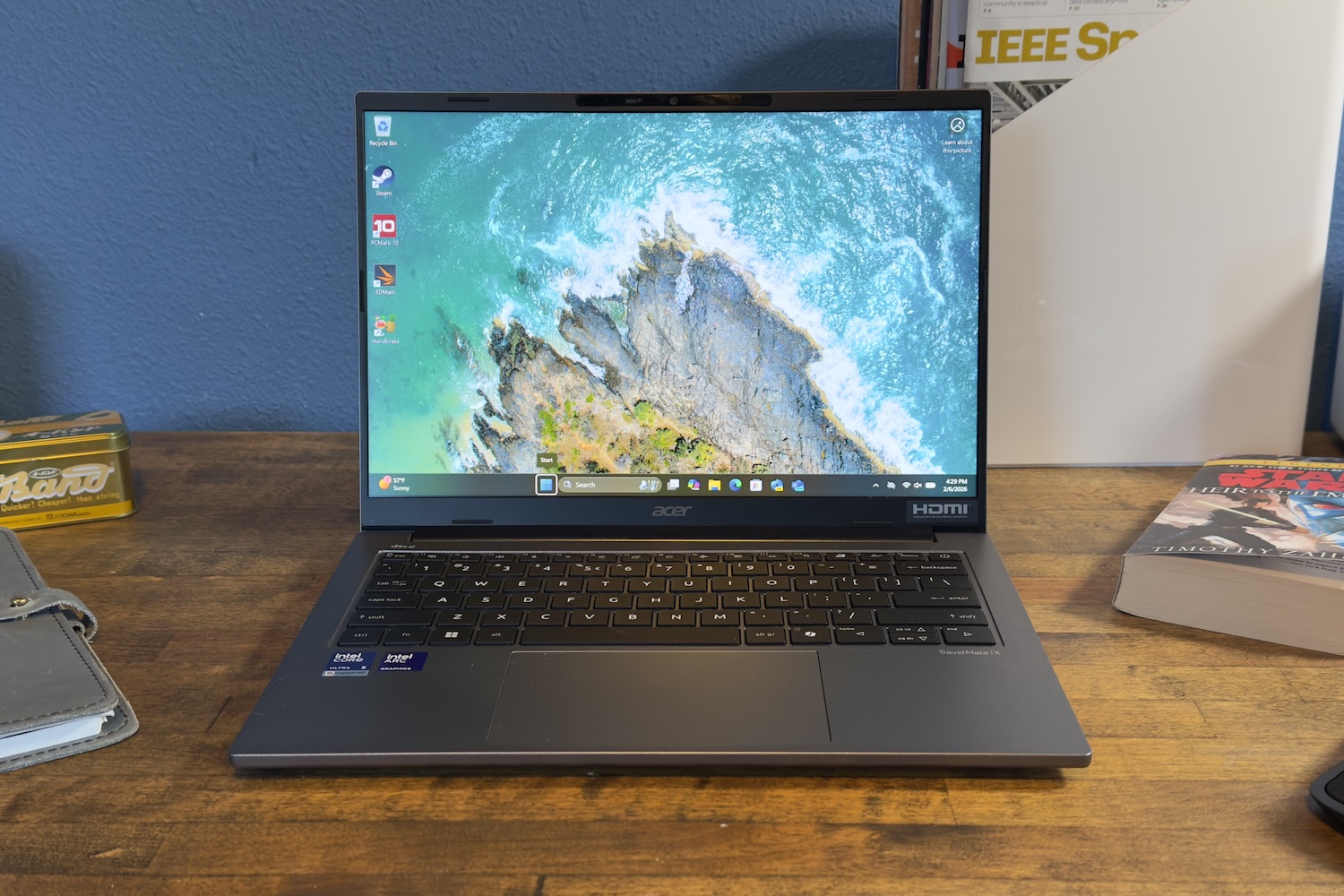
Battery life is another bright spot. A 65Wh cell, while not the largest in its class, lasts an impressive 20+ hours in standardized tests, translating to 14–18 hours of real-world use at moderate brightness. This endurance, combined with its 2.75-pound weight and 12.28×8.89×0.64-inch footprint, makes it one of the more portable options in the $700–$850 range—particularly when compared to bulkier ultrabooks or the $1,199.99 MSRP rivals.
The keyboard, a standout feature, is spacious and responsive, with 1.5mm key travel and a satisfying clicky feedback that rivals premium models. The 5-inch touchpad, however, feels plasticky and lacks the precision of competitors like the Lenovo ThinkPad. Missing, too, is a fingerprint reader, leaving Windows Hello facial recognition as the sole biometric option.
For professionals who prioritize value, the TravelMate X4 14 AI is a no-brainer when priced below $800. At its $1,199.99 MSRP, it’s a different story—overpriced for its capabilities. The 512GB SSD is the most glaring omission; many rivals offer 1TB for similar prices. Still, its Thunderbolt 4 versatility, Wi-Fi 7 future-proofing, and 120Hz display make it a versatile tool for developers, office workers, or anyone who needs a reliable second machine.
At CES 2026, where innovation often takes center stage, the TravelMate X4 14 AI won’t steal the show. But for those who need a laptop that does the job without the gimmicks, it’s a pragmatic choice—one that proves sometimes, substance matters more than style.