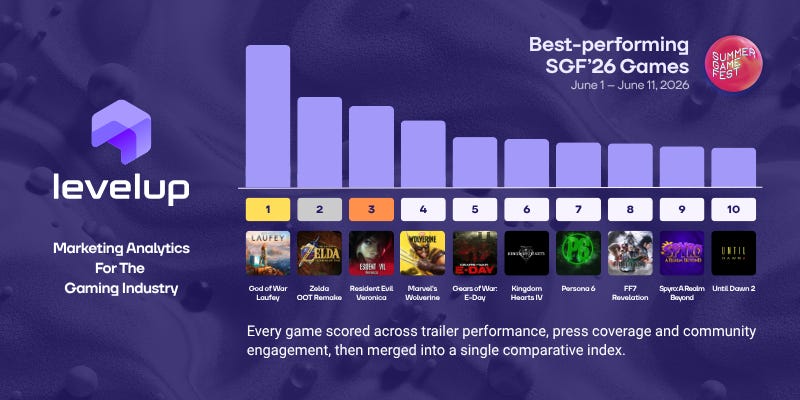
The Summer Game Fest 2026 marked a turning point in how game developers balance narrative ambition with technological execution. Unlike previous years that leaned heavily on spectacle, this iteration emphasized depth—both in storytelling and technical innovation. Games like 'God of War: Laufey,' the 'Ocarina of Time' remake, and 'Resident Evil: Veronica' stood out not just for their visuals but for how they redefined player engagement.
One of the most notable trends was the focus on narrative-driven experiences. 'God of War: Laufey,' set in Norse mythology, expanded its universe with intricate world-building and character development. Meanwhile, the 'Ocarina of Time' remake, a long-awaited return to a beloved classic, showcased how modern technology could enhance legacy titles without losing their essence. This dual approach—innovating within established franchises while pushing boundaries in new ones—set this year's showcase apart.
Technologically, the games demonstrated significant advancements. The 'Ocarina of Time' remake, for instance, utilized a next-gen rendering engine capable of delivering 4K resolution at 60 frames per second with ray tracing. This was a stark contrast to its original release in 1998, proving that remakes could not only preserve the spirit of the past but also leverage modern hardware to create something entirely new. Similarly, 'Resident Evil: Veronica' introduced dynamic lighting and physics-based destruction, pushing the envelope for survival horror games.
For players, this meant a more immersive experience with fewer compromises between visual fidelity and performance. However, the increased demands on hardware raised questions about accessibility. While high-end systems like the PlayStation 5 Pro and Xbox Series X could handle these advancements seamlessly, mid-range users might face limitations in resolution or frame rates.
A closer look at the technical specs reveals both progress and challenges. The 'Ocarina of Time' remake, for example, boasted a 12GB GDDR6 RAM configuration to support its advanced textures and lighting models. This was a significant leap from its predecessor, which operated on a modest 4MB cartridge. Yet, such requirements could alienate players who are not upgrading their hardware.
Despite these concerns, the games' reception suggested that the shift toward narrative depth and technical innovation resonated with audiences. 'God of War: Laufey,' in particular, drew praise for its cinematic storytelling and open-world design, setting a new benchmark for action-adventure titles. The 'Ocarina of Time' remake also generated excitement, proving that remakes could be just as impactful as original releases.
The Summer Game Fest 2026 thus served as a microcosm of the broader trends in gaming: a move toward more mature narratives and higher technical standards. Whether this trend will continue to gain traction or face backlash from players remains to be seen, but one thing is clear—it has redefined what audiences expect from their games.