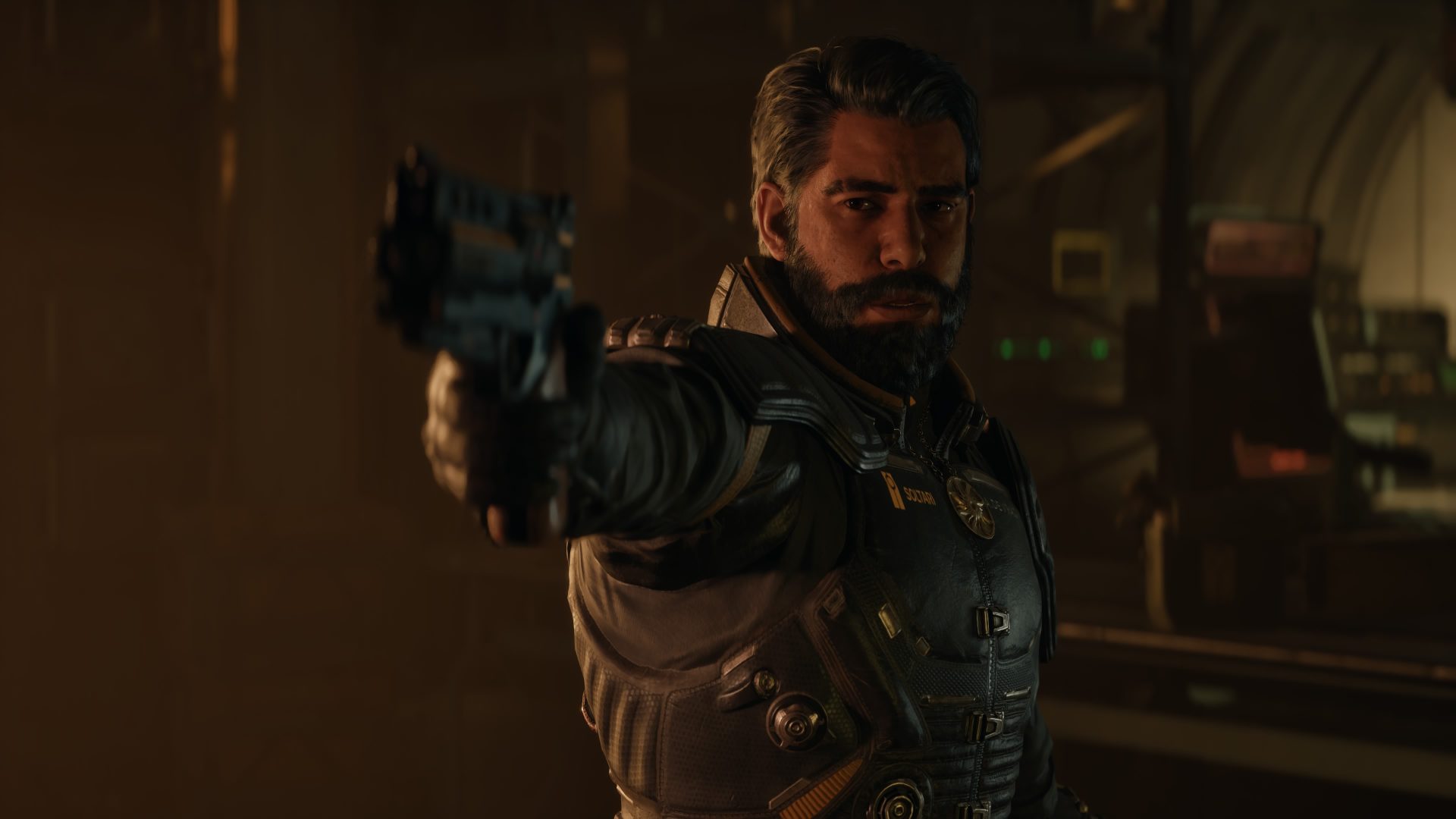
8.5 Saros Review – If Death is Welcome, Let Him Seek it There. Kai Tatsumoto • at EDT Game Info SarosApril 30th, 2026 PlatformPlayStation 5 PublisherSony Interactive Entertainment DeveloperHousemarque Arjun, for all of the scattered bits and pieces of his backstory that Housemarque dripfeeds to the player, is a pretty awful protagonist when you take a step back from the sci-fi mythology and look over his shoulder at the way he interacts with his colleagues and chases after his missing partner. Arjun is a flawed man with anger issues towards his father which manifests in the brief backstory vignettes players stitch together in the course of death and rebirth. The entire time I spent on Carcosa in his standard issue space boots was watching a man who refuses to take no for an answer slowly succumb to the madness seeping through Carcosa. Carcosa has a strange effect on people with most succumbing to the madness early on, others surviving through countless cycles. Arjun Devraj is very much the latter, having gone on expedition after expedition by the time players step into his space boots and it’s only after the latest exploratory trip to Carcosa that Saros begins. What started as a full expedition to track down the findings of the first three Echelon ground crews has dwindled down to a skeleton crew of less than a half dozen and surely can’t survive much longer if members of the survey corps either commit suicide or worse. Related Story GDDR6 Memory Demand Surge Could Be Bad News For Sony’s PlayStation 5 & Gaming GPUs Saros is indeed a roguelike at its very core, just as Selene’s tribulations in Returnal, but with a number of improvements intended to streamline the experience. Most obvious is the structure to levels this time around. In Returnal, players had to make their way through each and every biome in order each time they wanted to make progress towards the final chapter. Housemarque has taken the feedback to heart that hours long runs might not be the best approach for a bullet hell shooter. Each biome to Saros takes an average of twenty-to-thirty minutes to complete from beginning to end, but that assumes the player doesn’t die along the way. As players learn the intricacies of Carcosa, expect to see that game over splash screen and return back to Echelon IV’s homebase. But just because Arjun died along the way doesn’t mean he isn’t progressing the story forward. Each loop often leads to a new audio log or conversation with the expedition crew to gain a little more insight on the crew’s state of mind and the transcendant radiance of the sun. Progression across Carcosa comes by way of unlocking new biomes and incremental upgrades for Arjun’s arsenal. Whenever the overlord of a biome is defeated and a portal back to base is unlocked, Arjun can use that portal as a launching off point for his next bite-sized run. If you’re confident in your loadout and still have health to spare, there’s no reason not to press your luck and venture into the next biom to try and clear it on the first try. While the biomes are randomly generated with a variety of hand-crafted levels, much like Returnal, the locked doors and collectibles are typically in the same location every time. Housemarque eased up on the requirement to collect every audio log this time around for the platinum, instead giving players trophy objectives to get enough kills with every weapon or using them in creative ways in combat. I’m still lacking the trophy for five consecutive shotgun blasts with every pellet finding their target as one of the last roadblocks to the elusive platinum trophy. The currency Arjun picks up to increase his proficiency level in a given run can then be spent back at base on a simple and straightforward skill chart, rewarding the player with permanent unlockable rewards such as increased base stats, or giving augments to his tool set including dealing more stun damage with his melee hit or having a key in hand at the start of each run. Saros’ gunplay is what sets it apart from other roguelike action games, and it’s a natural evolution of the first draft in Returnal. Any weapon Arjun picks up performs differently from one another while having the same basic framework of shooting an enemy until your clip runs dry and requires a reload. Timing an active reload by pressing the shoot button when the bar is illuminated in the right spot rewards the player with a faster clip refill and sometimes a buff, depending on the random skills on the weapon. If you’re not one to have to juggle reload mechanics in the middle of combat, I absolutely recommend the Chakram for your weapon of choice, although it’s also the last weapon type to be unlocked. These function similarly to the Dreadbound from Returnal, launching out a small number of discs which automatically return after a set amount of time, or when the player uses the alt-fire function to recall them immediately. There’s a variant called the Ripsaw Chakram, which launches out a single disc that embeds itself in the target to do constant damage over time, but even in single-boss encounters, I preferred the standard variant, especially because of having multiple enemies surround Arjun and only having the ammunition for shooting one at a time. Mobility is another core part of the flow of combat in Saros that makes it feel like a joy to play. Arjun is very nimble on his feet, freely able to dash, jump, and evade all without dropping a shot. There’s also a handy block which can be used to absorb blue shots and convert them into the energy used for his drive/subweapons; on the other hand, holding the shield button down for too long, and it will start to consume the energy faster than it can be regenerated. The shield button also has a secondary feature of being the melee attack. While players might want to stay at range, sometimes enemies will come shielded, and the only way to clear those shields is to give them a quick right hook. While players may feel overwhelmed with the ballet of bullets coming their way when they first venture out into Carcosa, there’s a science to handling the various blue, yellow, and red bullets. Blue bullets are the ones that can be absorbed by your shield, yellow ones don’t cause direct damage to Arjun but instead sap away at his maximum health and are a permanent debuff unless a certain skill has been unlocked in the tool tree, and red bullets are the most dangerous and cannot be mitigated without using a modifier prior to the onset of a run to be able to dash through these bullets. The last one is the most unique, as with one permanent upgrade that’s unlocked towards the tail end of Saros, which can be deflected with a well-timed melee attack and counter right back at the enemy for massive damage. Saros is nothing short of a spectacle of particle effects and fluid gameplay if you’re invested in having a PlayStation 5 Pro. The experience runs smoothly at a solid 60FPS with the upgraded PlayStation Super Spectral Resolution that released back in March, doing some heavy lifting in the background and maintaining that smooth framerate; cutscenes do look a little bit jarring by comparison since Housemarque dials the performance back to 30FPS in exchange for rendering higher quality character models. The DualSense is also put to good use here with the adaptive triggers offering varying resistance to pulling the trigger for shots as well as half-pulls to activate the alt-fire modes on Arjun’s arsenal. If nothing else, I came away from my ten-to-twelve hours in Carcosa feeling like Saros was more of a revisit to the Returnal framework with the rough edges sanded down. While the moment to moment action is fantastic and I am grateful for Housemarque turning runs into more manageable gameplay sessions, my time in Carcosa felt like a familiar retreading of Returnal. If all you’re craving is Returnal 2 and the narrative is of little consequence, Saros is the perfect weekend blockb...