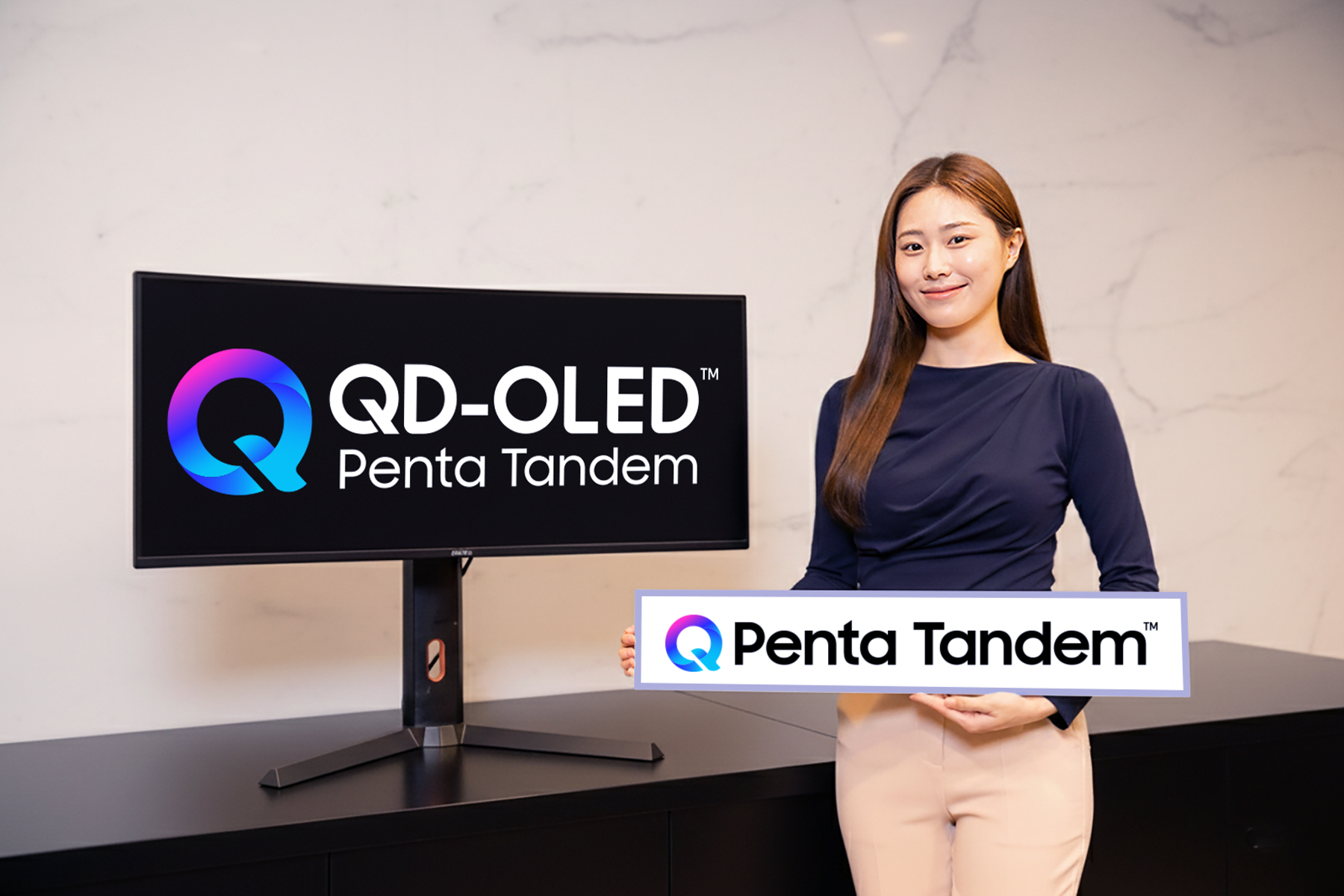
Samsung Display is redefining what’s possible in self-emissive displays with its newly branded QD-OLED Penta-Tandem technology, a five-layer organic light-emitting architecture that promises to set new benchmarks for brightness, color fidelity, and pixel density. The term Penta-Tandem—derived from the Greek penta (five)—highlights the core innovation: an additional layer of organic materials stacked onto the blue-emitting quantum dot layer, which acts as the primary light source in QD-OLED panels.
The upgrade isn’t just incremental. By increasing the number of organic layers from four to five, Samsung Display has improved luminous efficiency by 30% while doubling the lifespan of the materials. This translates to 4,500 nits peak brightness for TVs and 1,300 nits for monitors (measured at 3% OPR), a significant jump from previous generations. For context, that’s enough brightness to rival the best mini-LED panels while maintaining the deep blacks and instantaneous response times of OLED.
The technology also enables VESA DisplayHDR TrueBlack 500 certification—a rare achievement for self-emissive displays. To earn this badge, a panel must achieve a 0.0005 nits black level (near absolute darkness) while hitting 500 nits peak brightness at 10% OPR. Currently, only Samsung Display’s 31.5-inch UHD QD-OLED Penta-Tandem monitor holds this distinction, positioning it as a contender for high-end gaming and professional workflows.
A Five-Layer Advantage
At its core, Penta-Tandem addresses a fundamental challenge in high-resolution self-emissive displays: pixel density vs. brightness. As resolution climbs—such as in Samsung’s 27-inch UHD (3840×2160) panel at 160 PPI—each pixel’s light-emitting area shrinks, making it harder to maintain high brightness without compromising efficiency. The five-layer stack disperses energy more effectively, allowing panels to either burn brighter at the same power or consume less power for the same output. This is particularly critical for monitors pushing 240Hz or 360Hz refresh rates, where power efficiency directly impacts heat and battery life in portable setups.
The technology isn’t limited to one size. Samsung Display plans to roll out Penta-Tandem across its entire panel lineup this year, including
- Monitors: 27-inch UHD (already in production), 31.5-inch UHD, 34-inch WQHD, and a new 49-inch Dual QHD (5120×1440) model.
- TVs: Flagship self-emissive TVs from major OEM partners, continuing the trend set in 2025.
This expansion could accelerate adoption in 8K TVs, where QD-OLED’s color volume and contrast already outperform LCD alternatives. While 8K QD-OLED panels aren’t yet mass-produced, the efficiency gains from Penta-Tandem could make them more viable for mainstream adoption.
Who Benefits?
For gamers, Penta-Tandem’s combination of high brightness, low input lag, and 360Hz+ support makes it ideal for competitive esports monitors. The DisplayHDR TrueBlack 500 certification ensures deep blacks for immersive visuals, while the improved lifespan means fewer burn-in concerns over time. Professionals in video editing and design will appreciate the 100% DCI-P3 and Rec. 2020 coverage, along with the panel’s ability to handle HDR-10+ content without backlight bleed.
However, the technology comes with tradeoffs. QD-OLED panels remain expensive—likely targeting the $1,000+ range for high-end monitors—and their limited viewing angles (though better than traditional OLED) may deter some users. That said, Samsung Display’s move to standardize Penta-Tandem across its lineup suggests it’s betting on long-term scalability, potentially driving down costs as production ramps up.
With competitors like LG’s WOLED and Sony’s Crystal LED pushing boundaries in their own ways, Samsung’s five-layer stack reinforces its position as the leader in premium self-emissive displays. The question now isn’t whether Penta-Tandem can deliver—it’s how quickly the rest of the industry will follow.