Edge computing continues to face significant challenges in balancing memory capacity with thermal efficiency, particularly for AI applications. Longsys is addressing these constraints with two new memory technologies unveiled at Computex 2026, offering a path forward without demanding extensive hardware redesigns.
The AIDIMM module stands out by providing up to 128 GB of capacity through a single unit featuring a 256-bit bus. It achieves bandwidth of 307 GB/s, which eliminates the need for multiple memory sticks while also reducing thermal output and physical space requirements in AI edge devices. The module supports dynamic voltage scaling from 0.9 V to 1.05 V, enabling optimized power consumption suitable for mass deployment.
Complementing this is the AILPBGA chip, which delivers capacities ranging from 24 GB to 64 GB with similar bandwidth performance. Packaged in a compact 22×22 mm form factor, it maintains native LPDDR compatibility while outperforming traditional LPDDR5x solutions by multiple times without altering SoC designs. This streamlines development cycles for edge AI systems.
Both modules integrate a hardware-software storage framework that includes the Storage Processing Unit (SPU) and Intelligence Storage Agent (iSA). Together, these components implement HLCache, a technique that reduces DRAM usage by up to 30% while lowering overall hardware costs. The iSA’s scheduling engine employs expert offloading, intelligent cache management, and predictive prefetching—key for handling Mixture-of-Experts (MoE) large language models—and improves inference smoothness in edge devices.
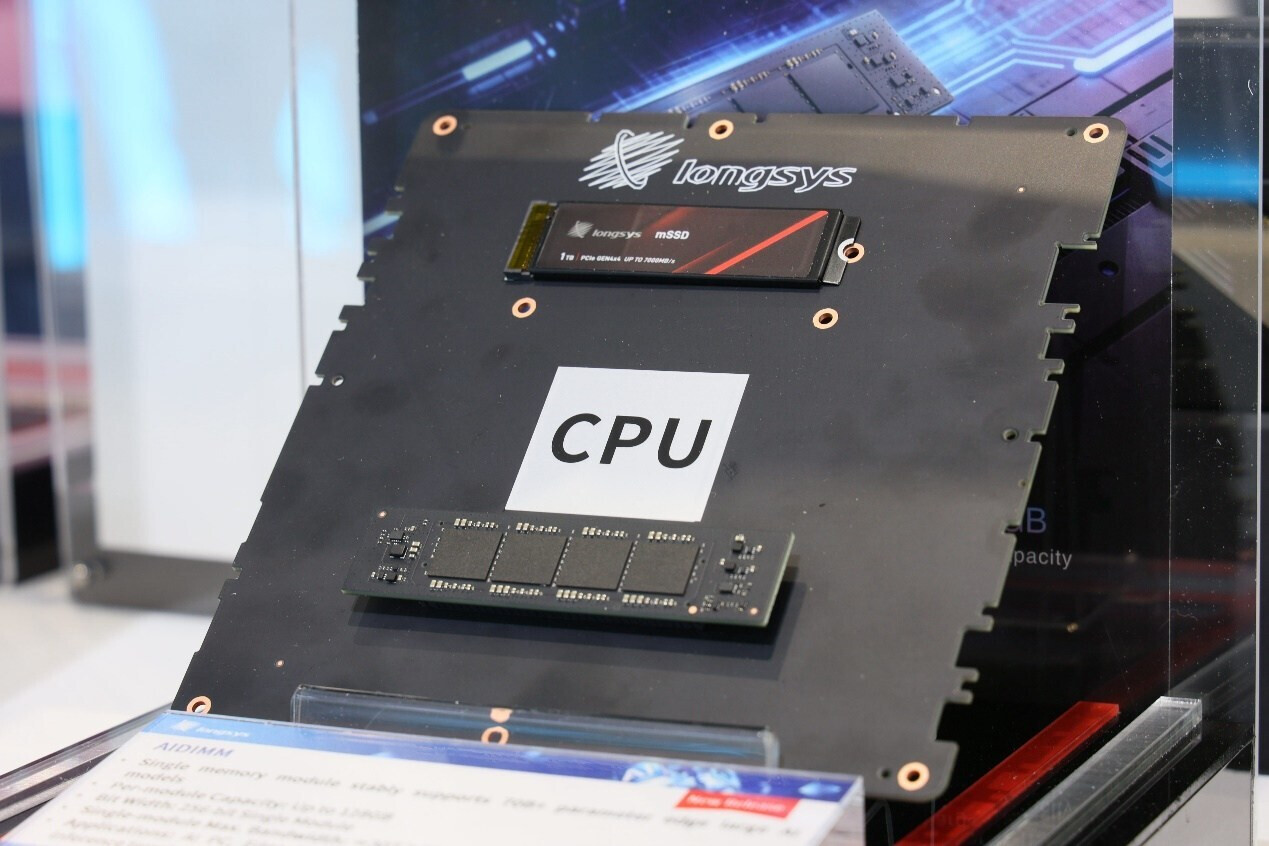
During live demonstrations, the modules were tested on an AMD Ryzen AI Max+ 395 platform. A 128 GB AIDIMM successfully ran a 397 billion parameter LLM, while a 64 GB configuration handled models with 80 billion and 122 billion parameters without performance degradation. Additionally, HLCache-enabled UFS storage demonstrated efficiency gains that allow lower-spec memory devices to run 13B and 20B AI models, potentially extending the lifespan of existing hardware while optimizing bill-of-materials (BOM) costs.
Longsys also highlighted its Gen 5 mSSD, which offers sequential speeds up to 11 GB/s and IOPS of 2.2 million with capacities reaching 8 TB. This storage solution incorporates VC liquid cooling to maintain performance under sustained workloads, addressing thermal constraints in high-density AI systems.
For small businesses and developers seeking edge AI capabilities without relying on cloud solutions, these modules present a viable alternative. However, their adoption will depend on pricing, global supply availability, and compatibility with existing software stacks. Longsys has not yet released final pricing or confirmed availability timelines, but industry benchmarks suggest these could become standards by late 2027.
The next steps for Longsys include setting confirmed pricing for the AIDIMM and AILPBGA modules, ensuring supply chain scalability, and securing adoption from major AI hardware manufacturers. These factors will determine whether the solutions can live up to their potential in transforming edge computing.