LG Display has unveiled its third-generation Tandem OLED technology at SID Display Week 2026, marking a major step forward in display innovation for the AI era. This new panel is tailored specifically for automotive applications, offering up to 18% lower power consumption and more than twice the lifespan of its predecessor, setting a new benchmark for performance and durability.
The third-generation Tandem OLED delivers brightness as high as 1,200 nits while maintaining performance for over 15,000 hours at room temperature. This advancement is achieved through a newly developed OLED element that optimizes hole and electron movement to minimize degradation, along with the application of a deep blue dopant to enhance color purity, brightness, and longevity. The technology stacks multiple organic light-emitting layers to improve efficiency and durability, further reinforcing LG Display's leadership in this space.
LG Display is also highlighting its OLED capabilities in other segments, including gaming and IT devices. In the gaming segment, the company is showcasing a 27-inch OLED panel with a 720 Hz refresh rate, recognized as Display of the Year by SID, as well as the world's first 39-inch 5K2K ultra-high-resolution curved OLED panel. For IT devices, LG Display is introducing a 16-inch Tandem OLED optimized for AI laptops, which is thinner and lighter while improving power efficiency and extending battery usage by up to 2.3 hours.
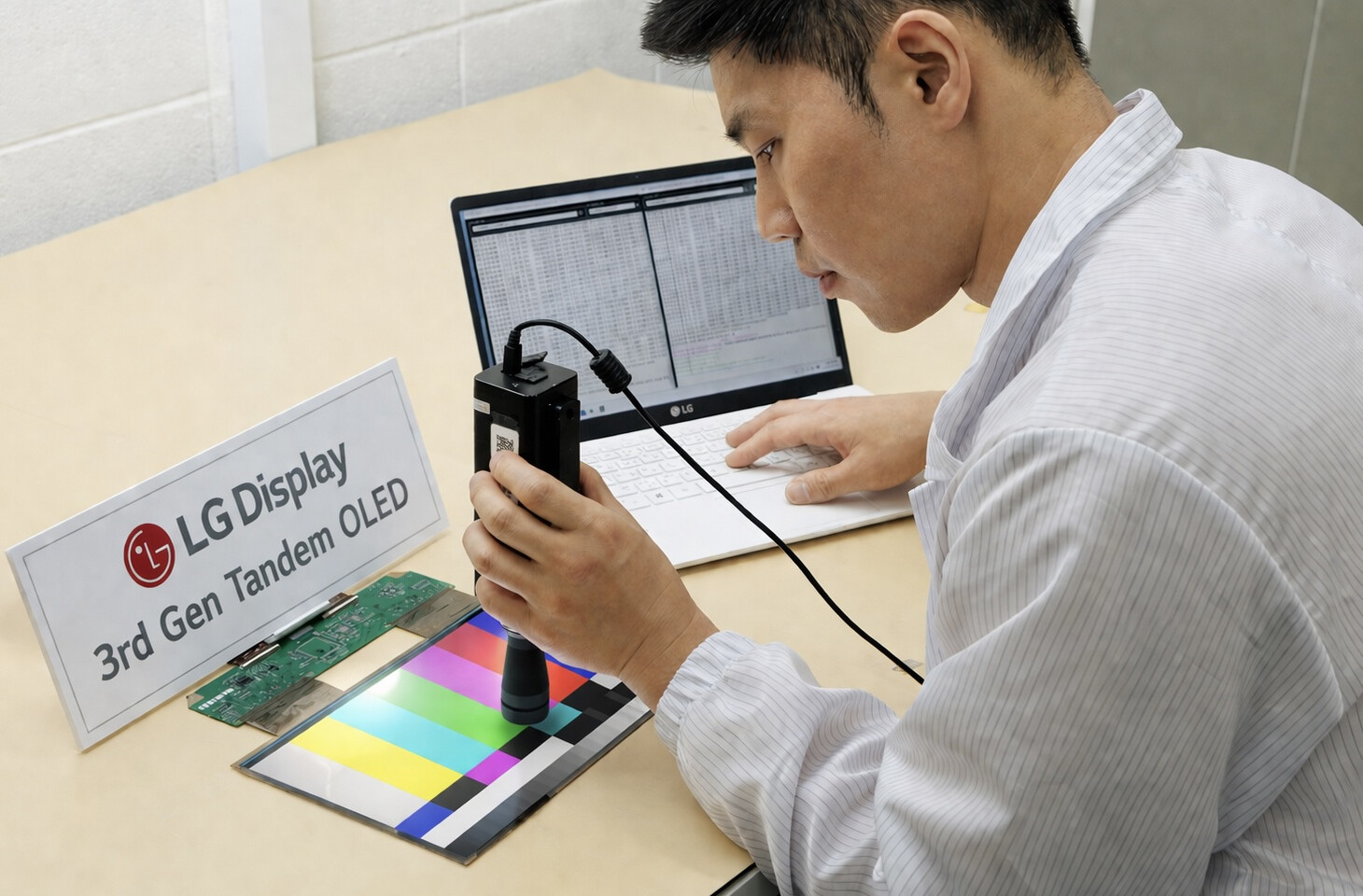
The company plans to begin mass production of the automotive panel within this year before expanding into IT and other applications. This move underscores LG Display's commitment to pushing the boundaries of OLED technology, with a focus on durability, high brightness, and long life. The advancements in Tandem OLED technology are expected to have a significant impact on the automotive industry, as well as on emerging fields such as physical AI.
LG Display is also demonstrating its expertise in automotive displays with a concept car featuring solutions tailored for Software Defined Vehicles (SDVs). This includes a 57-inch P2P panel spanning from driver to passenger seat and a 32-inch Slidable OLED that retracts into the ceiling. These innovations highlight the company's ability to meet the demanding requirements of automotive environments while delivering high performance and durability.
The new Tandem OLED technology is designed to withstand the rigors of automotive environments, making it suitable for various robot form factors in the emerging field of physical AI. This technology offers high design flexibility and can operate in diverse environmental conditions, further expanding its potential applications beyond the automotive sector.