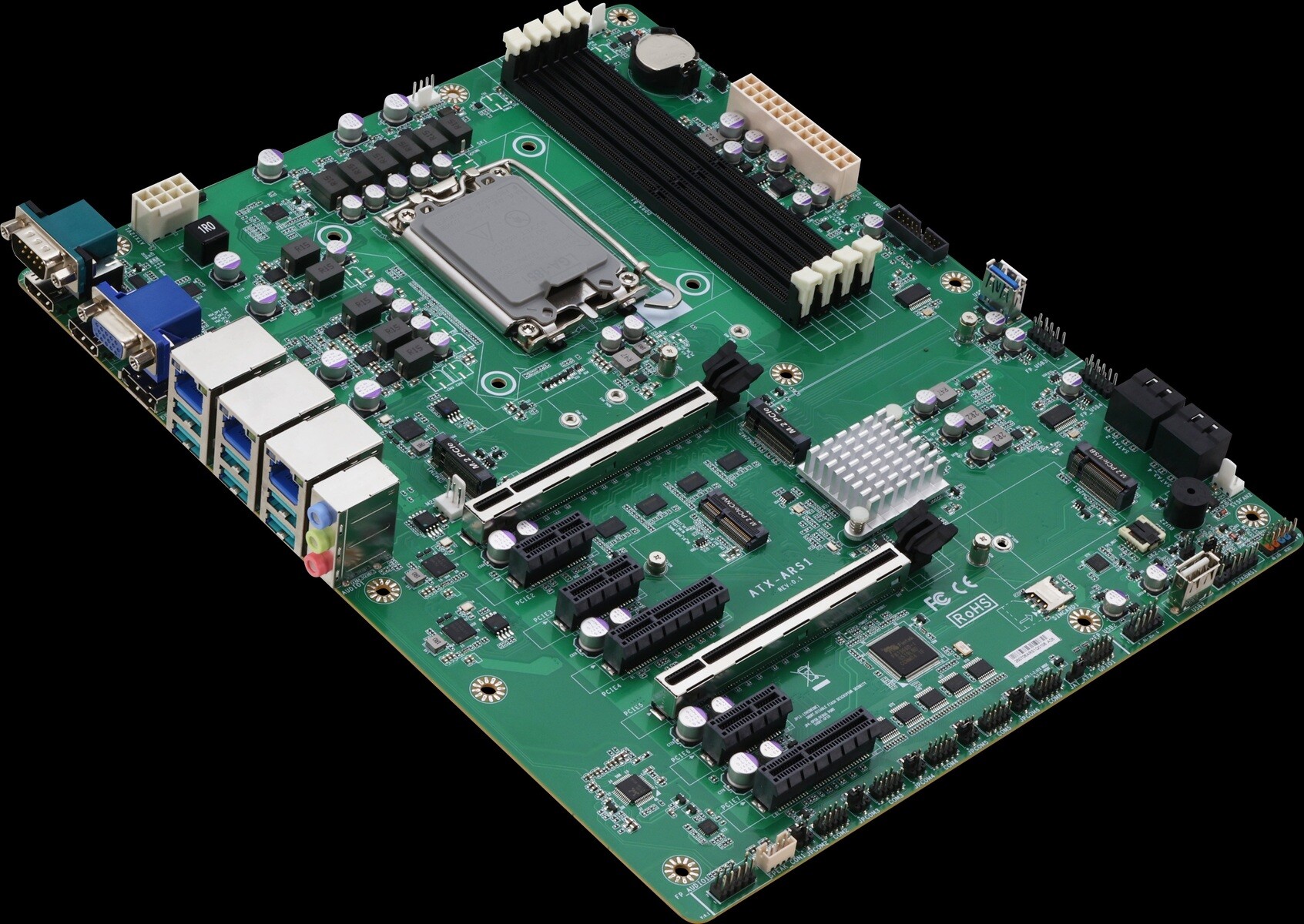
The ATX-Q870A motherboard from AAEON is designed to handle the full range of Intel Core Ultra Series 2 processors, including the upcoming Arrow Lake-S line. It supports up to 125 W CPUs with 24 cores and 24 threads, alongside integrated CPU, GPU, and NPU capabilities that deliver up to 36 TOPS of AI performance.
This places it squarely in the market for industrial automation systems and high-performance workstations. The board’s expandability is a standout feature, with two PCIe Gen 5 slots and five PCIe Gen 4 slots. These allow simultaneous deployment of high-end GPUs, AI accelerators, NVMe storage, and specialized modules like serial cards or sensor interfaces.
Storage and connectivity
- M.2 Slots: Four M.2 slots (two M-Key, one E-Key, one B-Key) for NVMe storage, Wi-Fi, 4G/5G expansion.
- SATA: Four SATA drives with RAID support (0, 1, 5, 10).
- Rear I/O: Three 2.5 GbE LAN ports, six USB 3.2 Gen 2 ports, one COM port, four display outputs (two HDMI 2.1, one DP 1.4a, one VGA).
- Internal Connectors: Three USB 3.2 Gen 1x1 interfaces, five RS-232 serial headers, 8-bit GPIO.
The rear I/O is notably upgraded from previous AAEON ATX models, with three 2.5 GbE LAN ports—each capable of handling high-bandwidth tasks—alongside six USB 3.2 Gen 2 ports and a mix of display outputs (HDMI 2.1, DisplayPort 1.4a, VGA). Internally, the board offers additional USB 3.2 Gen 1x1 interfaces, RS-232 serial headers, and GPIO for low-level control.
Performance tradeoffs
The ATX-Q870A is built around DDR5 memory, with support for up to 256 GB of dual-channel RAM. This aligns it with the latest CPU platforms while maintaining compatibility with both Windows 11 and Linux environments. However, the lack of official DDR4 support may limit its appeal in cost-sensitive deployments where DDR4 remains a viable option.
While the board’s PCIe Gen 5 slots promise high-bandwidth connectivity for GPUs and accelerators, real-world performance will depend on the specific workload and thermal constraints of industrial environments. The 125 W TDP rating for Arrow Lake-S CPUs suggests power efficiency is a key consideration, but long-term reliability under sustained loads remains an untested factor.
For buyers focused on future-proofing, the ATX-Q870A offers a compelling package of raw performance and expandability. However, those operating in environments where DDR4 or lower-power platforms are still relevant may find limited justification for the upgrade path this board represents.