The GMKtek NucBox K13 is a compact powerhouse, cramming Intel's Lunar Lake architecture into a mini PC form factor that barely exceeds the size of a smartphone. At its core lies the Core Ultra 7 256V processor, a chip built on TSMC's advanced N3B process with a tiled design. This SoC balances performance and efficiency, featuring 8 cores—4 Lion Cove P-cores and 4 Skymont E-cores—delivering up to 4.8 GHz on the P-cores and 3.7 GHz on the E-cores while maintaining a base frequency of 2.2 GHz across both types.
Powering the system is an integrated Arc 140V GPU, part of Intel's Xe2 architecture. The Arc 140V operates at up to 1.95 GHz and supports advanced features like ray tracing units and XMX acceleration, enabling multi-frame generation with XeSS3. This iGPU delivers performance that rivals discrete GPUs such as the RTX 4060 or RTX 5050 in synthetic benchmarks, though real-world gaming results are more modest.
AI and Productivity
The Lunar Lake architecture brings significant AI capabilities to the NucBox K13. The Core Ultra 7 256V offers 120 platform TOPS of compute power, with 48 TOPS coming from its NPU and an additional 5 TOPS from the CPU itself. This makes it a strong candidate for AI workloads, including text generation and image processing tasks. The chip supports modern AI frameworks like Open VINO, WindowsML, DirectML, ONNX Runtime, and WebNN, ensuring compatibility with a wide range of applications.
Performance Benchmarks
In synthetic benchmarks, the NucBox K13 shows strong performance relative to its power constraints. The 3DMark CPU Profile test yields scores that position it competitively among mini PCs, though not at the top tier. For example, in Blender's Samples Per Minute test, it delivers 6,543 samples, which is respectable for a system with a 30W TDP. Cinebench 2024 results are similarly strong, with multi-core scores reaching 120,606 points.
Gaming Capabilities
The Arc 140V iGPU in the NucBox K13 is capable of handling modern games at 1080p resolution with upscaling technologies. In Cyberpunk 2077, it achieves an average of 60 FPS with balanced XeSS upscaling, while Forza Horizon 5 runs at around 91 FPS under similar settings. More demanding titles like Borderlands 4 see performance drop to about 30 FPS without frame generation, but enabling frame generation pushes it closer to 60 FPS.
Design and Connectivity
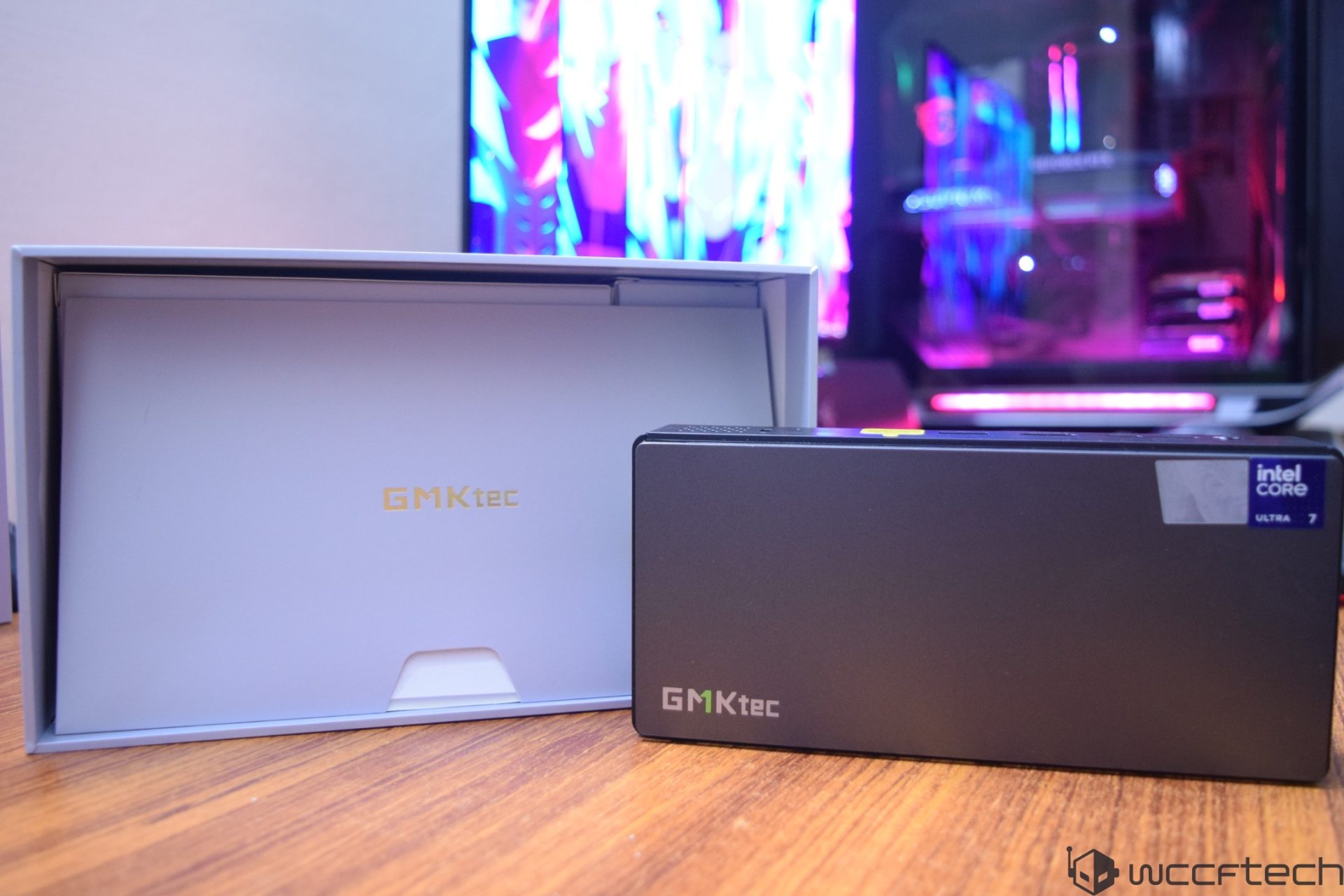
The NucBox K13 is a departure from GMKtek's previous square designs, opting for a sleek rectangular form factor that emphasizes compactness. Despite its small size, the unit includes a blower fan to manage thermal output effectively. The front I/O features two USB 3.2 Gen 2 ports and a 3.5mm audio jack, while the rear offers dual USB4 Type-C ports with Thunderbolt 4 support, a 5 GbE LAN port for high-speed networking, HDMI 2.1 output, and a DC power input.
Storage and Memory
The NucBox K13 comes equipped with 16 GB of LPDDR5x memory, which operates at 8533 MT/s. This is one of the few Lunar Lake SKUs to support this amount of onboard memory, though a 32 GB variant would have been preferable for more demanding workloads. Storage options are robust, with a pre-installed 1 TB Huawei eKitStor Xtreme 200E PCIe Gen4 SSD offering read/write speeds of up to 7000/6500 MB/s. A secondary M.2 slot allows for additional storage, supporting capacities up to 8 TB.
Thermal and Power Efficiency
The NucBox K13 is designed with power efficiency in mind. It operates at a base TDP of 17W but can scale up to 30W under standard boost conditions and 37W during maximum thermal power (MTP). This flexibility allows it to balance performance and battery life, making it suitable for both stationary and portable use cases. Thermal performance is impressive, with the system maintaining temperatures below 60°C even under heavy gaming loads.
Conclusion
The GMKtek NucBox K13 is a remarkable mini PC that encapsulates the potential of Intel's Lunar Lake architecture in a pocket-sized form factor. It delivers strong CPU and GPU performance, excels in AI workloads, and offers a comprehensive set of connectivity options. While its 16 GB memory configuration may limit some high-end applications, it remains a versatile choice for productivity tasks, gaming, and AI-related work. Its compact design, efficient power management, and robust I/O make it a standout in the mini PC market.