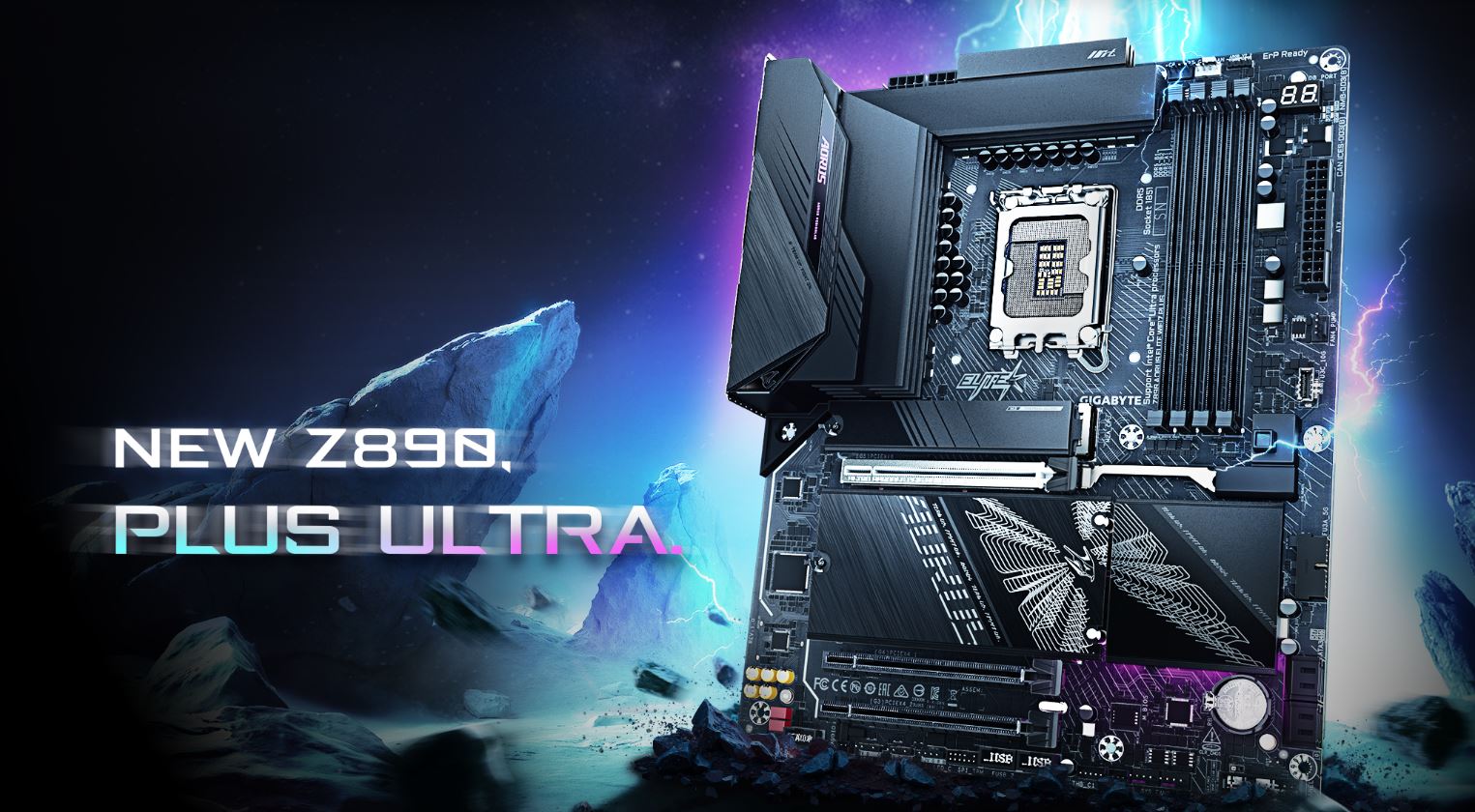
Gigabyte has launched its latest Z890 Plus series motherboards, designed specifically for Intel’s Arrow Lake Refresh CPUs. These boards feature two standout technologies: Ultra Turbo Mode and D5 Duo X, both aimed at maximizing performance without sacrificing stability.
The Ultra Turbo Mode is a one-click optimization that promises up to 40% performance improvement in supported workloads, such as Hitman 3 with APO enabled. This mode offers three profiles—LV1 Intel 200S Boost, LV2 Intel Turbo Mode, and LV3 Extreme Mode—to tailor performance for different scenarios.
Complementing this is the D5 Duo X technology, which optimizes memory performance in 2-DIMM configurations. It supports high-frequency DDR5 memory, including CQDIMM kits that have been tested up to 6400 MT/s on a 256 GB module. Gigabyte has collaborated with memory manufacturers like ADATA and TeamGroup to ensure compatibility.
Key Specifications
- Ultra Turbo Mode: Three performance profiles for optimized workloads, including a claimed 40% boost in certain games.
- D5 Duo X Technology: Supports high-frequency DDR5 memory, including CQDIMM kits up to 6400 MT/s on 256 GB modules.
- VRM Design: Digital Twin 16+1+2 phase VRM for sustained performance under load.
- Connectivity: WiFi 7 and 5G LAN support, alongside EZ-DIY features for easier assembly.
The Z890 Plus series is divided into four sub-series: Elite, EAGLE, FORCE, and Duo X. The first two models available are the Z890 AORUS ELITE WiFi7 PLUS and Z890 EAGLE WiFi7 Plus, with others expected to follow soon.
These motherboards cater to PC builders looking for high performance without compromising stability. The Ultra Turbo Mode simplifies overclocking, while D5 Duo X ensures that memory performance is not a bottleneck in modern workloads. With support for the latest DDR5 standards and WiFi 7, these boards are positioned as premium options for Arrow Lake-based systems.
The introduction of these features raises questions about their real-world impact, particularly in sustained workloads where thermal management becomes critical. While Gigabyte’s claims are promising, further benchmarks will be needed to validate performance under extended loads.