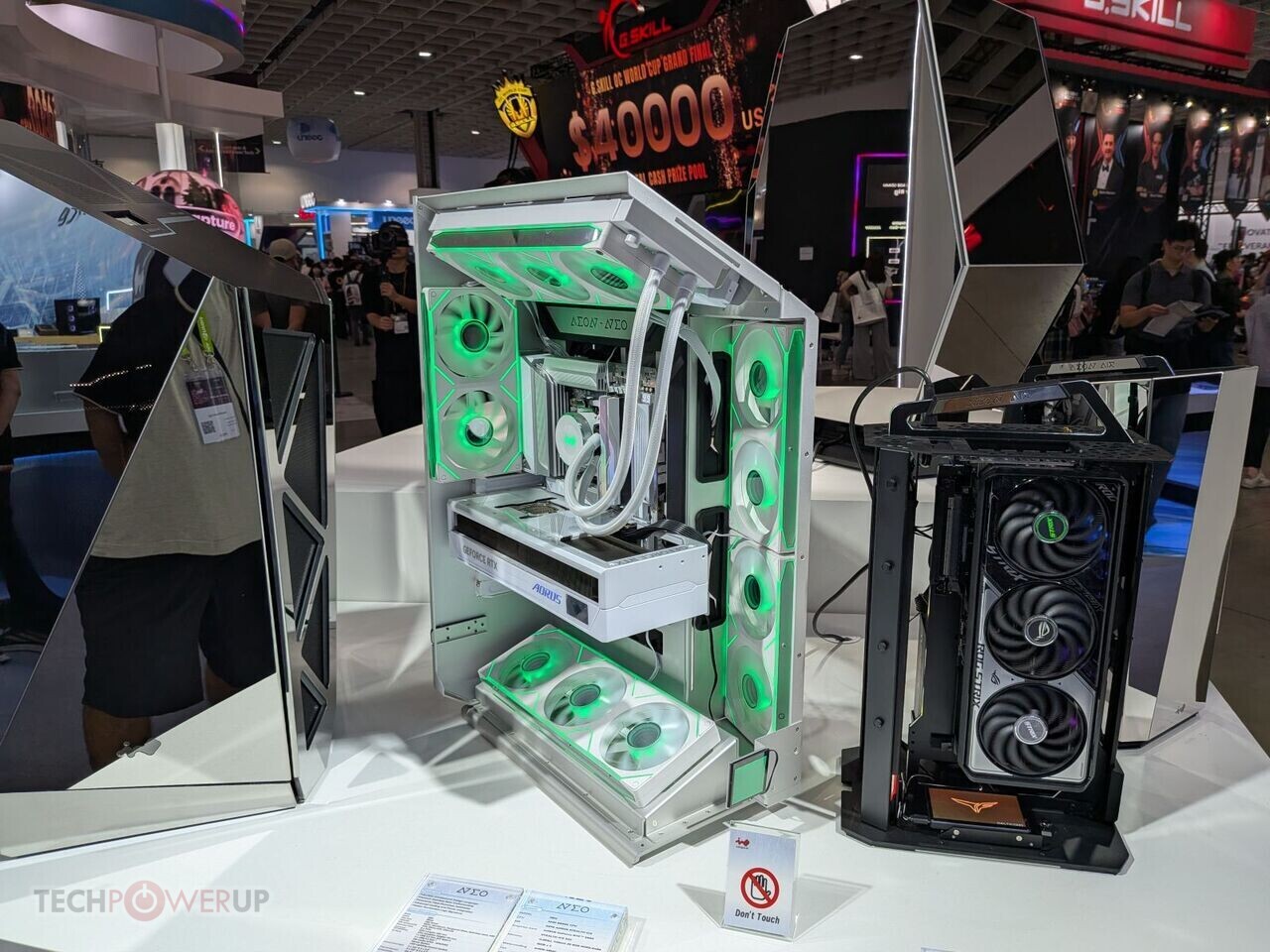
The RTX 5090’s power draw isn’t just a number—it’s a stress test for every component in its chassis. At Computex 2026, Cougar introduced the NU-series workstation cases and WS-series PSUs designed to handle that load, but the question remains: how much of this is over-engineering, and how much is necessary?
Key specs for the NU 700 and NU 500 cases focus on extremes. The full-tower NU 700 supports up to eight GPU slots, a 480 mm graphics card, dual CRPS PSUs, and radiators as large as 420 mm at the top or 360 mm in front. Airflow is managed through seven fan mounts—three 120 mm (or two 140 mm) at the front, three more at the top, and one at the back. The mid-tower NU 500 scales down slightly: seven GPU slots, a 380 mm card limit, four fans (three front, one rear), and a single 360 mm radiator slot.
- Motherboard: ATX, CEB, E-ATX, SSI-EEB
- GPU slots: NU 700 (8), NU 500 (7)
- Graphics card length: NU 700 (480 mm), NU 500 (380 mm)
- Radiator support: NU 700 (420 mm top/360 mm front), NU 500 (360 mm front)
- Fans: NU 700 (seven slots, mixed 120/140 mm), NU 500 (four slots, mixed 120/140 mm)
That’s the upside—here’s the catch. The NU 700’s dual-PSU support is a rare feature, but it demands careful cable management to avoid clutter. The 480 mm card clearance is impressive on paper, yet most RTX 5090s ship with shorter blower-style coolers, making the full extension unnecessary for most builds. Similarly, the NU 500’s radiator slot is front-mounted, which works for liquid cooling but adds bulk to a mid-tower form factor.
The WS-series PSUs push boundaries further. Prototypes in 1,600 W, 2,400 W, and 3,200 W configurations claim 200% power excursion, four native PCIe 5.1 12V-2x6 connectors, and 80 Plus Platinum efficiency—all with Japanese capacitors and a fluid dynamic bearing fan that drops to zero RPM when idle. The smaller 180 mm chassis fits the 1,600 W and 2,400 W models, while the 3,200 W version stretches slightly longer.
Why it matters: AI workstations aren’t just about raw power—they’re about sustaining performance without thermal throttling. The NU-series cases excel in cooling capacity, but their practicality hinges on whether users need the full range of features or if they’ll end up paying for unused slots and radiator space. The WS PSUs, meanwhile, deliver the headroom needed for multi-GPU setups, but their modularity remains untested in real-world builds.
The roadmap isn’t clear yet—no release date has been confirmed—but the focus on PCIe 5.1 and 12V-2x6 connectors suggests these products are aiming to stay ahead of next-gen GPUs. For now, enterprise buyers should weigh whether these platforms solve a specific problem (sustained AI workloads) or if they’re simply leading the market toward more complex, higher-cost builds.