ASUS is pushing beyond traditional gaming monitor boundaries with three new displays designed to handle both 4K clarity and high-speed refresh rates. The ROG Strix XG27UCG Gen 2, ROG Strix XG27UCS Gen 2, and TUF Gaming VG27UQEL5A all feature 27-inch 4K Fast IPS panels with a 0.3 ms minimum response time, but the challenge lies in whether this performance carries over when switching to lower resolutions for competitive gaming.
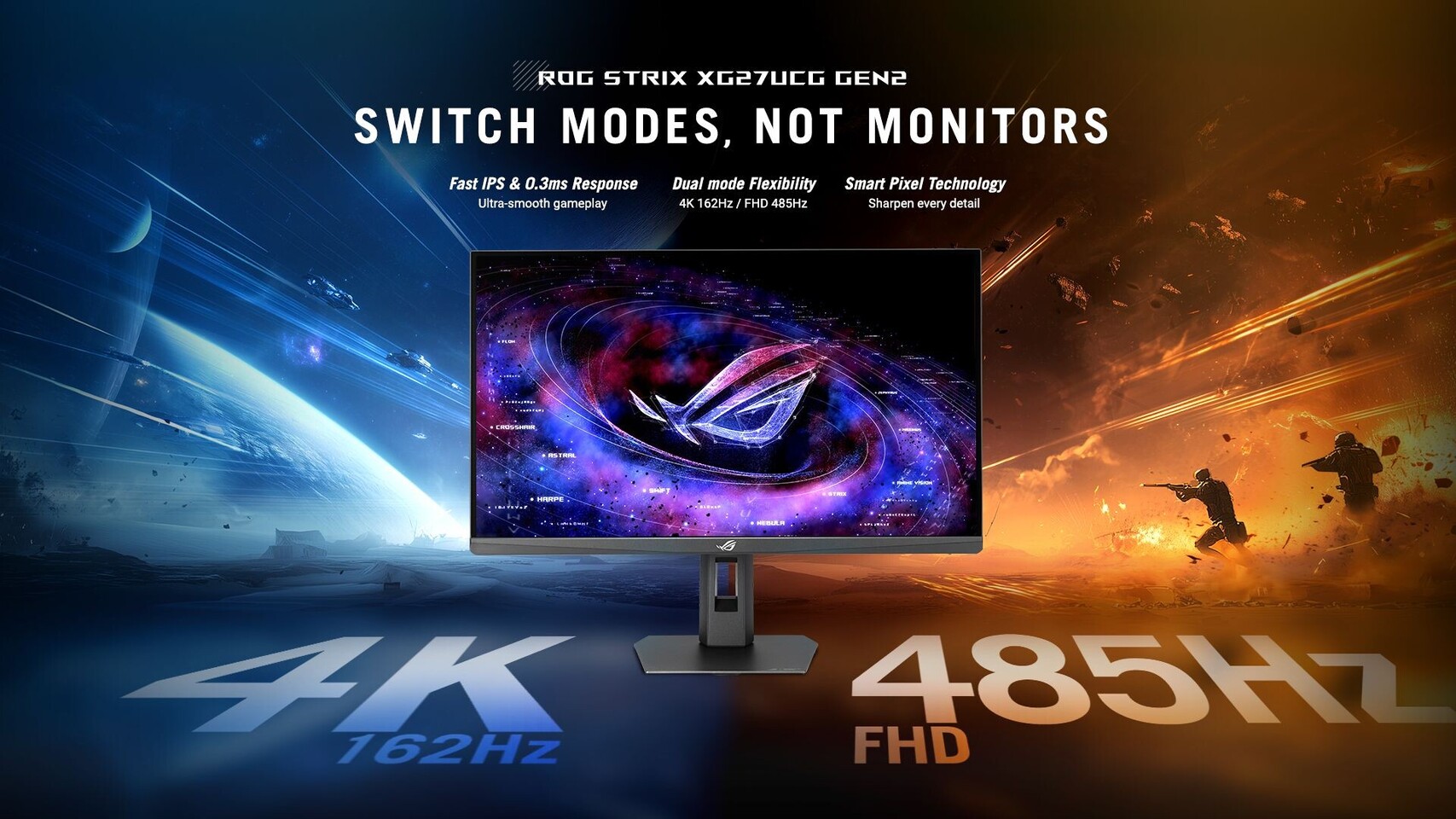
The core of these monitors is ASUS’s Dual Mode technology, which allows users to switch between high-resolution and high-refresh-rate settings with a single hotkey. When set to high refresh rates, Smart Pixel technology upscales frames to 4K-level detail even at FHD or QHD resolutions. The ROG Strix XG27UCG Gen 2 can toggle between 4K@162 Hz and FHD@485 Hz, while the XG27UCS Gen 2 offers 4K@160 Hz and FHD@324 Hz. In comparison, the TUF Gaming VG27UQEL5A provides 4K@80 Hz or FHD@310 Hz.
- Display:
- - 27-inch 4K Fast IPS panel
- - 0.3 ms minimum response time (all models)
- - VESA DisplayHDR 400 certification
- - 95% DCI-P3, 130% sRGB color gamut (ROG Strix only)
- Performance Modes:
- - ROG Strix XG27UCG Gen 2: 4K@162 Hz or FHD@485 Hz
- - ROG Strix XG27UCS Gen 2: 4K@160 Hz or FHD@324 Hz
- - TUF Gaming VG27UQEL5A: 4K@80 Hz or FHD@310 Hz
- Connectivity:
- - USB-C with 15 W Power Delivery (ROG Strix models)
- - DisplayPort 1.4 (all models)
- - HDMI 2.1 (ROG Strix), HDMI 2.0 (TUF model)
The real test will be whether Smart Pixel upscaling delivers a noticeable improvement in clarity at high refresh rates. While the technology promises sharper details, its effectiveness in real-world scenarios is still up for debate. The monitors also include ASUS Extreme Low Motion Blur Sync (ELMB Sync), which works with variable refresh rates to reduce ghosting and tearing—a feature that has become standard in modern gaming displays.
Impact on Gaming
The dual-mode approach addresses a growing demand for versatility, but it comes with trade-offs. High refresh rates at lower resolutions may appeal to competitive FPS players, while 4K@80 Hz or higher suits AAA titles and productivity tasks. The ROG Strix models, with their 162 Hz/160 Hz 4K modes, position themselves as premium choices for content creators, but the jump from 80 Hz to 160 Hz in 4K is significant—likely pushing power requirements higher.
Availability and pricing are not yet confirmed, leaving buyers to speculate on whether these monitors will be a true step forward or just another evolution in display tech. One thing is certain: the trend toward dual-mode displays reflects broader shifts in how gamers expect their hardware to adapt to different workloads.