AOC has quietly redefined what it means to be an office monitor. The Q24B36X (23.8-inch) and Q27B36X (27-inch) join the B3 series, packing 144 Hz refresh rates and sub-millisecond response times into a design that refuses to compromise on color or comfort. These aren’t just displays for spreadsheets; they’re versatile tools for anyone who toggles between work, study, or casual gaming without skipping a beat.
What sets them apart isn’t just the 2560x1440 resolution—sharper than Full HD but still practical for desk use—but how fluidly they handle motion. Scrolling through documents feels almost weightless at 144 Hz, while fast-paced games (when the mood strikes) benefit from a 0.5 ms MPRT response time that eliminates ghosting and blur. It’s a balance rarely seen outside gaming setups, yet AOC pulls it off without sacrificing eye comfort or color accuracy.
The IPS panels deliver 123 ppi on the smaller model (Q24B36X) and 109 ppi on the larger (Q27B36X), with coverage that stretches beyond sRGB into DCI-P3 territory. Viewing angles are wide enough for collaboration, and 300 cd/m² brightness ensures readability in most office lighting without washing out colors.
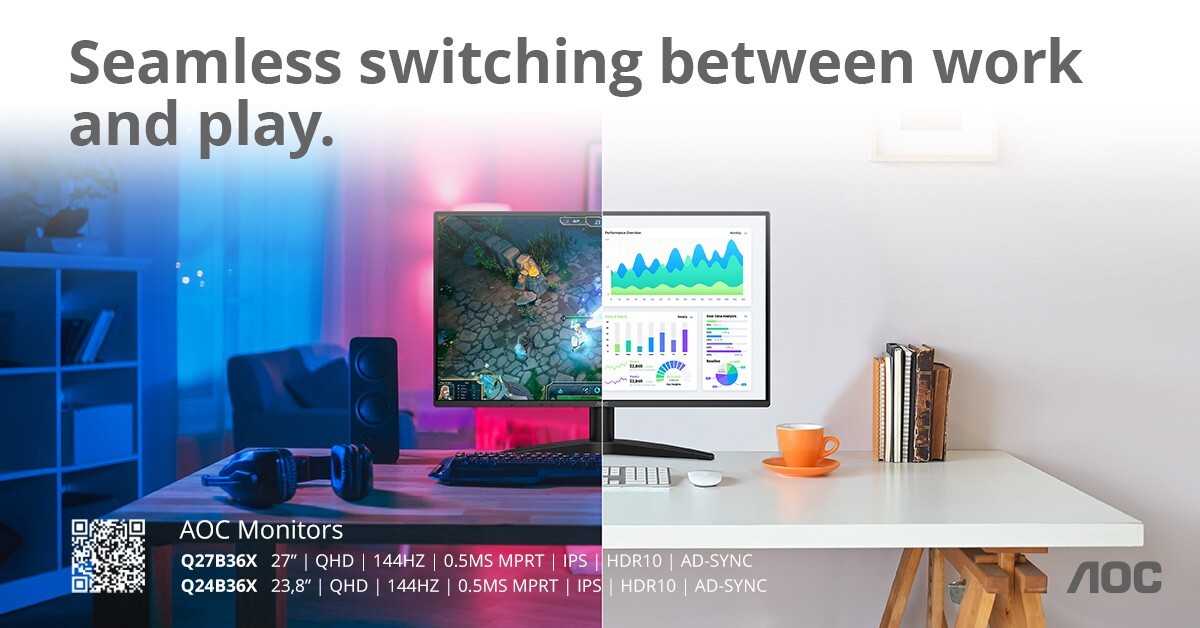
Adaptive-Sync and HDR10 support add polish: no screen tearing during intense workloads or HDR content, while Flicker-Free and Low Blue Light modes cater to long sessions. The tilt-adjustable stand (-5°/21°) and VESA 100x100 compatibility mean these monitors adapt to nearly any setup.
Connectivity is straightforward: one HDMI 2.0 and one DisplayPort 1.4 input cover most PCs, consoles, and laptops, while a 3.5 mm headphone jack keeps audio private without adapters. The bezels are slim, the design is clean, and both models share the same performance—just scaled for different desk sizes.
Pricing starts at £109 (Q24B36X) and £129 (Q27B36X), positioning them as premium yet accessible options. They’ll be available from January 2026, offering a compelling alternative to those tired of choosing between bland productivity displays or over-engineered gaming monitors.