When AMD’s Threadripper Pro 9995WX launched as the company’s most powerful desktop CPU—packing 96 cores and 192 threads—its 350W default TDP was already a warning to system builders. But a recent overclocking experiment by enthusiast Geekerwan has shattered expectations, pushing the CPU to 1,340W under load with a custom direct-die watercooling setup that would make even the most hardened HEDT tinkerers reconsider their power budgets.
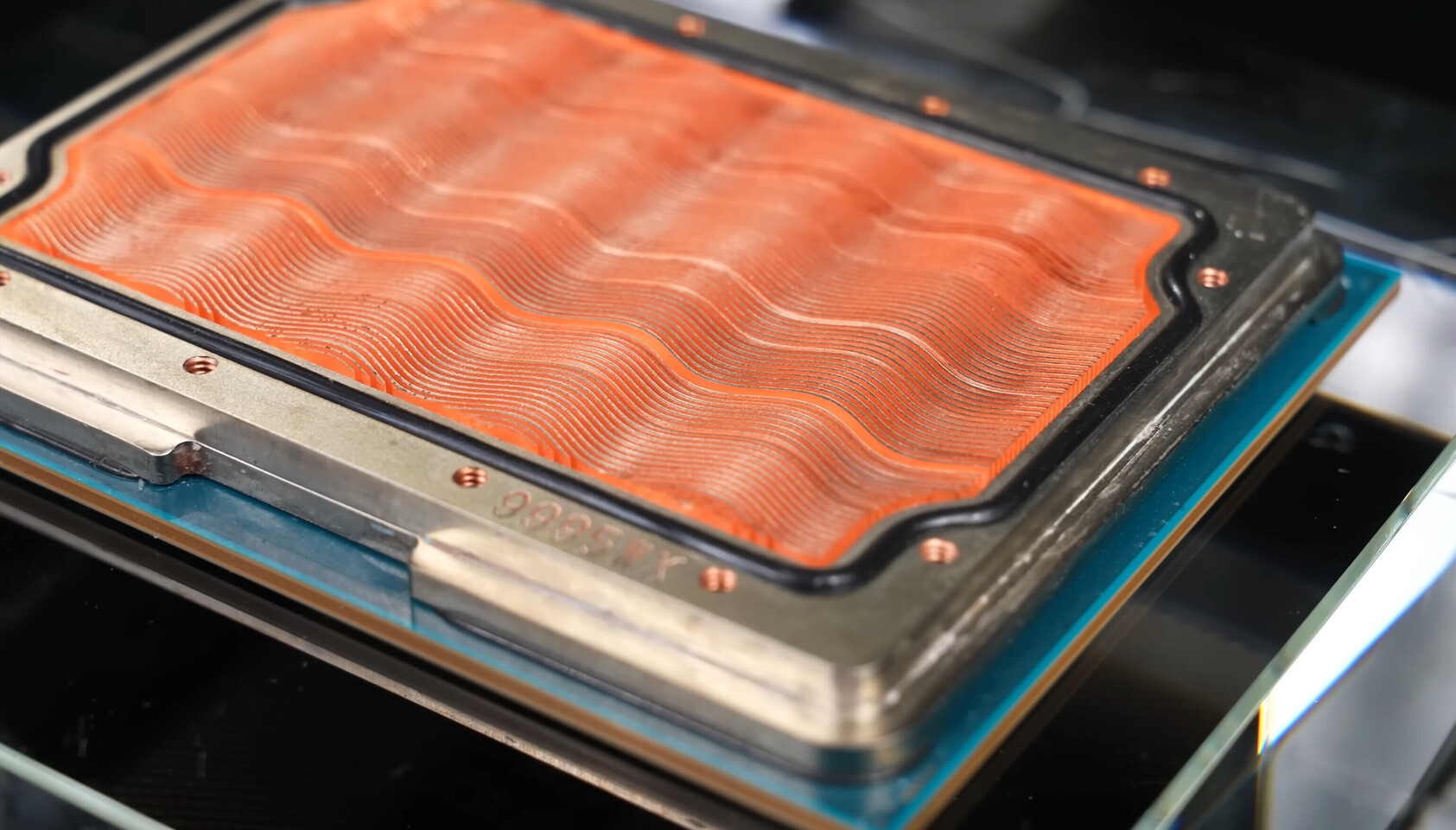
The key? A 4.1mm-thick integrated heat spreader (IHS) repurposed into a waterblock, milled with a curved, S-shaped fin structure—a design optimized through simulation to maximize heat transfer. Unlike traditional straight fins, the wavy pattern forces coolant to travel a longer path, improving efficiency by 20% while fitting into the tight constraints of AMD’s IHS. The result? Temperatures hovering between 30°C and 50°C under Cinebench 2026—a feat that would cripple most air-cooled setups.
To sustain such extreme performance, Geekerwan deployed an industrial-grade cooling rig: two Bosch automotive water pumps, a 37-gallon water reservoir, and an external chiller to maintain stable temperatures. The system’s total power draw spiked to 1,700W, requiring a 700W PSU and a 12VHPWR connector—hardware typically reserved for high-end workstations or supercomputing clusters.
The overclock itself—a 5.325 GHz all-core boost—placed the Threadripper Pro 9995WX in 7th place in Cinebench R23, just behind a liquid nitrogen-cooled Ryzen Threadripper Pro 7995WX running at 6.2 GHz. While LN2 remains the gold standard for extreme overclocking, this build proves that even with air and water, AMD’s latest HEDT flagship can rival cryogenic setups in raw performance.
Who stands to benefit? This isn’t just a flex for overclocking enthusiasts. The experiment highlights the thermal limits of AMD’s 3D V-Cache architecture in high-core-count CPUs, where traditional cooling methods struggle to keep pace. For professional workloads—AI training, rendering, or HPC clusters—this level of custom cooling could become necessary as power demands rise. That said, the $12,000 price tag of the Threadripper Pro 9995WX means such setups will remain niche, catering only to those with deep pockets and a taste for engineering extremes.
For most users, the takeaway is simpler: AMD’s HEDT platform is pushing the boundaries of what’s possible, but it comes at a cost. Whether you’re a content creator, a data scientist, or just a spectator of overclocking history, this build is a reminder that even the most advanced CPUs need unconventional cooling to unlock their full potential.
Key specs of the overclocked Threadripper Pro 9995WX
- Cores/Threads: 96 / 192
- Overclocked Frequency: 5.325 GHz (all-core)
- Power Draw: 1,340W (CPU), 1,700W (system)
- Cooling: Custom S-fin direct-die waterblock, industrial chiller, 37-gallon reservoir
- Temperatures: 30–50°C under Cinebench 2026
- Benchmark: 7th in Cinebench R23 (behind LN2-cooled 7995WX)
- PSU Requirement: 700W with 12VHPWR
The build also underscores the thermal challenges of AMD’s Zen 6 architecture, particularly in high-core-count configurations. While the 2 nm CCDs and 3 nm I/O die improve efficiency over predecessors, sustained overclocking at this scale demands liquid cooling that most consumer setups can’t match. For now, this remains a record—one that may not be easily replicated without similar resources.
Availability for such custom cooling setups is not confirmed, as this was a one-off experiment. However, the techniques demonstrated could influence future high-end workstation designs, particularly in industries where thermal management is as critical as performance.