The data center is no longer just about raw power—it’s about precision. A single-socket server, once dismissed as a niche player, now sits at the heart of AMD’s latest EPYC 8005 series, promising efficiency without sacrificing performance. This isn’t just an incremental upgrade; it’s a rethinking of how servers are built for edge workloads, telecom infrastructure, and storage-dense environments where space and power constraints dictate design choices.
AMD’s move targets scenarios where multi-socket systems would be overkill—a telco base station crammed into a 1U chassis, an edge AI cluster running on limited real estate, or a storage array packing more drives per rack. The EPYC 8005 series delivers up to 96 cores and 192 threads in a single CPU, paired with up to 24 channels of DDR5 memory and support for PCIe 5.0. The trade-off? A single-socket design that demands careful workload planning but offers a compelling alternative to traditional dual- or quad-socket setups.
Why Single-Socket Now?
Single-socket servers have long been the domain of budget builds, but AMD is pushing this architecture into high-performance territory. The reasoning is simple: not every workload needs four sockets. Edge computing, for instance, often prioritizes latency over brute-force throughput. A telco network processing real-time traffic can’t afford to route data across multiple CPUs just to hit a performance ceiling that’s rarely touched. Similarly, storage arrays benefit from memory bandwidth and per-core efficiency—areas where single-socket designs excel.
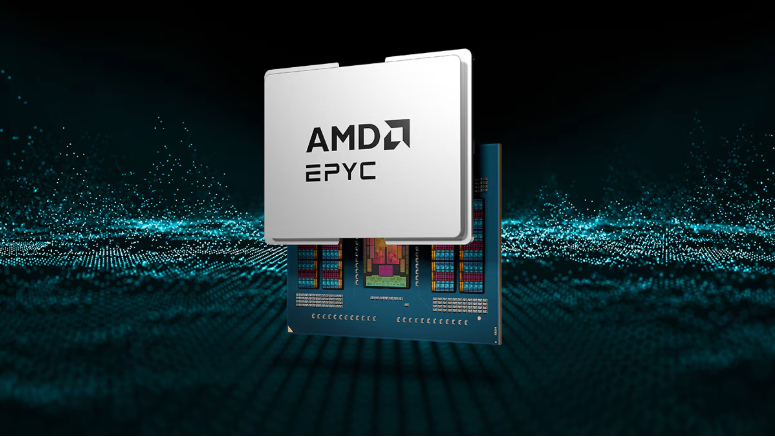
- Performance Highlights:
- Up to 96 cores / 192 threads (Zen 4 architecture)
- DDR5 support with up to 3,840 MT/s memory speeds
- PCIe 5.0 for accelerated I/O and storage
- AM5 socket compatibility for future upgrades
The EPYC 8005 series also introduces new power efficiency features, including adaptive clocking and thermal design optimizations tailored for dense deployments where heat dissipation is a critical factor. However, the shift to single-socket means legacy multi-socket workloads may require rebalancing—something AMD acknowledges but frames as an opportunity rather than a limitation.
Market Reactions and Future-Proofing
The EPYC 8005 series isn’t just about today’s needs; it’s laying groundwork for tomorrow’s challenges. With AM5 socket support, users can upgrade to future Zen architectures without replacing the entire platform—a rare flexibility in a market dominated by rigid multi-socket designs. This positions AMD as a forward-thinking player in an industry where agility is increasingly valued over sheer scale.
For enterprise buyers, the question isn’t just about raw specs but about ecosystem fit. Single-socket servers demand a rethink of cooling, power draw, and workload distribution, yet they offer undeniable advantages for edge deployments and telecom infrastructure. AMD’s bet is that efficiency will outweigh the complexity, making this series a strategic choice for those looking to future-proof their infrastructure without overpaying for unused capacity.
The EPYC 8005 series may not be the first single-socket powerhouse on the market, but it’s a calculated gamble that could redefine what enterprise servers are capable of—one socket at a time.