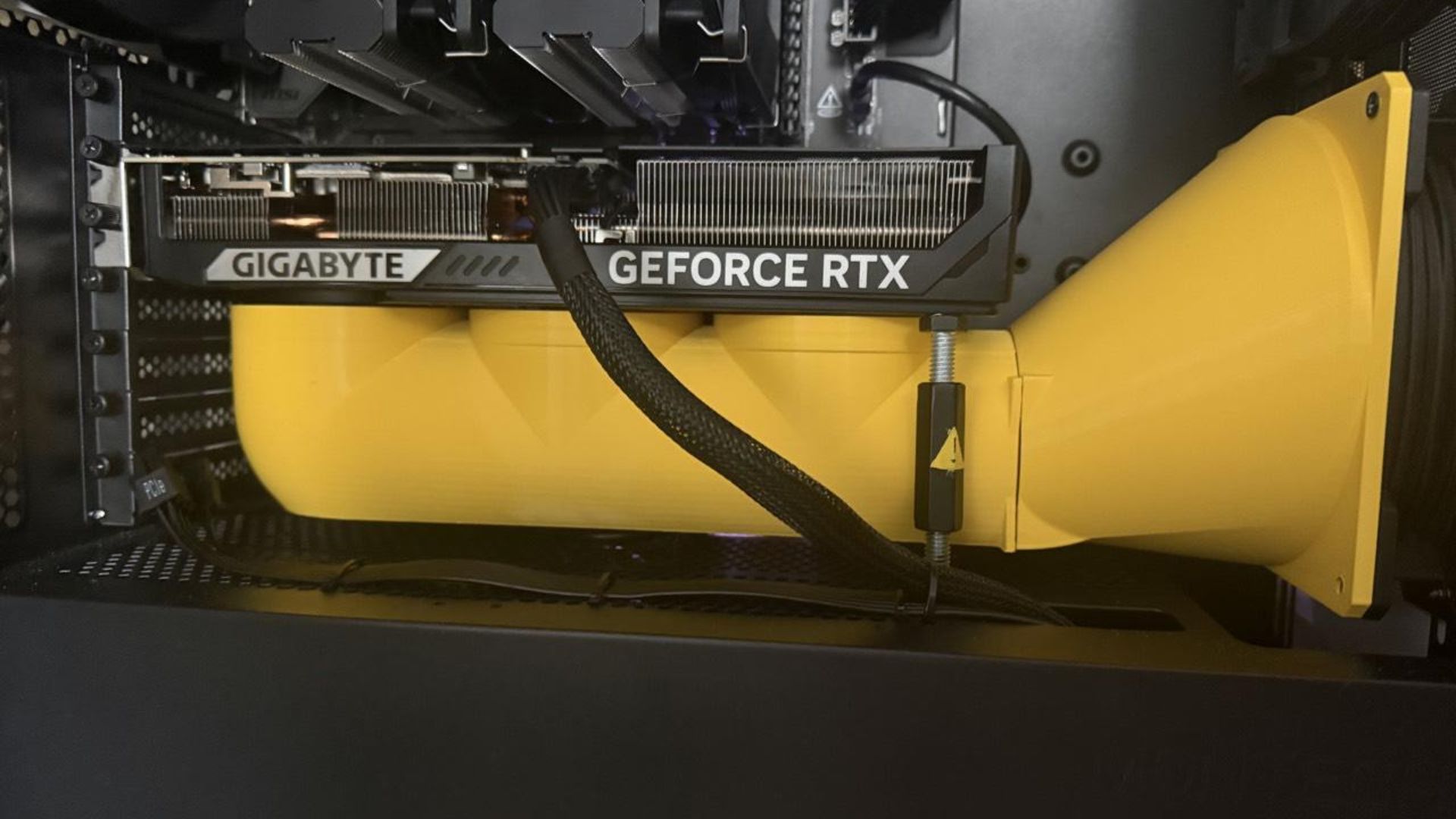
A gaming PC enthusiast has taken a creative approach to GPU cooling by designing and 3D-printing an air duct for the NVIDIA RTX 5070. The duct, shaped like a car intake manifold, attaches to the bottom of the GPU and directs hot air out of the front of the case. While it offers aesthetic appeal, its thermal performance is more nuanced than expected.
The project, shared on Reddit, aims to enhance airflow by redirecting exhaust from the GPU fans through a cone-shaped outlet at the front of the case. The duct features three smaller intake holes on top, mimicking the design of automotive manifolds. Despite its intricate construction, benchmark results suggest limited cooling gains under load, with some trade-offs in noise and idle performance.
The Design and Construction
Unlike standard GPU coolers, this custom duct is entirely 3D-printed, including the fan mount at the front of the case. The design was inspired by automotive intake systems, with the goal of improving airflow efficiency. However, the RTX 5070’s stock fans struggle to pull enough air through the duct, leading to higher noise levels during benchmarking.
Benchmarking and Real-World Performance
- Cooling: Slight temperature reduction in synthetic benchmarks like Heaven, but minimal impact on real-world gaming performance.
- Noise: Increased fan noise under load due to restricted airflow into the GPU fans.
- Aesthetics: A bold, eye-catching addition that stands out in a build, though functionality is secondary.
The duct’s effectiveness is debated among users. While it does not significantly improve thermal performance, it serves as a statement piece for custom PC builds. The creator acknowledges the design flaws but remains optimistic about future iterations.
Key Specs
- GPU Model: NVIDIA RTX 5070 (Founders Edition)
- Duct Material: 3D-printed plastic
- Fan Mount: Custom-designed for front-case exhaust
- Design Inspiration: Automotive intake manifolds
This project highlights the balance between form and function in PC cooling. While it may not deliver substantial thermal improvements, it demonstrates the potential of custom 3D-printed solutions for enthusiasts willing to experiment with airflow dynamics.