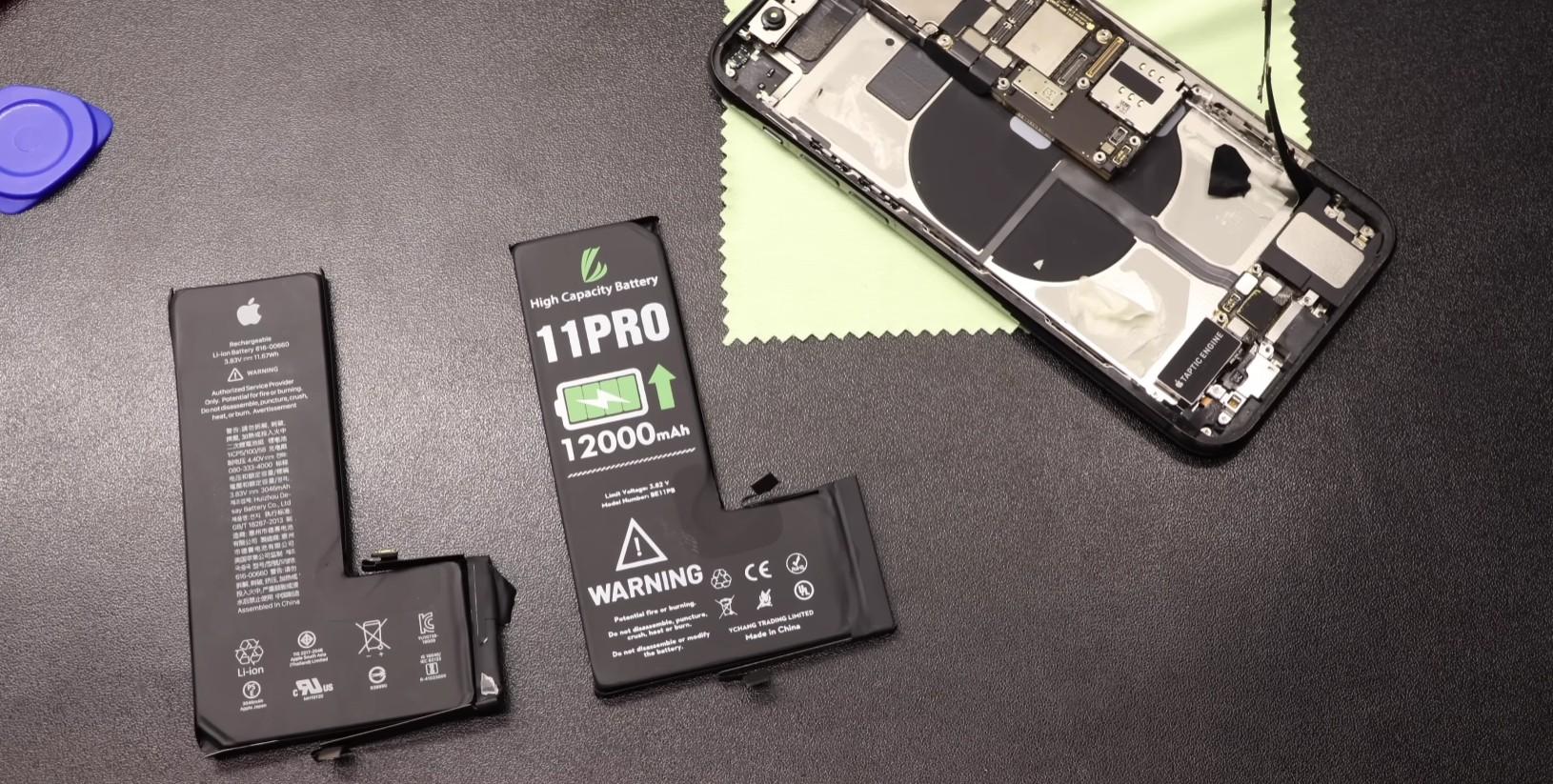
Apple has long cited the physical dimensions of its iPhones as the reason behind modest battery upgrades over the years. The iPhone 17 Pro Max’s 5,088mAh cell marked the largest leap yet, but even that pales in comparison to what’s now possible. A recent battery swap experiment on an iPhone 11 Pro—nearly seven years old—shows that a 12,000mAh battery can physically fit inside the same chassis, with no modifications required. That’s four times the original 3,046mAh cell, and it raises serious questions about Apple’s battery strategy.
The mod, documented by a repair-focused YouTube channel, began with a standard iPhone 11 Pro whose battery health had degraded to 67%. Instead of a routine replacement, the creator installed a third-party battery with a capacity of 12,000mAh—though the device registered it as 10,000mAh in system settings. The installation was straightforward, with the new battery occupying the same footprint as the original. This suggests the use of a silicon-carbon anode design, a more advanced chemistry that allows for higher energy density without expanding the physical size.
What power users gain—and lose
- Extended runtime: A 12,000mAh battery would theoretically provide over 2.5x the original battery life, potentially pushing the iPhone 11 Pro to two full days of mixed use—something even the latest iPhones struggle to achieve without optimization.
- No thermal throttling: Larger batteries often generate more heat, but the silicon-carbon variant is known for better thermal stability, which could reduce performance drops under sustained loads.
- Weight tradeoff: While the battery fits the same form factor, the increased capacity likely adds 10–15 grams to the device’s weight—subtle for most users but noticeable in long-term use.
- Charging speed limits: Fast charging on the iPhone 11 Pro is capped at 20W, meaning even a massive battery would take over three hours to fully recharge from 0%. Users expecting rapid top-ups would still be constrained.
The mod also highlights a key limitation: Apple’s USB-C port (introduced in the iPhone 15 series) supports up to 24W charging, but the iPhone 11 Pro’s Lightning port remains stuck at 18W—a bottleneck that would persist even with a larger battery. This suggests that while Apple could fit bigger batteries, it may prioritize other factors, such as supply chain consistency or perceived premium design over raw endurance.
Why Apple isn’t doing this—and what it means for the future
The experiment underscores that Apple’s reluctance to adopt larger batteries isn’t about engineering constraints but likely about trade-offs in reliability, cost, and user experience. For instance
- Battery safety: Higher-capacity cells, even with advanced chemistries, carry a slightly elevated risk of thermal events. Apple’s reputation for flawless hardware would be at stake if defects slipped through quality control.
- Supply chain efficiency: Manufacturing millions of devices with consistently high battery health requires tight tolerances. A single batch with subpar cells could lead to widespread replacements, a logistical nightmare at scale.
- Market positioning: Apple has long framed its iPhones as premium devices with optimized (not necessarily maximal) specifications. A 12,000mAh iPhone might appeal to power users but could alienate those who prioritize slimness or rapid charging.
Yet the mod also serves as a stark reminder of what’s possible. Competitors like Samsung and OnePlus have long offered 5,000mAh+ batteries in mid-range phones, proving that larger capacities don’t require sacrificing portability. If Apple were to adopt a similar approach, it could redefine expectations for iPhone longevity—especially for users who rely on their devices for work, travel, or media consumption.
The iPhone 18 Pro Max is expected to push battery sizes further, but whether it will break the 6,000mAh barrier remains unclear. What is certain is that Apple’s hesitation isn’t about the physics of the chassis—it’s about the broader calculus of design, safety, and market perception. And for power users, that means the quest for a truly all-day iPhone may require third-party solutions—for now.