Valve’s Steam Controller arrived in 2015 as a radical experiment: a controller that abandoned traditional thumbsticks in favor of two trackpads, one for navigation and one to replace the right stick. At launch, it was a $50 curiosity—a device that promised to bridge the gap between console gaming and PC precision but delivered a design that felt more like a rejected concept sketch than a finished product.
Its legacy, however, is undeniable. Despite never achieving mainstream adoption, the Steam Controller laid the groundwork for Valve’s later successes, including the Steam Deck’s refined dual-trackpad layout. A decade later, it’s worth asking: Was it a flawed vision, or simply one that arrived too early?
- Compatibility: Windows 10/11, macOS, SteamOS
- Connectivity: Wireless (battery-powered) and wired (Micro USB)
- Thumbstick layout: Single left joystick; right-side trackpad replaces right stick
- Weight: 286 grams
- Dimensions: 120 x 160 x 64.2 mm
- Price at launch: $50 (later dropped to $5)
The Steam Controller’s design is its most glaring flaw. The sunken left side and absence of a right thumbstick give it an unfinished, almost mockup-like appearance—reminiscent of Xbox’s abandoned 720-era prototypes. Its buttons lack the satisfying weight of competitors, emitting a hollow clack that feels more like a hardware warning than intentional feedback. The trackpads, while innovative, suffer from a distracting ticking noise during haptic feedback, and the entire device has a plastic-heavy, rattling feel that suggests it was built for prototypes, not living rooms.
Battery access is at least practical: a latch at the back reveals a compartment for AA batteries, which can be swapped without tools. Wireless play is seamless once connected via a USB dongle, but the trade-off for cordless convenience is a controller that feels less substantial in hand.
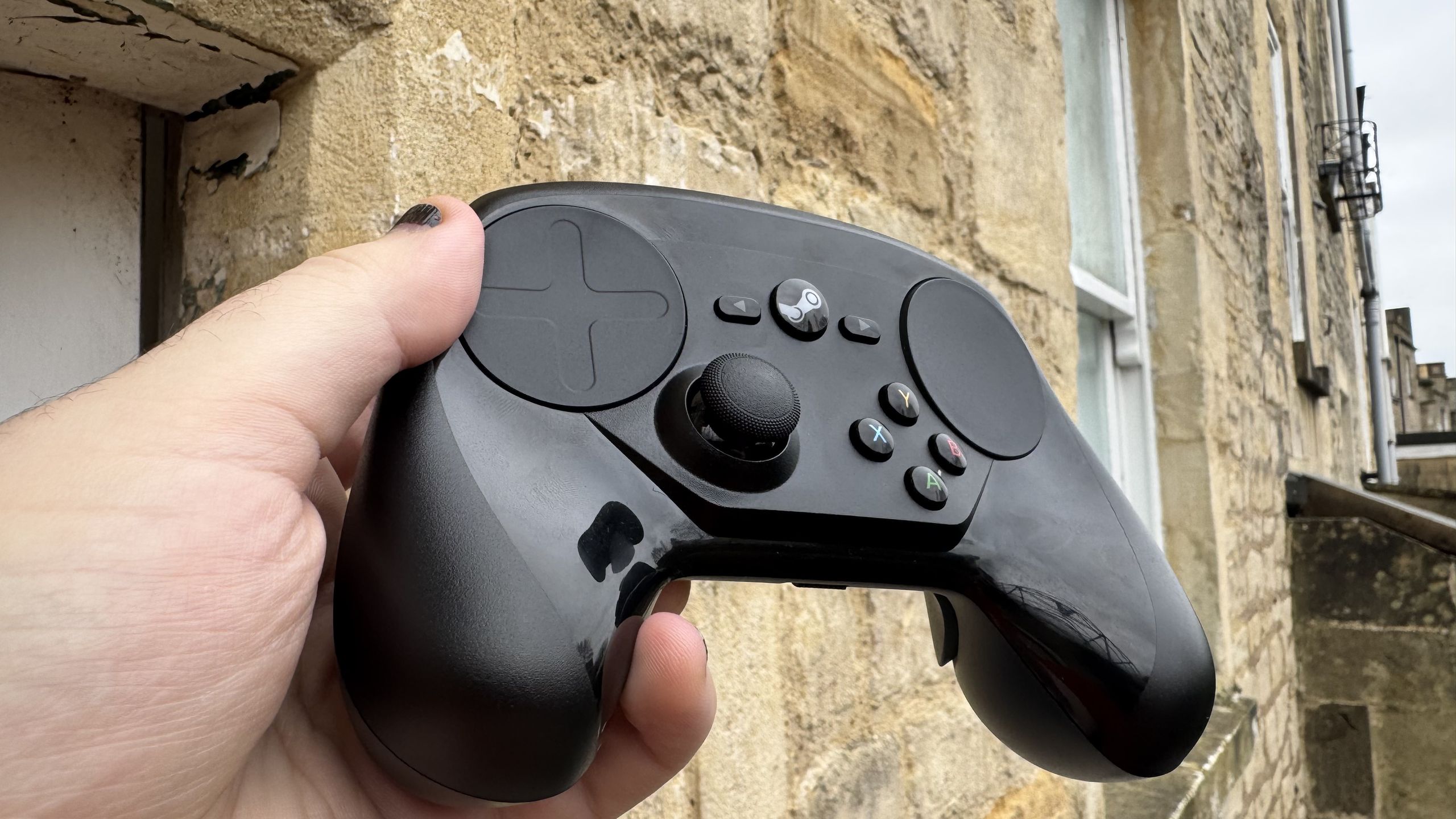
Performance tells a similar story. In traditional shooters like Counter-Strike 2, the trackpad’s imprecise cursor control forces a steep learning curve. Snap shooting becomes a chore, and movement feels less fluid than with a mouse or even a conventional controller. Games like Rocket League expose deeper flaws: the trackpad’s nonlinear response makes camera control stuttery, and button placement forces awkward stretches that lead to accidental inputs. Even in non-FPS titles, the lack of native support for trackpad-based mouse emulation creates jarring control schemes—such as Such Art, which treats the trackpad as a joystick, turning smooth brush strokes into jerky hops.
Yet where the Steam Controller stumbles in mainstream games, it excels in niche use cases. Strategy titles like Against the Storm and Crusader Kings 2 reveal its true potential: a trackpad is far more precise than a D-pad for navigating menus, and the absence of a right stick reduces clutter in games with complex UI demands. The controller’s real strength lies in its flexibility—it’s not just a tool for couch co-op but a bridge between console and PC workflows. This adaptability became the foundation for the Steam Deck, whose dual-trackpad design refined the original’s ideas into something more polished.
Today, the Steam Controller is a relic—its $5 price tag a testament to how little demand it generated. But its influence persists. The Steam Deck’s controls owe their existence to its experiments, and modern titles like Elden Ring now support trackpad-based aiming, proving Valve’s vision wasn’t entirely misguided. It was simply ahead of its time—a device that asked players to rethink controls before they were ready to embrace the change.