Microsoft has announced the general release of DirectX 12 Shader Model 6.9, marking a substantial leap forward in graphics programming with a suite of powerful new tools for developers. The update, part of Agility SDK 1.619 and DirectX Shader Compiler (DXC) version 1.9.2602.16, brings long-awaited enhancements to the Direct3D 12 API, including stricter hardware requirements and expanded functionality for high-performance applications.
The core of this release is the introduction of Long Vector support, allowing developers to manipulate HLSL vectors up to 1024 elements in length with seamless efficiency. This feature, combined with extended support for 16-bit float operations through specialized HLSL functions like IsNan and IsInf, provides deeper control over precision and performance in complex graphical computations.
Additionally, previously optional hardware capabilities—such as 16-bit and 64-bit shader operations—are now mandatory, ensuring consistency across platforms while pushing the boundaries of what modern GPUs can achieve. Microsoft has also addressed developer feedback with targeted improvements, including a Revised Resource View Creation API and new CPU Timeline Query Resolves that streamline GPU overhead.
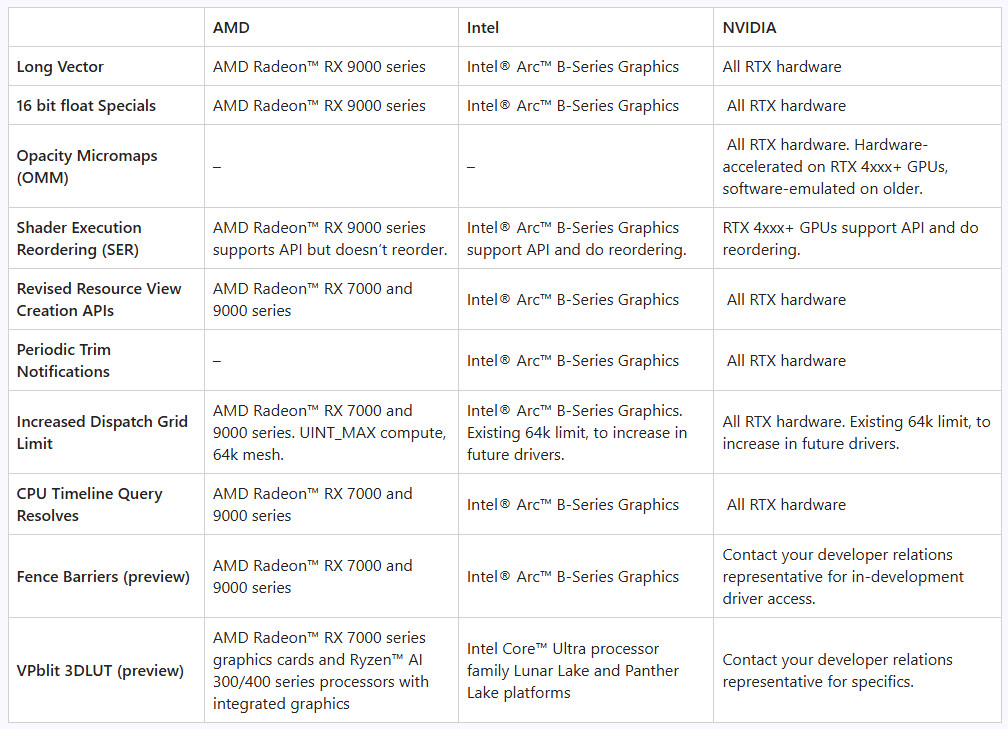
Key Advancements in Direct3D 12
The release includes several long-awaited features moving out of preview, most notably Opacity Micromaps (OMMs) and Shader Execution Reordering (SER). OMMs enable hardware to process complex alpha-tested geometry with reduced shader overhead, a feature first hinted at in 2022 with NVIDIA’s Ada Lovelace architecture. SER, on the other hand, allows applications to dynamically reorder ray execution for optimized parallel processing, further refining real-time rendering performance.
Hardware Support and Future Outlook
While Microsoft has not provided a detailed breakdown of hardware support for Shader Model 6.9, industry experts suggest that the update will be most impactful on newer GPU architectures, particularly those from NVIDIA, AMD, and Intel, which have already begun integrating these capabilities into their latest driver stacks.
The Agility SDK 1.719-preview, released alongside this update, introduces a set of experimental features aimed at pushing the envelope for future graphics development. Developers are encouraged to explore both stable and preview versions to stay ahead of evolving industry standards.