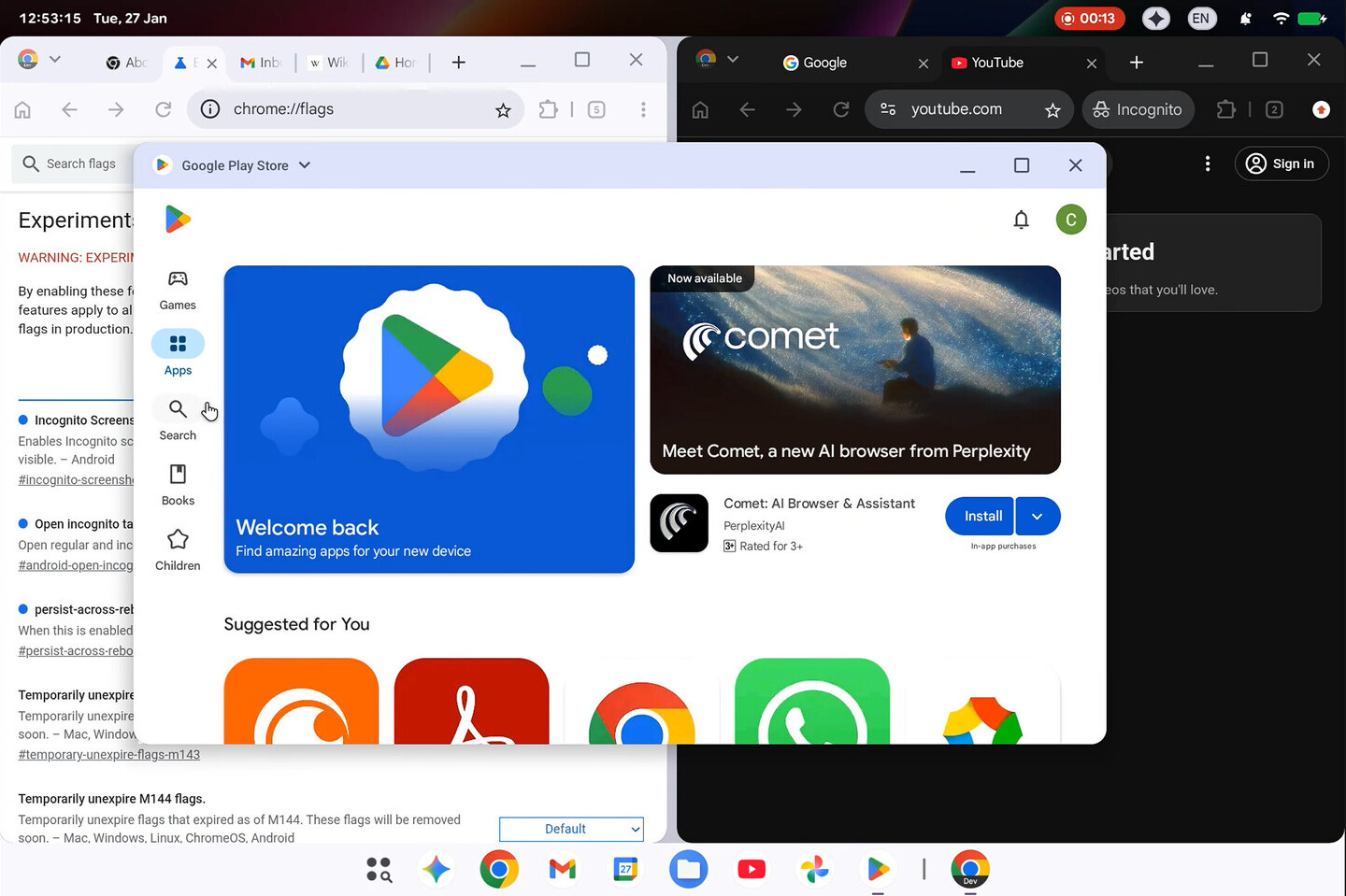
Google’s push into desktop computing has taken a concrete shape, with a leaked build of its Aluminium OS surfacing online. Unlike traditional Android, this version is designed to run on x86 architecture—specifically, an HP Elite Dragonfly 13.5 Chromebook equipped with Intel’s 12th-gen Alder Lake-U processors. The leak, accidentally shared via a Chrome Incognito bug report, offers the first real look at how Google plans to merge its ChromeOS and Android for PC efforts into a single, AI-optimized operating system.
The interface hints at a deliberate fusion of aesthetics: a taskbar anchored at the bottom (like Windows 11), paired with macOS-like window management and GNOME-style desktop elements. A Gemini AI button sits prominently in the top-right corner, alongside battery and Wi-Fi indicators—a clear signal that local AI processing is a core feature. Under the hood, the OS leverages Android 16, but with critical adjustments to support x86 hardware, marking a departure from the Arm-based mobile systems Google has historically targeted.
This isn’t the first time Google has teased an Android-powered desktop. At Qualcomm’s Snapdragon Summit in September 2025, executives confirmed plans to unify ChromeOS and Android for PC under a single codebase. The result? A system optimized for x86’s processing power, with built-in support for NPUs (neural processing units) to handle Google’s open-source Gemma models locally. That means AI tasks—from real-time transcription to on-device image generation—could run without cloud dependency, a major shift for Google’s typically cloud-reliant ecosystem.
Key Features of Aluminium OS
While the leak provides limited details, key aspects emerge
- Architecture: Designed for x86 (Intel Alder Lake-U in testing), breaking Android’s traditional Arm focus.
- Interface: Hybrid design with Windows-like taskbar placement and macOS/GNOME influences.
- AI Integration: Gemini button for quick AI access, NPU support for local Gemma model processing.
- Base OS: Android 16, modified for desktop workflows.
- Hardware: Tested on HP Elite Dragonfly 13.5 (12th-gen Intel Core).
The leak underscores Google’s ambition to create a seamless bridge between mobile and desktop experiences. By leveraging x86’s performance while retaining Android’s app ecosystem, Aluminium OS could appeal to users who want ChromeOS’s simplicity but with the flexibility of a full-fledged desktop OS. However, challenges remain: driver support for x86 peripherals, app compatibility layers, and convincing developers to optimize for a new platform. If successful, it could force competitors like Microsoft and Apple to rethink their own strategies for merging mobile and desktop paradigms.
Google has yet to confirm an official release date or hardware partners beyond the test unit. But with AI at the forefront of its vision, Aluminium OS may redefine what a ‘Google device’ looks like—starting on the desktop.