Gaming monitors are no longer a niche segment; they have become the backbone of the desktop display market, accounting for over 31% of all monitor shipments in 2025. This surge—part of a broader 4.3% increase in global monitor sales—reflects a fundamental shift in how consumers prioritize performance, particularly in high-end gaming setups.
The driving force behind this growth is the rapid evolution of refresh rates and panel technologies. Monitors with 120 Hz and above are now standard for many gamers, aligning closely with the capabilities of modern GPUs, including NVIDIA's RTX50 series. This synergy between hardware and software has created a demand ripple effect, where advancements in one area spur innovation in another, leading to faster, more responsive displays.
Among the most notable developments are OLED monitors, which offer near-perfect black levels and sub-millisecond response times. While still premium-priced, models from Samsung (QD-OLED) and LG (WOLED) are pushing the boundaries of what gamers expect in terms of visual fidelity. Dual-mode monitors, capable of switching between 4K@240 Hz and 1080p@480 Hz, are also gaining traction, providing a flexible solution that caters to both current hardware capabilities and future upgrades.
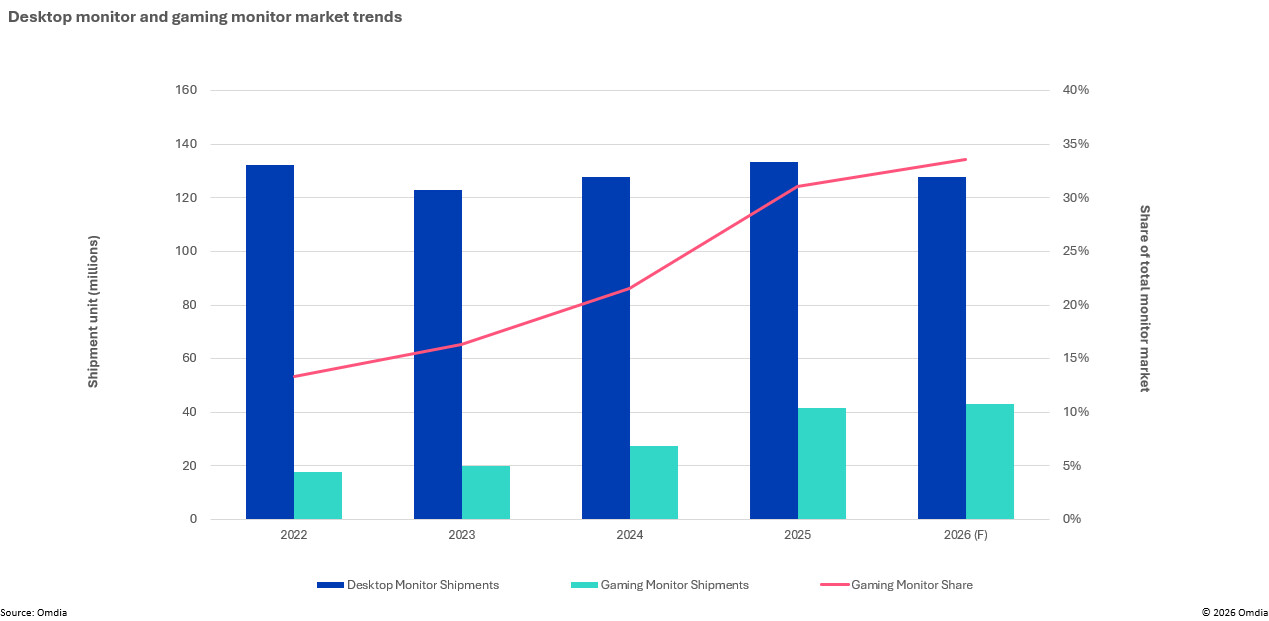
Despite these advancements, challenges remain. OLED burn-in concerns, though improved, still linger in the minds of consumers, while supply chain fluctuations continue to impact production costs. However, the momentum is clear: gaming monitor shipments have grown for eleven consecutive quarters, setting record highs and outpacing conventional display growth significantly.
As the industry looks ahead, the focus will likely shift toward making these high-performance monitors more accessible without compromising on quality. With Esports demand surging and dual-mode innovations becoming more mainstream, gamers are increasingly expecting displays that not only meet but exceed their performance needs. The result is a market poised for continued expansion, driven by both technological advancements and changing consumer expectations.