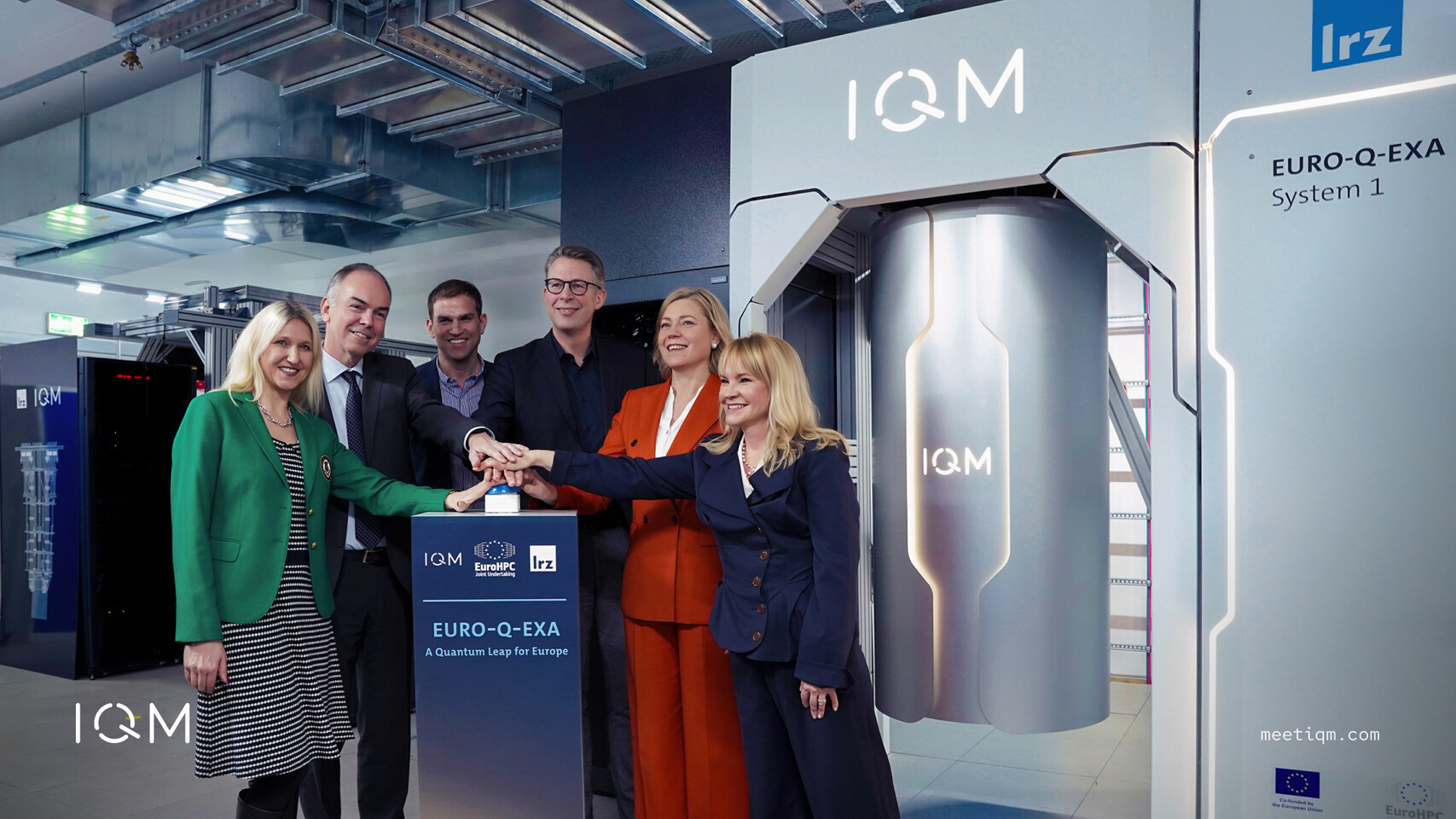
Europe’s push for quantum independence has reached a new milestone with the launch of Euro-Q-Exa, the continent’s first operational quantum computer hosted at Germany’s Leibniz Supercomputing Centre (LRZ) in Garching, near Munich. Unlike cloud-based quantum services, this system is designed for hands-on European research, embedding quantum capabilities directly within a high-performance computing (HPC) environment.
The initiative, part of the EuroHPC Joint Undertaking, goes beyond mere access—it enables local expertise, algorithm development, and hybrid workflows that combine quantum and classical computing. By integrating 54 superconducting qubits built on IQM’s Radiance platform, Euro-Q-Exa serves as a testing ground for applications in drug discovery, climate modeling, and neurodegenerative disease research.
Why Local Control Matters
Europe’s approach contrasts with reliance on external providers. Instead of remote access, researchers at LRZ will operate, maintain, and scale the system themselves. This hands-on model fosters institutional knowledge and ensures intellectual property remains within the continent. A second, more powerful system with 150 qubits is expected by the end of 2026, further expanding Europe’s quantum capacity.
This isn’t an isolated effort. Six quantum computers are being deployed across Europe’s supercomputing centers, including installations in Czechia, France, Italy, Poland, and Spain. The goal: a coordinated, sovereign quantum infrastructure that reduces dependency on non-European providers.
A Blueprint for Hybrid Computing
The real innovation lies in Euro-Q-Exa’s tight integration with LRZ’s existing supercomputing resources. Researchers can now develop hybrid applications that leverage both quantum and classical processors—a critical step toward practical, large-scale quantum use. For example, simulating molecular interactions for drug design or optimizing climate models could see dramatic speedups by combining quantum sampling with classical HPC.
Industry and academia will also benefit. Universities and research institutes can collaborate on the same platform, accelerating talent development and interoperable solutions. Bavaria’s role as a hub for this initiative underscores its ambition to position Germany—and Europe—as leaders in next-generation computing.
Beyond the Lab: A Strategic Move
Officials emphasize that Euro-Q-Exa is more than hardware—it’s a statement on technological sovereignty. By hosting and operating the system locally, Europe avoids the risks of outsourcing quantum development. The European Commission has framed this as part of a broader strategy to shape the nascent quantum market, with four systems already operational and two more under procurement.
Germany’s Bavarian Minister of State for Science and the Arts, Markus Blume, called the project a cornerstone of Europe’s digital future. Garching is where innovation is calculated, he stated, highlighting the region’s role in hosting both quantum and AI infrastructure. The Leibniz Supercomputing Centre, with its legacy in HPC, now adds quantum to its portfolio—a fusion that could redefine research in Europe.
Looking ahead, the system’s upgrade to 150 qubits by late 2026 will push boundaries further, but the immediate impact is clear: Europe is no longer waiting for quantum computing to arrive. It’s building it—on its own terms.