The collaboration between Dassault Systèmes and NVIDIA marks a turning point in how industries simulate, design, and operate complex systems. By integrating Dassault’s Virtual Twin technologies with NVIDIA’s AI infrastructure—including Omniverse, BioNeMo, and Nemotron—the two companies aim to create science-validated Industry World Models. These models will serve as mission-critical frameworks, not just predictive tools, enabling real-time decision-making across biology, materials science, engineering, and manufacturing.
Unlike traditional AI systems that rely on abstract data patterns, this partnership grounds AI in physics-based simulations, ensuring reliability in high-stakes applications. The result is a platform capable of scaling from molecular discovery to autonomous factory operations—all while maintaining data sovereignty and privacy.
The Core of the Partnership
The foundation of this collaboration lies in two key innovations
- Virtual Twin Factories: Dassault’s 3DEXPERIENCE platform will integrate NVIDIA’s AI accelerators to create autonomous, software-defined production systems. Factories can now simulate entire supply chains in real time, optimizing for efficiency and sustainability without physical prototypes.
- Skilled Virtual Companions: Using NVIDIA’s Nemotron models and Dassault’s domain expertise, AI agents will assist engineers and researchers by processing vast datasets, identifying anomalies, and suggesting optimizations—effectively acting as context-aware assistants within the platform.
This isn’t just about faster simulations. The partnership introduces a new paradigm for industrial AI: one where models are validated by scientific principles rather than statistical trends. For example, NVIDIA’s BioNeMo platform will pair with Dassault’s BIOVIA tools to accelerate drug discovery and material science, while SIMULIA’s AI-driven physics simulations will enable instantaneous design validation.
Industry-Wide Impact
Early adopters—including Bel Group (food packaging), OMRON (automation), Lucid Motors (automotive engineering), and the National Institute for Aviation Research—are already testing the platform’s capabilities. Bel Group, for instance, plans to use the AI infrastructure to model sustainable packaging solutions at scale, while Lucid Motors will leverage multi-physics Digital Twin simulations to reduce certification time for electric vehicle components without compromising accuracy.
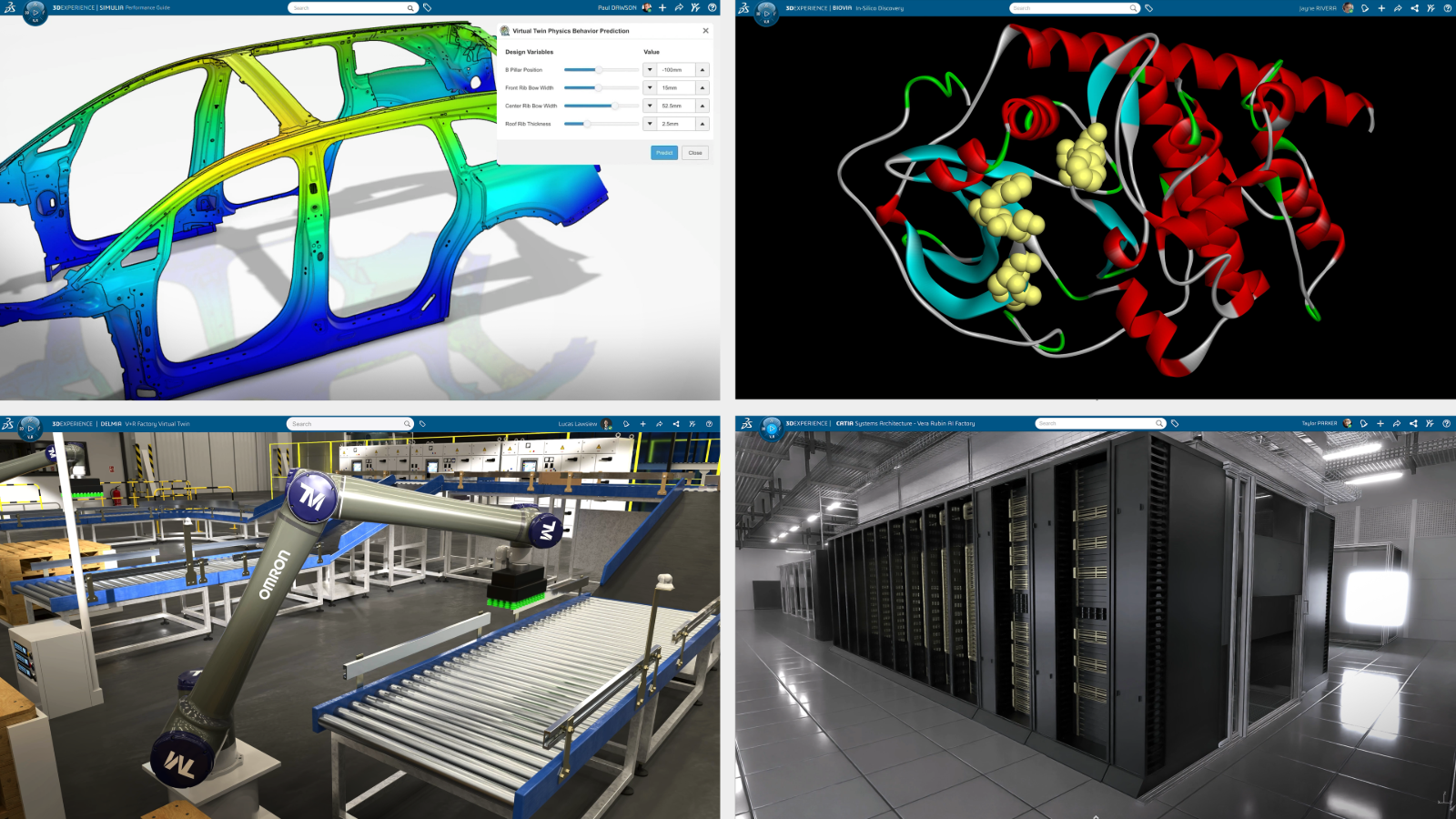
OMRON’s focus on autonomous manufacturing highlights another critical application: software-defined factories. By combining NVIDIA’s Omniverse libraries with Dassault’s DELMIA Virtual Twin, manufacturers can transition from traditional automation to self-optimizing production lines—adapting in real time to demand shifts or defects.
Technical Backbone
The partnership leverages a mix of NVIDIA’s hardware and software ecosystems
- NVIDIA AI Infrastructure: CUDA-X libraries and Omniverse DSX Blueprints will accelerate model training and deployment, ensuring compatibility with Dassault’s sovereign cloud strategy (via OUTSCALE AI factories).
- Open Models & Libraries: NVIDIA’s BioNeMo (for biology), CUDA-X (for physics simulations), and Nemotron (for agentic AI) will integrate with Dassault’s 3DEXPERIENCE platform, creating a unified environment for cross-disciplinary workflows.
- Data Sovereignty: OUTSCALE AI factories, deployed across three continents, will host models locally, addressing concerns over intellectual property and regulatory compliance—a critical factor for industries like aerospace and defense.
The collaboration was officially announced at Dassault Systèmes’ annual 3DEXPERIENCE World event, where CEO Pascal Daloz and NVIDIA’s Jensen Huang emphasized the shift from AI as a tool to AI as a systemic enabler. Unlike generic generative AI, this platform is designed for industrial precision, where errors could have costly—or even catastrophic—consequences.
The long-term vision extends beyond individual companies. By standardizing Industry World Models, the partnership aims to create a shared framework for global industries, reducing silos and enabling seamless collaboration between design, simulation, and production teams.
For industries grappling with complexity—whether in chip manufacturing, aircraft design, or pharmaceuticals—this could be the infrastructure that finally bridges the gap between digital prototypes and physical reality.